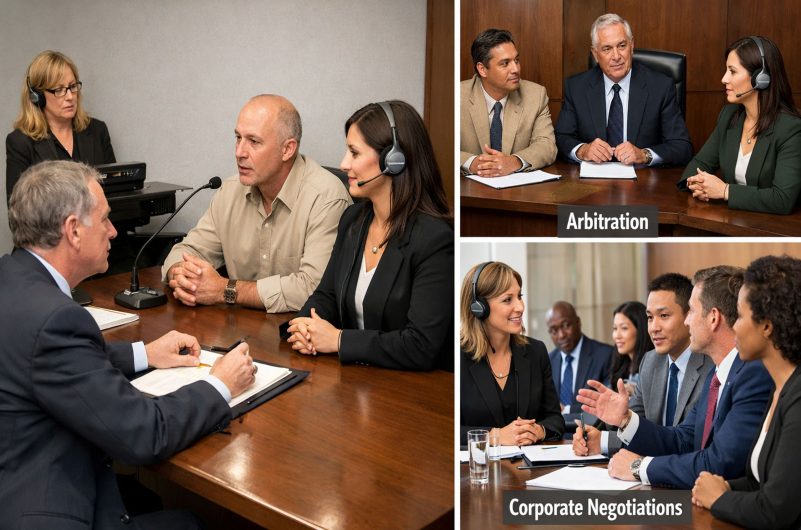
Litigation teams, arbitration counsel, in-house legal departments, deal teams, and executive assistants still need in-person interpreting for their highest-stakes conversations. They need it when precision, control, and presence matter most. A deposition can shape trial strategy. An arbitrator can turn on one answer. A negotiation can shift after one pause, objection, or side comment.
Remote options remain useful. However, some settings still favor physical presence. Face-to-face communication often requires stronger context and cultural understanding. Its interpretation page also emphasizes nonverbal communication, tone, and intent in in-person assignments.
That distinction matters in 2026. The California Courts Language Access Services materials state that court interpreters must work in simultaneous, consecutive, and sight translation modes. It also says they must transfer meaning faithfully in each mode. Those demands help explain why high-stakes legal events still require careful format decisions. California Courts Language Access Services, Modes of Interpretation.
Why In-Person Interpreting Still Matters in High-Stakes Settings
In-person interpreting still offers advantages that remote formats cannot always match. Parties share the same room. They can read pacing, body language, interruptions, and shifts in tone more clearly. That setting often helps when discussions move fast, emotions rise, or strategy turns on nuance.
The issue is not nostalgia. It is risk control. Depositions, arbitrations, and negotiations often involve long turns, overlapping speech, exhibits, objections, and sensitive terminology. Therefore, the communication environment matters as much as the language pair.
In legal settings, the mode of interpreting also matters. California Courts Language Access Services lists simultaneous, consecutive, and sight translation as core modes. It also says interpreters must render meaning faithfully and speak both languages fluently.
When In-Person Interpreting Is Better Than Remote
Some occurrences work better on video. Others shouldn’t start there. We recommend in-person interpreting for sessions that run several hours, involve substantial exhibits, feature multiple speakers, or carry major legal or commercial implications.
- When counsel expects difficult questioning, frequent objections, or extended witness answers, use in-person interpreting for depositions. Depositions are recorded. They are a kind of court interpretation due to the weight of oath-based testimony.
- In-person interpretation is needed for arbitrations with live testimony, document review, procedural discussions, or quick counsel-tribune communications. Sometimes physical presence reduces friction and improves turn management, leading to more effective communication and a smoother negotiation process.
- In-person interpretation is needed for corporate negotiations with senior executives, for sensitive commercial terminology, for cultural complexity, and for side conversations that affect the main contract. Trust, timing, and reaction affect negotiations. Therefore, the interpreting format should handle all three.
In-Person Interpreting for Depositions Requires Stronger Preparation
Depositions can look simple from the outside. One lawyer asks questions. One witness answers. Yet the reality is more demanding. The interpreter must manage pace, terminology, memory, note-taking, and objections without distorting the record.
NAJIT states that deposition work specifically relies on consecutive interpreting skills. It also frames consecutive mode as the best fit for question-and-answer exchanges, with limited exceptions.
That matters for buyers. A fluent bilingual speaker is not enough. A deposition interpreter needs process awareness, legal vocabulary, and disciplined delivery. The team also needs to brief the interpreter before the session starts.
In-Person Interpreting for Depositions Starts Before the Oath
Good deposition support begins before anyone enters the room. Counsel should share the case type, participant list, expected duration, terminology, and any exhibits that can be disclosed in advance. Clients should give interpreters access to speeches and presentations before the event.
That preparation supports legal deposition interpreter services in very practical ways. It reduces hesitation around proper names, product terms, acronyms, and recurring issues. It also helps the interpreter manage tone and pace more consistently.
Lawyers should also plan the room. The interpreter needs a clear line of sight to the witness and questioning attorney. The court reporter also needs a stable audio environment. Therefore, seating and microphone placement deserve real attention.
In-Person Interpreting for Depositions Needs Consecutive Discipline
Consecutive mode slows the room slightly, but it protects clarity. NAJIT says that consecutive interpreting works well in interviews because the gaps in speech support clear, accurate transcripts when needed.
That is one reason an on-site interpreter for depositions remains valuable. The interpreter can control turn-taking more effectively in person. Counsel can also spot confusion faster and correct the course before the record drifts.
In-Person Interpreting for Arbitrations Supports Better Hearing Control
Arbitrations often combine legal formality with business complexity. Witnesses may discuss technical systems, pricing models, timelines, or contractual language in rapid detail. At the same time, counsel may shift between examination, submissions, and procedural exchanges. Therefore, hearing control matters.
In-person interpreting helps in these situations because everyone shares one communication space. The interpreter can handle transitions between testimony, side explanations, and document review with fewer technical obstacles. AIIC’s distance interpreting guidance also highlights remote risks related to audio or video quality and the reliance on participants’ equipment.
An arbitration team should not choose a format solely for convenience. It should ask where misunderstandings are most likely. If the answer involves expert evidence, credibility, or real-time strategic decisions, in-person support usually deserves serious preference.
In-Person Interpreting for Arbitrations Works Best with Shared Documents
Arbitrations often live inside bundles, spreadsheets, and marked exhibits. In-person interpreting for arbitration hearings gives the interpreter better access to what the room is seeing at that exact moment. That helps when counsel jumps between tabs, printed pages, and witness bundles.
Teams should still prepare document packs in advance. They should flag witness names, contract sections, technical terms, and disputed phrases. That step supports accuracy during fast-moving exchanges.
In-Person Interpreting for Corporate Negotiations Protects Nuance
Corporate negotiations rarely follow a linear path. A room may include legal counsel, finance leads, commercial directors, and outside advisors. One speaker may test a position. Another may soften it. A third may introduce a cultural cue that matters more than the words themselves.
That is where in-person interpreting earns its place. In-person assignments help with context, cultural cues, tone, and intent. Those factors are central in commercial negotiations, where phrasing, hesitation, and delivery can affect trust.
A remote format can still work for some deals. However, the room changes when interpreters must depend on screens, internet stability, and controlled microphone behavior. AIIC’s 2025 guidance notes risks around audio and video quality in distance interpreting.
In-Person Interpreting for Corporate Negotiations Needs Commercial Briefing
Deal teams should not brief the interpreter with generic notes. They should explain the business context, the deal stage, the expected sticking points, and any sensitive vocabulary. This step supports interpreter services for business negotiations and reduces avoidable pauses.
The briefing should also note who has authority in the room. Negotiations often shift after one executive comment. Therefore, the interpreter needs to understand the stakes behind each speaker.
What Clients Should Share Before In-Person Interpreting
Clients often ask how much information they should provide. The answer is simple. Share enough to support accuracy and flow, while protecting privileges, as needed.
Provide these materials whenever possible:
- Participant names and roles
- Agenda or procedural outline
- Expected duration
- Key terminology and acronyms
- Public or non-privileged exhibits
- Prior versions of contracts or statements
- Pronunciation notes for names and brands
- Any special room or security rules
This preparation enhances in-person interpreting by reducing surprises. It also helps the interpreter stay consistent across long sessions.
Need reliable in-person interpreting for a deposition, arbitration, or negotiation?
eTranslation Services can help your team prepare for high-stakes communication.
Five Best Practices for In-Person Interpreting in High-Stakes Events
Strong results usually come from simple discipline. Teams do better when they follow a repeatable process.
- Book early and brief early.
Early booking gives more time to match subject matter and format. Early briefing also reduces preventable terminology issues. - Match the interpreter to the event type.
Depositions, arbitrations, and negotiations require different strengths. Ask for legal, technical, or commercial experience where relevant. - Control the room.
One person should speak at a time. The chair or lead counsel should enforce pacing from the start. - Prepare materials in a usable format.
Provide searchable PDFs, clean exhibit lists, and glossaries. Avoid sending scattered screenshots minutes before the session. - Plan for duration and fatigue.
Long sessions may require team support or structured breaks. Buyers should discuss the subject before the event begins.
These practices support quality by reducing noise. They also help everyone focus on substance, not recovery.
Common Mistakes That Undermine In-Person Interpreting
The biggest mistake is treating the interpreter like a last-minute accessory. That usually leads to thin briefing, poor seating, and unrealistic timing. Then the room blames the language support for failures that began in planning.
Overloading the session with exhibits that no one has seen before is another mistake. This issue appears often in depositions and arbitrations. It can also surface in negotiations with marked drafts and financial schedules.
A third mistake involves pace. Counsel may know that consecutive interpreting takes more time, yet still run the room as if it does not. Therefore, teams should adjust schedule expectations in advance.
The final mistake is choosing a format by habit. Some organizations default to remote because it feels faster. Others default to in-person without asking whether the event truly needs it. Good teams decide based on risk, not routine.
In-Person Interpreting and Technology Still Need to Work Together
Choosing in-person interpreting does not mean ignoring technology. High-stakes sessions still depend on document platforms, exhibit screens, e-bundles, recording protocols, and secure file sharing. Therefore, the interpreter should understand the basic tool environment before the event starts.
Useful tools may include:
- Secure document repositories
- Shared exhibit lists
- Real-time scheduling tools
- Clean digital bundles
- Microphones with reliable pickup
- Printed backup glossaries
- Secure messaging for logistics only
The best setups keep documents accessible and distractions to a minimum. That balance helps professional in-person interpreting services perform at a higher level.
How to Decide Between In-Person Interpreting and Remote Options
Before buying, ask questions. Credibility issues, heavy paperwork, interruptions, or long turns? Future relevance of the record? Must attendees read room reactions? In-person interpretation may be best.
Remote options enable short, controlled, low-risk swaps. Medical appointments, legal proceedings, and educational settings use OPI, VRI, ASL, and in-person interpretation for effective communication. This helps because not all events need the same format.
Some distance-unsuitable events remain. AIIC advises on remote vulnerabilities in sound, image, and participant equipment. Legal or business discussions elevate those issues.
What Success Looks Like in In-Person Interpreting
Success often looks understated. The room moves steadily. The witness understands the question. The tribunal follows the answer. The executives stay focused on the deal. No one wonders what was missed.
That result depends on the process. It depends on the format choice, the interpreter’s fit, room control, and briefing quality. Therefore, buyers should measure success before the event begins. They should know what smooth looks like.
Useful indicators include on-time starts, few clarification requests, steady pacing, and fewer misunderstandings-related interruptions. Those signs are practical. They also help teams improve future bookings.
The Advantage of Planning Before the Stakes Peak
In-person interpreting remains the better choice when the room carries legal pressure, commercial sensitivity, or procedural complexity. Depositions need disciplined, consecutive work. Arbitrations need control across testimony and documents. Negotiations need nuance, timing, and trust. In-person interpretation is a strong option for legal proceedings and business meetings. That makes it well placed to support clients who cannot afford communication drift.
If your next deposition, arbitration, or corporate negotiation will affect strategy or outcome, treat language support like part of the event design. Brief early, choose carefully, and give the interpreter what they need to succeed.
Ready to secure in-person interpreting for your next high-stakes matter? Contact eTranslation
Services for in-person interpreting that supports clarity, control, and confidence.
Frequently Asked Questions (FAQs)
When should a law firm choose in-person interpreting for a deposition?
Choose it when the testimony is long, technical, or heavily contested. It also helps when the record may shape a later strategy.
Is in-person interpreting better than video for arbitration hearings?
Often, the answer is yes, especially in hearings that involve a significant number of witnesses or documents. The shared room can reduce friction and support tighter hearing control.
What should counsel send before an interpreted deposition?
Send participant names, subject matter, expected duration, and usable exhibits. Also, send terminology lists and pronunciation notes when available.
Can in-person interpreting help in merger or contract negotiations?
Yes. Negotiations often depend on tone, pause, and reaction. Physical presence can help preserve those cues.
Should companies use the same interpreter for multiple negotiation rounds?
Consistency often helps. The interpreter learns the terminology, the parties, and the rhythm of the discussions.
How early should clients book in-person interpreting?
Book as early as possible for legal and executive events. Early booking improves fit, preparation time, and room planning.
What if an arbitration includes technical evidence?
Ask for an interpreter with familiarity with the relevant subject matter. Then, share approved materials before the hearing.
Do interpreters need access to exhibits in advance?
Yes, when possible. Advance access improves terminology consistency and reduces avoidable hesitation during questioning.
Can in-person interpreting still work with digital bundles and remote documents?
Yes. Many high-stakes sessions use digital tools. However, the team should test file access and room flow first.
What makes in-person interpreting successful in corporate settings?
Good briefing, controlled turn-taking, and realistic timing matter most. The interpreter also needs a clear commercial context.