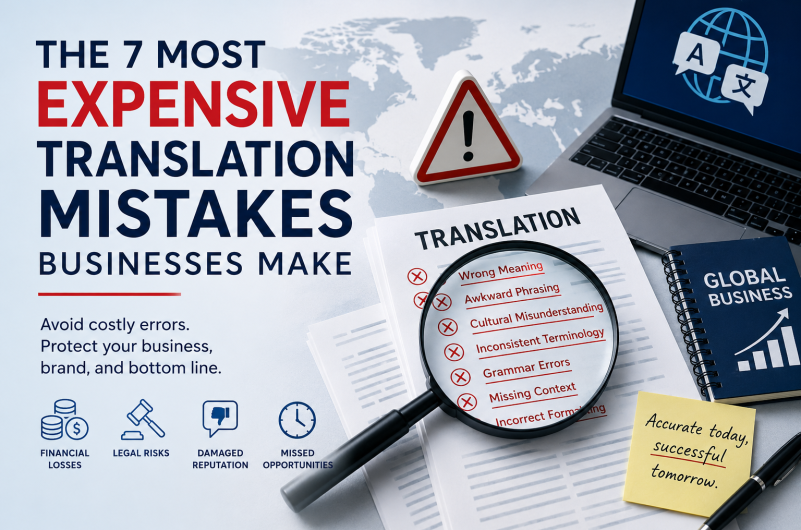
A single translation mistake can cost a business far more than the price of correcting a document. A poorly translated contract can create legal disputes, an unclear product label can damage customer trust, and a confusing marketing message can weaken an international launch. These problems often begin with decisions that seemed harmless, such as choosing the cheapest provider or relying on unreviewed machine translation.
Professional translation services help businesses avoid these costly errors by combining language expertise, subject knowledge, quality checks, and cultural understanding. As companies expand into international markets, accurate communication becomes essential for protecting revenue, maintaining compliance, and building lasting customer relationships.
Here are seven expensive translation mistakes businesses should avoid and practical ways to prevent them.
1. Choosing the Cheapest Translation Provider
Low-cost translation may look attractive when a company has a tight budget. However, a provider who lacks qualified translators, subject expertise, or a reliable review process may deliver work that requires extensive corrections.
For example, an inaccurate translation of a financial report or product specification can lead to misunderstandings, delayed approvals, or costly rework. The original savings may disappear once employees have spent hours correcting errors.
How to avoid it: Compare providers based on translator qualifications, industry experience, quality assurance, turnaround time, and revision policies—not price alone. A reliable service provider should explain what the quoted price includes.
2. Relying Entirely on Machine Translation
Machine translation has improved significantly and can help teams process large volumes of content quickly. However, it may still miss context, tone, cultural meaning, or specialized terminology.
A literal translation of a marketing slogan, for instance, might sound unnatural or carry an unintended meaning in another language. In healthcare or legal documents, an incorrect term can create more serious risks.
Professional translation services can combine technology with human expertise through machine translation post-editing (MTPE). Qualified linguists review machine-generated content, correct errors, and ensure that the final text meets the intended purpose and quality standards.
How to avoid it: Match the translation method to the content’s risk level. Use automated translation selectively for suitable material, and require qualified human review for sensitive, regulated, or customer-facing content.
3. Ignoring Cultural Differences and Local Meaning
A message can be grammatically correct yet fail with its intended audience. Humor, idioms, colors, images, measurements, and buying preferences can vary across markets.
For example, a promotional campaign developed for American consumers may sound awkward or culturally inappropriate when translated directly for customers in Japan, France, or Brazil.
This is where localization becomes important. Unlike translation alone, localization adapts content to the linguistic, cultural, and practical expectations of a specific market.
How to avoid it: Work with native-language specialists who understand the target audience. For websites, advertisements, software, and product descriptions, consider cultural review and in-market testing before launch.
4. Overlooking Industry-Specific Terminology
Every industry has its own vocabulary. A word used in everyday conversation may have a precise meaning in law, medicine, engineering, or finance.
Inconsistent terminology can confuse readers and weaken the credibility of technical documents. In regulated industries, errors may also trigger additional reviews, approval delays, or compliance concerns.
Experienced translators use approved terminology, reference materials, and industry-specific knowledge to maintain consistency across documents.
How to avoid it: Provide glossaries, style guides, and previous translations whenever possible. For complex projects, choose a provider with relevant subject-matter experience and a terminology management process.
5. Skipping Translation Review and Quality Assurance
Even experienced translators can overlook a typo, formatting issue, missing sentence, or incorrect number. Without a structured review process, these problems may reach customers or business partners.
A translated contract might contain inconsistent dates, while a user manual could omit a critical instruction. These errors can create avoidable confusion and additional costs.
Professional translation services should include appropriate quality checks, such as bilingual review, terminology verification, proofreading, and formatting checks based on the project’s requirements.
How to avoid it: Establish a quality assurance process before work begins. For high-risk documents, define who reviews the translation, which standards apply, and how corrections will be handled before final delivery.
6. Failing to Plan for Deadlines and Project Scope
Businesses sometimes request translations at the last minute, assuming every document can be completed within hours. However, large projects, specialized terminology, complex layouts, and multiple target languages require careful coordination.
Poor planning can delay product launches, marketing campaigns, tenders, or regulatory submissions. Rushed work may also leave insufficient time for review.
How to avoid it: Share the source files, target languages, word count, deadline, and intended use as early as possible. A professional provider can assess the scope, recommend a realistic schedule, and identify urgent requirements before work starts. Same-day service may be possible for many short documents, depending on complexity and availability.
7. Choosing a Provider Without Checking Credentials or Security
Not every translation company has the expertise or safeguards needed for confidential business information. Sharing contracts, employee records, medical documents, or financial reports with an unsuitable provider can expose a company to privacy and security risks.
Businesses may also encounter inconsistent quality when a provider cannot demonstrate relevant qualifications, secure file-handling procedures, or clear accountability.
How to avoid it: Check the provider’s industry experience, translator qualifications, confidentiality terms, and data protection practices. For sensitive projects, ask about access controls, secure transfer methods, retention policies, and any required compliance measures.
Why Professional Translation Services Are Worth the Investment
The real cost of translation extends beyond the initial invoice. Businesses must also consider correction time, missed deadlines, reputational damage, customer confusion, and potential legal or regulatory consequences.
Professional translation services help reduce these risks through qualified linguists, consistent terminology, appropriate technology, and quality control tailored to each project. They also support a more consistent customer experience across languages and markets.
These benefits apply across industries. Healthcare organizations need accurate patient information, law firms require precise legal terminology, manufacturers depend on clear technical documentation, and e-commerce companies need product content that customers can understand and trust.
How to Choose the Right Translation Partner
Before selecting a provider, businesses should ask three important questions:
- Does the provider understand the industry? Relevant experience matters when translating specialized or regulated content.
- Is quality assurance included? The provider should explain its review process and how it manages terminology and corrections.
- Can the service meet the project’s requirements? Confirm supported languages, turnaround times, confidentiality measures, and pricing before approving the work.
A transparent provider will explain the available options and help the business choose a suitable solution rather than simply offering the lowest price.
Prevent Costly Errors Before They Reach Your Customers
Translation mistakes can affect revenue, customer confidence, compliance, and international growth. The good news is that many of these problems are preventable with proper planning, qualified linguists, and a dependable quality assurance process.
eTranslation Services provides professional translation services tailored to business needs, from certified document translation to industry-specific content and multilingual localization. With access to more than 200 languages and language pairs, businesses can find solutions suited to their documents, audiences, and deadlines.
Planning an international launch or need an important document translated accurately? Contact eTranslation Services to request a quote and discuss a reliable, customized translation solution that helps protect your business from avoidable errors.