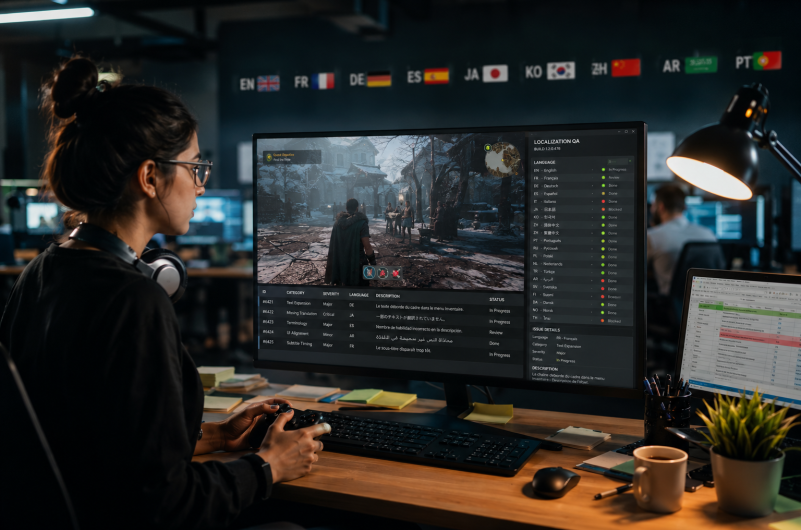
A game can be technically ready for launch and still have hundreds of localization problems waiting to be discovered.
A button may be cut off in German. A subtitle may be too long in French. A character name may display incorrectly in Japanese. Arabic text may flow in the wrong direction. A translated skill description may be grammatically correct but completely wrong for the context of the game.
When a title is launching in 20 or more languages, these issues can multiply quickly.
This is where professional Game LQA Services become essential. Linguistic Quality Assurance combines language expertise, functional testing, and real-world gameplay checks to identify localization problems before players encounter them. For studios working toward a global launch, an experienced LQA Tester provides an additional layer of quality control when time, accuracy, and consistency matter most.
What Are Game LQA Services?
Game LQA Services are designed to test the linguistic quality and functionality of a localized game. The process goes beyond checking whether translated sentences are grammatically correct.
An LQA Tester reviews localized content inside the actual game environment. This can include menus, subtitles, dialogue, character names, quests, tutorials, item descriptions, achievements, notifications, settings, error messages, and other player-facing content.
The tester also looks for technical problems that affect how language is displayed.
Text may overlap another interface element, disappear from a dialogue box, use the wrong font, display unsupported characters, or break at an inappropriate point. In right-to-left languages, the tester may need to verify text direction, punctuation, alignment, and interface behavior.
The objective is simple: the localized version should feel as polished and usable as the original.
A Day in the Life of an LQA Tester During Crunch
During the final stages of game development, testing rarely follows a predictable schedule. New builds arrive, content changes, bugs are fixed, voice-over files are updated, and localization strings may continue to change.
An LQA Tester must keep pace with those changes without losing track of previously reported issues.
A typical testing cycle begins with reviewing the latest build, release notes, localization files, test cases, known issues, and terminology references. The team identifies what changed since the previous version and prioritizes those areas.
Testing then moves into the game.
A tester might spend the morning checking a newly localized quest across several languages. Later, the focus may shift to character dialogue, inventory screens, subtitles, or platform-specific UI.
When a problem appears, it needs to be documented clearly. A useful LQA bug report normally identifies the language, platform, build version, location, reproduction steps, expected result, actual result, severity, and supporting evidence such as screenshots or video.
This level of detail helps developers reproduce and resolve issues faster, which becomes particularly important during crunch.
Why Testing 20 Languages Is More Complicated Than It Sounds
It is tempting to think multilingual testing simply means repeating the same process 20 times. In practice, each language introduces its own challenges.
German, for example, can require more screen space than English. French and Spanish can change sentence length and grammatical structure. Japanese and Chinese use different writing systems and have different UI considerations. Arabic requires careful attention to right-to-left presentation. Korean may require specific font and character support.
There are also cultural and contextual differences.
A word that works in a menu may not be appropriate in dialogue. A literal translation may change the meaning of a joke. A character’s level of formality may be wrong for the intended personality. A game item may have one approved name in the terminology database but appear under another name somewhere else.
These are issues that automated checks alone cannot reliably identify.
Common Problems Found During Game LQA
Some localization defects appear repeatedly across games and software products.
Text overflow is one of the most visible. Translated text can become longer than the original and break the user interface.
Missing translations can also occur when new strings are added late in development. Players may suddenly see English text inside an otherwise localized game.
Terminology inconsistencies create another problem. A weapon, character, faction, or ability should normally have a consistent localized name throughout the player experience.
Contextual translation errors can be harder to detect. A sentence may be grammatically correct but communicate the wrong meaning because the translator did not have sufficient context.
Subtitle problems can involve incorrect timing, missing lines, poor line breaks, or text that remains on screen too briefly.
Character encoding and font issues can prevent certain characters from displaying correctly.
There can also be cultural, regional, and platform-specific problems that only become obvious during actual gameplay.
How Professional LQA Testing Solves These Problems
Professional Game LQA Services use a structured process rather than simply asking linguists to play through a build and report anything that looks wrong.
A strong LQA workflow typically combines native-language testers, defined test cases, severity classifications, terminology references, bug-tracking systems, and platform-specific testing.
Automation can support this process by identifying issues such as missing translations, placeholder errors, duplicated strings, or formatting inconsistencies.
However, human review remains essential.
An automated system may identify that a sentence contains the correct words. It cannot reliably determine whether the sentence sounds natural for a particular character, whether a joke works in context, or whether a culturally sensitive reference needs adaptation.
That is why the most effective LQA solutions combine technology with experienced linguistic professionals.
The Business Benefits of Game LQA Services
For game studios, professional LQA is not simply another testing expense. It is a quality-control investment that can reduce the risks associated with a global launch.
Effective multilingual LQA can help studios:
- Identify localization defects before release
- Reduce last-minute localization corrections
- Improve consistency across languages
- Protect the player experience
- Detect UI and text-display problems
- Validate subtitles and localized dialogue
- Reduce confusion caused by incorrect terminology
- Support simultaneous international launches
- Protect the reputation of the game and studio
A localization problem that reaches thousands or millions of players can be difficult and expensive to correct after launch. Finding it during testing gives the development team an opportunity to address it before it affects the wider audience.
Where Game LQA Applies
LQA is relevant across almost every type of interactive entertainment.
AAA console releases may require extensive testing across PlayStation, Xbox, PC, and other platforms. Mobile games need testing across different screen sizes, operating systems, and device configurations. Online games introduce additional challenges because content can continue changing after launch.
Indie studios face many of the same localization challenges, although their internal resources may be more limited.
Professional LQA can also support DLC, expansions, patches, live-service content, seasonal events, updates, and post-launch releases.
The same principles extend beyond gaming to software applications, websites, SaaS platforms, e-learning products, and other multilingual digital experiences.
Best Practices for Multilingual Game LQA
The strongest LQA programs begin before the final build.
Early testing gives development teams more time to correct structural problems. It also allows testers to identify recurring localization issues before they spread across the entire product.
A centralized terminology database should be maintained throughout development. Translators, reviewers, LQA testers, and developers should have access to the same approved terminology and style guidance.
Testing should also happen in context whenever possible. Reviewing strings in a spreadsheet can identify linguistic problems, but it cannot reveal every issue that appears inside the actual game.
Bug severity should be clearly defined as well. A minor punctuation problem should not receive the same priority as a broken purchase button or missing critical instruction.
Finally, testing should be planned according to the actual release schedule. Trying to test 20 languages in the final few days creates unnecessary pressure and increases the risk of unresolved defects.
Common Mistakes Studios Should Avoid
One of the biggest mistakes is treating LQA as simple proofreading.
Localization testing involves language, functionality, context, usability, and cultural considerations. A translation can be linguistically correct and still fail when displayed inside the game.
Another mistake is relying entirely on machine translation or automated QA tools. These technologies can improve productivity, but they should support rather than replace qualified human testing.
Studios should also avoid using vague bug reports. Developers need actionable information. A report that explains exactly where the problem occurs and how to reproduce it is much more valuable than a general comment that “the translation looks wrong.”
Finally, localization testing should not be compressed simply because the launch date is approaching. The closer a game gets to release, the more expensive major changes can become.
Choosing the Right Game LQA Service Provider
Not every localization provider has the same testing capabilities.
A qualified Game LQA Service provider should have experienced native-language testers, structured QA processes, reliable reporting systems, and an understanding of the platforms and markets involved.
The provider should also be able to adapt its approach to the project.
A narrative-heavy RPG may require extensive dialogue, character, terminology, and subtitle testing. A competitive multiplayer title may place greater emphasis on menus, player communication, item descriptions, and frequent live-content updates.
The right provider understands these differences and builds a testing strategy around the game’s specific requirements.
Clear communication is equally important. During crunch, development teams need concise reports, accurate severity ratings, fast escalation of critical issues, and reliable progress updates.
Why Professional LQA Matters Before a Global Launch
Players rarely separate localization quality from the overall quality of a game. If menus are broken, subtitles are poorly timed, or character dialogue sounds unnatural, the problem becomes part of the player’s perception of the title.
Professional Game LQA Services help studios catch those problems before they reach the market.
By combining native linguistic expertise, functional testing, cultural awareness, structured reporting, and platform-specific knowledge, an experienced LQA team can provide the quality control needed for demanding multilingual releases.
For studios preparing a global launch, the goal is not simply to translate a game into 20 languages. The goal is to make sure the game works, reads, and feels right in every market.
A professional LQA Tester can help make that happen.
If a game is being prepared for release across multiple languages or platforms, a professional LQA service provider can assess the project’s language coverage, testing requirements, build schedule, and target markets. Contact the team to discuss a customized Game LQA Services solution designed to identify localization bugs, improve consistency, and support a smoother global launch.