A handwritten document can hold information that exists nowhere else: a family letter, an old civil record, a personal statement, a signed note, or a page from an official file.
Translating it is possible in many cases, but handwriting adds a step that typed documents do not have. Before the content can be translated, the translator must first be able to read and interpret the original writing accurately.
The condition of the document, the writer’s penmanship, the language, and the amount of context available can all affect the result.
Here is what to expect when requesting handwritten document translation.
Can Handwritten Documents Be Translated?
Yes, many handwritten documents can be translated.
A translator may be able to work from the original document, a scan, or a clear photograph. The key question is whether enough of the writing can be read with reasonable confidence.
Handwritten translation may be suitable for:
- Personal letters
- Family records
- Historical documents
- Diaries and journals
- Notes and statements
- Handwritten certificates
- Court or legal records
- Medical notes
- School records
- Immigration documents
- Forms completed by hand
- Marginal notes or annotations
- Older civil or religious records
Not every word will always be legible. A responsible translation provider should identify unclear sections rather than guess at content that cannot be read reliably.
Handwritten Translation Usually Begins With Transcription
A typed document already presents the source text in a form the translator can read directly.
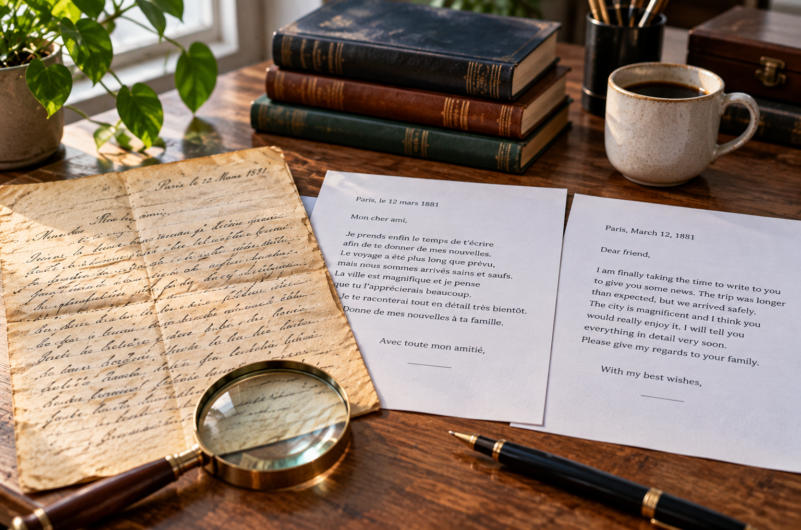
A handwritten document may first need to be transcribed. This means converting the handwritten content into typed text in the original language.
The general process may involve:
- Reading and transcribing the handwriting
- Identifying unclear or damaged sections
- Translating the readable content
- Reviewing names, dates, numbers, and terminology
- Formatting the translated version
- Adding certification when required
Transcription and translation are related, but they are not the same task.
The transcription records what appears in the source language. The translation communicates that content in the target language.
For broader projects involving official records, letters, forms, and other files, learn more about professional document translation services.
What Makes Handwritten Documents Difficult to Translate?
Some handwritten documents are clear and straightforward. Others require more time to interpret.
Several factors can affect readability.
Individual Handwriting Style
Every person writes differently.
Letters may be connected, shortened, slanted, or formed in ways that are difficult to recognize. The same letter may also appear differently throughout one document.
Cursive writing can be especially challenging when the writer uses an older or highly personal style.
Document Age
Older documents may use handwriting conventions that are no longer common.
The document may also contain:
- Historical spelling
- Archaic vocabulary
- Older abbreviations
- Outdated titles
- Regional expressions
- Writing styles associated with a particular period
Reading the language may therefore require more than modern fluency.
Fading or Damage
Ink can fade over time. Paper may become stained, torn, folded, or discolored.
Words may also be hidden by:
- Stamps
- Seals
- Signatures
- Creases
- Water damage
- Binding
- Notes written over other text
A high-quality scan or several photographs taken from different angles may help reveal details that are difficult to see in one image.
Poor Image Quality
Even clear handwriting can become unreadable in a blurry photograph.
Common problems include:
- Low resolution
- Shadows
- Glare
- Cropped edges
- Pages photographed at an angle
- Fingers covering text
- Heavy filters
- Uneven lighting
- Images sent through apps that compress files
The quality of the submitted image directly affects what the translator can examine.
Abbreviations and Informal Language
Handwritten material often contains shortened words, personal references, nicknames, incomplete sentences, or expressions that make sense only to the writer and intended reader.
Context can help the translator understand these details.
For example, knowing that a letter concerns a property, family relationship, immigration matter, or medical appointment may clarify an otherwise ambiguous word.
Multiple Languages
A document may use more than one language.
It can also contain:
- Foreign names
- Latin phrases
- Regional terms
- Transliteration
- Local dialect
- Official stamps in another language
Tell the provider about every language you expect to appear in the document. This helps the team determine which linguistic expertise the project requires.
What Happens When a Word Cannot Be Read?
A translator should not invent content to make a translation appear complete.
When part of a handwritten document is genuinely unreadable, the translation may use a clear notation such as:
- [illegible]
- [unreadable word]
- [text obscured]
- [signature]
- [handwritten note unclear]
The exact wording may depend on the purpose of the translation and the provider’s formatting practices.
A partly unreadable source does not necessarily prevent the rest of the document from being translated. The translator can often proceed while marking the sections that could not be confirmed.
The client may also be asked to provide:
- A clearer scan
- Another photograph
- The original document
- A related page
- Background information
- A previous typed copy
Additional context should be used to help interpret the source—not to replace or rewrite what actually appears on the page.
Can Old or Historical Handwriting Be Translated?
Yes, but historical documents can require more specialized work.
Older handwriting may differ significantly from current writing styles. Vocabulary, spelling, titles, and document structure may also reflect the period in which the material was created.
Historical handwritten documents may include:
- Family letters
- Church records
- Census records
- Land documents
- Military records
- Immigration records
- Birth, marriage, or death records
- Diaries
- Court files
- Business correspondence
- Archival manuscripts
The appropriate translator should understand the language used in the document and be comfortable working with its historical form.
In some projects, the client may request:
- A source-language transcription
- A modernized source-language version
- A direct translation
- Explanatory notes
- A side-by-side format
These are different deliverables, so the expected output should be agreed upon before work begins.
Can a Handwritten Translation Be Certified?
A handwritten document may be eligible for certified translation if the source can be read and translated with sufficient confidence.
A certified translation generally includes a signed statement concerning the completeness and accuracy of the translation and the translator’s competence.
Certification does not make unclear handwriting readable. It also does not replace the receiving organization’s requirements.
If the document will be submitted to a court, immigration authority, school, licensing body, government office, or another institution, provide the submission instructions when requesting the translation.
You may also need to clarify whether the institution wants:
- A certified translation
- A copy of the source document
- An original signed certification
- Notarization
- A particular format
- A translator affidavit
- Another type of authentication
Certification and notarization are separate requirements. Read our guide to certified vs. notarized translation for a clearer comparison.
How Are Names and Signatures Handled?
Names require special attention because handwritten letters can be interpreted in more than one way.
If you know the correct spelling of a person’s name, provide it as a reference. The same applies to:
- Addresses
- Places of birth
- Company names
- Case numbers
- Identification numbers
- Dates
- Titles
- Family relationships
Reference information helps the translator verify the handwriting, but it should not be used to insert content that is not present in the source.
Signatures are generally identified as signatures rather than translated as ordinary text. If a printed name appears beneath a signature, that printed information may also be reproduced in the translation.
Stamps, seals, handwritten annotations, and crossed-out words should be handled according to their relevance and visibility.
How to Photograph or Scan a Handwritten Document
You do not need professional scanning equipment for every project, but the image must be clear enough for close review.
Place the Document on a Flat Surface
Flatten the page carefully without damaging it.
Avoid holding the document in your hand while taking the photograph. Movement can cause blur, and fingers may cover important text.
Use Even Lighting
Natural light or a well-lit room usually works better than a single harsh light.
Avoid direct flash when it creates glare on laminated pages, glossy ink, seals, or plastic covers.
Photograph the Entire Page
Include all four corners and do not crop handwritten notes, stamps, signatures, or page numbers.
If a close-up is needed, send both:
- One full-page image
- One detailed image of the difficult section
The full-page image provides context, while the close-up helps with readability.
Keep the Camera Parallel to the Page
Photographing a document from an angle can distort letters and lines.
Position the camera directly above the page whenever possible.
Use the Original File
Send the highest-quality version available.
Images copied through multiple messaging apps may lose detail because of compression.
Do Not Apply Heavy Filters
A mild brightness adjustment may help, but aggressive sharpening or contrast filters can change the appearance of thin pen strokes.
Send the original image as well as any enhanced version so the translator can compare them.
Send Every Relevant Page
Include:
- Front and back
- Attachments
- Envelopes when relevant
- Continuation pages
- Marginal notes
- Related documents that provide context
Do not assume a blank-looking reverse side is irrelevant if it contains a stamp, seal, note, or endorsement.
What Information Should You Give the Translation Provider?
A clear request helps the provider assess the project properly.
Include:
- The source language
- The target language
- The number of pages
- The purpose of the translation
- Where the document will be submitted
- Your deadline
- Whether certification is required
- Whether you need a transcription
- Whether you need the original layout reproduced
- Any known names, dates, or places
- Relevant submission instructions
Tell the provider if preserving line breaks, crossed-out text, spelling variations, or handwritten structure is important.
A historical research project may require a different presentation from an immigration or court submission.
How Long Does Handwritten Document Translation Take?
Turnaround depends on more than the number of pages.
A one-page handwritten letter may take longer to assess than several pages of clear typed text.
Factors that may affect the timeline include:
- Readability
- Language
- Document age
- Amount of handwriting
- Image quality
- Subject matter
- Certification requirements
- Formatting
- Research needed for older terminology
- Translator availability
Send the document itself when asking about turnaround. A provider usually cannot assess handwritten material accurately from a verbal description alone.
If the project is time-sensitive, mention the exact deadline and ask whether urgent translation services are available for the document.
How Is Handwritten Translation Priced?
Pricing may reflect both transcription and translation work.
The provider may consider:
- Number of pages
- Amount of readable text
- Difficulty of the handwriting
- Language pair
- Document age
- Subject matter
- Formatting requirements
- Certification
- Deadline
A page containing two short handwritten sentences is different from a densely written diary page.
For that reason, sending the actual files is the best way to obtain an accurate quote.
How to Choose a Handwritten Translation Provider
Look for a provider that is willing to assess the source before confirming the project.
Useful questions include:
- Can you read this handwriting style?
- Is transcription included?
- How are illegible words marked?
- Can you work with older forms of the language?
- Will the translation be reviewed?
- Can certification be added if required?
- Will names, stamps, seals, and annotations be identified?
- What file quality do you need?
- What will the final format look like?
Be cautious of anyone who promises a complete translation before reviewing a difficult handwritten source.
The provider should be transparent about what can and cannot be read.
Need a Handwritten Document Translated?
eTranslation Services provides professional translation for personal, legal, immigration, academic, business, and other documents.
Send a clear copy of the handwritten material together with:
- The source and target languages
- Its intended use
- Your deadline
- Certification requirements
- Any available reference information
The team can review the document, assess its readability, and confirm the available service and turnaround.
Request a translation quote or contact eTranslation Services with questions about your file.
Frequently Asked Questions About Handwritten Document Translation
Can a translator read difficult cursive handwriting?
It depends on the handwriting, language, image quality, and translator’s familiarity with the writing style. The document should be reviewed before the provider confirms what can be translated.
Do I need to type the document before sending it?
Not necessarily. The translation provider may be able to transcribe the handwriting as part of the project. Tell the provider whether you also need a copy of the source-language transcription.
What if only part of the document is readable?
The readable sections may still be translated. Unclear or obscured content should be identified rather than guessed.
Can handwritten letters receive certified translation?
Potentially, yes. Certification depends on the readability of the source, the translation process, and the requirements of the receiving organization.
Can old family documents be translated?
Yes, although older handwriting, spelling, and terminology may require a translator familiar with the historical form of the language.
Should I send the original document?
Start by sending a high-quality scan or photograph. The provider can tell you whether inspection of the original is necessary.
Can handwritten notes in the margins be translated?
Yes, if they are readable. Tell the provider whether every annotation should be included.
Can a blurry photograph be enhanced?
Image adjustments may improve visibility, but they cannot reliably restore information that was never captured. Taking a new photograph is usually better when the original document is available.
Readability Comes Before Translation
A handwritten document can often be translated, but the process starts with a careful reading of the source.
Clear images, complete pages, useful context, and realistic expectations make the work easier. When words cannot be confirmed, they should be marked transparently rather than reconstructed through guesswork.
Send the document itself for review before relying on a price or deadline. That gives the translation provider the information needed to determine what can be read, what service is required, and how the finished translation should be prepared.