When people speak different languages, even a simple conversation can become complicated without the right support. For businesses, healthcare providers, legal professionals, and public service organizations, choosing the right interpretation method can make a real difference in communication, efficiency, and trust.
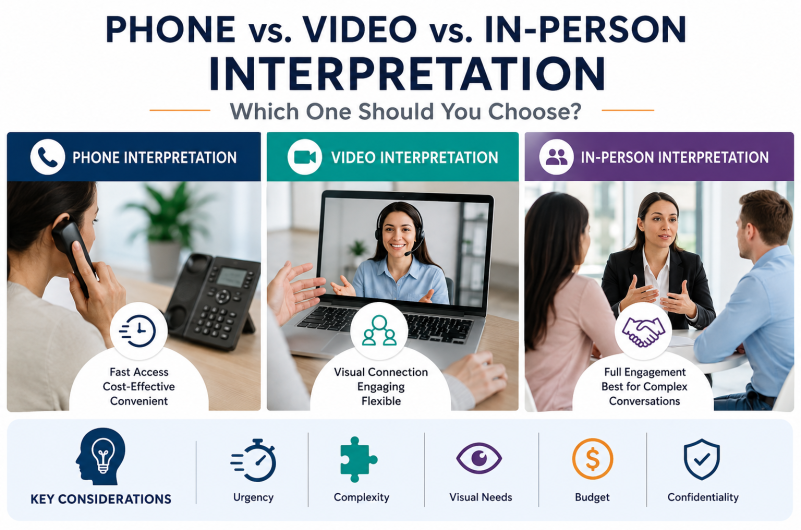
Understanding phone vs video vs in-person interpretation helps organizations select the most effective solution for each situation. Phone interpretation offers speed and convenience, video interpretation adds visual context, and in-person interpretation provides direct, face-to-face communication.
However, the best option depends on the conversation’s complexity, the participants’ needs, privacy requirements, and available resources. Here is how the three methods compare and when each one makes the most sense.
What Is the Difference Between Phone, Video, and In-Person Interpretation?
Professional interpretation allows people who speak different languages to communicate accurately with the help of a qualified interpreter. The main difference between these services is how the interpreter connects with the participants.
- Phone interpretation: Participants communicate with an interpreter through a telephone or conference call.
- Video interpretation: Participants connect with an interpreter through a video call, allowing them to see one another.
- In-person interpretation: A qualified interpreter attends the meeting or appointment and interprets face-to-face.
Each method supports multilingual communication, but the format affects accessibility, preparation, cost, and the ability to interpret nonverbal cues.
Phone vs Video vs In-Person Interpretation: Which Is Best?
There is no single solution for every situation. The right choice depends on how quickly interpretation is needed and how much visual or personal interaction the conversation requires.
| Situation | Best Option |
| Urgent phone call | OPI |
| Short customer-service conversation | OPI |
| Medical consultation requiring visual cues | VRI |
| Court hearing | In-person / specialized remote |
| Major business meeting | In-person |
| Rare language needed immediately | OPI |
When Should Businesses Choose Phone Interpretation?
Phone interpretation is ideal when speed, convenience, and broad language access are priorities. Organizations can connect with professional interpreters remotely without coordinating travel or arranging a physical meeting.
For example, a hospital may need an interpreter to help a patient understand appointment instructions, while a customer service team may need immediate assistance with a multilingual inquiry.
Key benefits include:
- Fast access to interpreters, including for urgent requests.
- No travel or on-site scheduling requirements.
- Flexible support for multiple languages.
- Practical cost savings for short or routine conversations.
Phone interpretation works particularly well for straightforward discussions. However, it does not provide visual cues, which may make complex conversations or emotionally sensitive situations more challenging.
When Is Video Interpretation the Better Option?
Video interpretation combines remote access with face-to-face interaction. Participants can observe facial expressions, gestures, and other visual signals that may help clarify meaning.
This can be especially useful in healthcare consultations, behavioral health appointments where appropriate, social services, and situations involving visual demonstrations.
For instance, a healthcare professional explaining how to use a medical device may benefit from video interpretation because the patient can see the demonstration while communicating through an interpreter.
Video interpretation also reduces the need for travel while preserving some of the personal connection associated with in-person meetings.
Its main limitations are technology-related. A reliable internet connection, suitable devices, adequate lighting, and a private setting are essential for effective communication.
When Should Organizations Use In-Person Interpretation?
In-person interpretation is often preferred when a conversation involves significant complexity, sensitive information, or extensive face-to-face interaction.
Legal proceedings, important medical consultations, community meetings, and certain high-stakes interviews may benefit from having a qualified interpreter physically present.
The interpreter can observe body language, follow the flow of conversation, and help manage communication between several participants. This can be valuable when people need additional support to follow a detailed discussion.
However, in-person interpretation usually requires more planning. Travel, scheduling, interpreter availability, and minimum booking periods can increase the overall cost.
Organizations should reserve this option for situations where direct presence provides a meaningful benefit rather than assuming it is always the most effective choice.
What Factors Should Influence the Decision?
Choosing between interpretation methods involves more than comparing prices. Several practical considerations can help organizations make a better decision.
Urgency: If an interpreter is needed immediately, phone interpretation may be the most practical option. Video can also provide rapid access when the necessary technology is available.
Complexity: Detailed legal, medical, or technical discussions may require an interpreter with specialized subject knowledge. Depending on the circumstances, video or in-person interpretation may provide additional support.
Visual communication: If gestures, facial expressions, or physical demonstrations are important, video or in-person interpretation is generally more suitable.
Budget: Phone interpretation often avoids travel expenses, while video reduces the need for on-site attendance. In-person services may cost more because of travel and scheduling requirements. Actual rates vary by provider, language, duration, and specialization.
Confidentiality: All three methods require appropriate privacy safeguards. Organizations should evaluate interpreter confidentiality practices, secure communication systems, and any applicable legal or regulatory requirements.
Which Industries Benefit From Professional Interpretation?
Professional interpretation supports organizations that serve people with different language needs.
Healthcare providers use interpreters to discuss symptoms, treatment options, consent, and follow-up instructions. Accurate communication helps patients understand important information and ask relevant questions.
Legal professionals may use interpretation during client consultations, interviews, depositions, and other proceedings where permitted. The interpreter’s qualifications and the applicable procedural requirements are essential.
Businesses rely on interpretation for customer support, employee communication, supplier discussions, and international meetings. Public agencies and nonprofit organizations also use these services to make information and essential services more accessible.
The appropriate method depends on the specific interaction. A routine customer inquiry may only require phone interpretation, while a complex consultation may benefit from video or in-person support.
Best Practices for Getting the Most From Interpretation Services
Organizations can improve communication quality by preparing before the conversation begins.
First, identify the required language and, when relevant, the participant’s preferred dialect. Next, explain the purpose of the meeting so the service provider can assign an interpreter with suitable experience.
Participants should speak clearly, use manageable sentences, avoid unnecessary jargon, and allow time for interpretation. They should also address the person they are speaking to rather than directing every statement toward the interpreter.
For video sessions, test the equipment beforehand and choose a quiet, private location. For in-person meetings, arrange suitable seating and allow the interpreter to hear every participant.
Finally, confirm whether the assignment requires specialized expertise, confidentiality measures, or particular qualifications before scheduling the service.
Why Does Choosing the Right Interpretation Provider Matter?
The interpretation method is only part of the decision. Service quality also depends on the interpreter’s language proficiency, subject knowledge, professionalism, and ability to communicate accurately under pressure.
A reliable provider should explain its service options, clarify scheduling requirements, and help organizations determine which format fits their needs. It should also be transparent about pricing, interpreter qualifications, confidentiality practices, and any limitations in availability.
The goal is not simply to arrange a conversation in another language. It is to help participants understand one another accurately, make informed decisions, and move forward with confidence.
Choose the Right Interpretation Solution for Your Needs
When comparing phone vs video vs in-person interpretation, the best choice is the one that matches the conversation’s urgency, complexity, visual requirements, and budget.
Phone interpretation offers convenient access, video interpretation combines flexibility with visual communication, and in-person interpretation provides direct support for situations that benefit from face-to-face interaction.
Choosing the right format can help reduce misunderstandings, improve service delivery, and build stronger relationships with customers, patients, employees, and partners.
Need professional interpretation services for your organization? eTranslation Services offers interpretation solutions tailored to different communication needs. Contact the team to discuss your language requirements, compare available options, and request a quote for reliable, professional support that helps every conversation count.