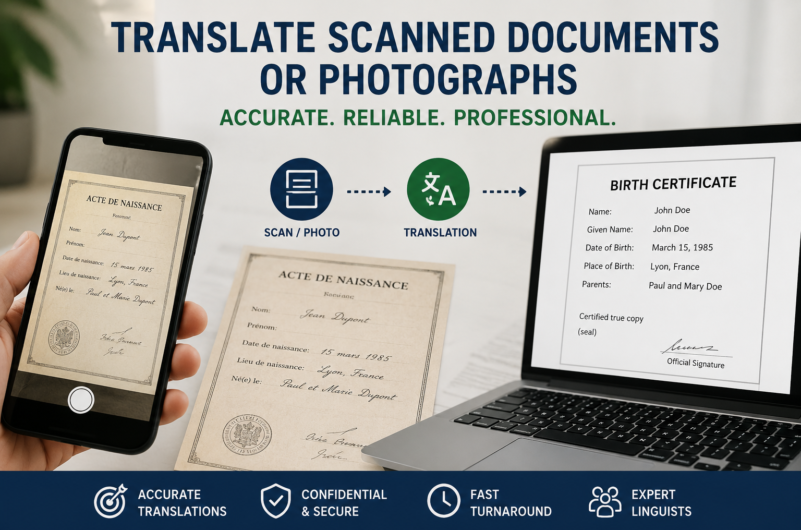
A document does not have to be in an editable format to be translated. Whether it is a scanned PDF, a photograph of a birth certificate, a picture of a contract, or a printed business document, professional translators can work with these files and convert their contents into another language.
However, translating scanned documents involves more than simply converting words from one language to another. The quality of the original image, document layout, handwriting, stamps, signatures, and formatting can all affect the final result.
For businesses, legal professionals, healthcare providers, and individuals handling official paperwork, understanding this process helps prevent delays, translation errors, and unnecessary expenses. So, can a scanned document or photograph be translated? Absolutely. The important question is how to ensure the translated version remains accurate, complete, and professionally presented.
Can You Translate Scanned Documents or Images?
Yes. Scanned documents and photographs can be translated using a combination of Optical Character Recognition (OCR) technology and professional human translation.
OCR software extracts readable text from an image or scanned file and converts it into digital text. Once extracted, the content can be translated into the target language.
However, OCR is not always perfectly accurate. Poor image quality, unusual fonts, handwritten notes, and complex layouts can cause the software to misread words or omit important details.
For this reason, professional translation providers typically combine document processing technology with human review to ensure accuracy.
Common file types accepted for translation include:
- Scanned PDF documents
- JPG and JPEG photographs
- PNG images
- TIFF files
- Pictures of printed certificates and official records
- Scanned contracts, reports, and business documents
Even when the original file cannot be edited, its contents can usually be translated without requiring the customer to recreate the document.
How Does the Translation Process Work?
Translating an image-based document involves several steps. Each stage helps preserve the original meaning and ensures that important information is not overlooked.
1. Document Assessment
The service provider first examines the submitted file. This includes checking image resolution, readability, document condition, language, and formatting.
If certain sections are blurry or incomplete, the provider may request a clearer copy before proceeding.
2. Text Extraction Using OCR
OCR technology identifies printed characters and converts them into editable text. This makes it easier to process large documents and reduces the need for manual transcription.
However, numbers, dates, names, and special characters require particular attention because even a minor recognition error can change the meaning of a document.
3. Professional Human Translation
Once the text has been extracted and checked, a qualified translator translates the content into the requested language.
Industry knowledge is particularly important for legal, medical, financial, and technical documents, where terminology must be precise and consistent.
4. Quality Assurance and Formatting
The translated content undergoes proofreading and quality checks. Depending on the project, the provider may also recreate the original layout, including tables, headings, seals, labels, and other visual elements.
The final document is then reviewed to ensure completeness, readability, and consistency.
What Are the Common Challenges When Translating Scanned Documents?
Although modern technology makes document translation more accessible, several issues can affect the quality of the final result.
Poor image resolution: Blurry photographs and low-resolution scans make it difficult for OCR software and translators to identify individual characters.
Handwritten content: Handwriting can be challenging to interpret, especially when dealing with older records, handwritten annotations, or signatures.
Complex formatting: Tables, columns, charts, and multi-section documents can become misaligned during text extraction.
Official stamps and seals: Important information may appear inside stamps, handwritten notes, or official markings that automated systems cannot reliably recognize.
Unusual terminology: Legal, medical, and technical documents often contain specialized vocabulary that requires subject-matter expertise.
These challenges explain why automated translation alone may not be sufficient for documents that require a high level of accuracy.
Why Should Businesses Use Professional Scanned Document Translation Services?
For businesses operating across international markets, document accuracy directly affects communication, compliance, and daily operations.
A poorly translated contract, employee record, medical report, or technical specification can create misunderstandings and costly delays.
Professional translation services help address these risks through qualified linguists, structured quality assurance, and industry-specific solutions.
Key benefits include:
- Greater accuracy: Human translators review extracted content and correct errors that automated tools may overlook.
- Time savings: Businesses can submit existing scans and photographs instead of manually recreating documents.
- Consistent terminology: Professional providers maintain language consistency across related documents and projects.
- Confidentiality: Established providers follow appropriate procedures for handling sensitive business and personal information.
- Flexible formatting: Translated documents can be delivered in editable or presentation-ready formats, depending on project requirements.
These benefits are especially valuable for organizations managing large volumes of multilingual documentation.
Which Industries Need Scanned Document Translation?
Scanned document translation supports a wide range of business and professional applications.
Legal and immigration: Birth certificates, marriage certificates, court records, affidavits, contracts, and immigration paperwork frequently arrive as scanned copies.
Healthcare: Medical histories, laboratory reports, prescriptions, patient records, and consent forms may need translation to support communication across language barriers.
Finance and banking: Financial statements, tax records, loan applications, and compliance documents often require accurate multilingual versions.
Manufacturing and engineering: Equipment manuals, inspection reports, technical drawings, and product specifications may contain scanned information that needs translation for international operations.
Education: Academic transcripts, diplomas, certificates, and school records are commonly submitted as photographs or scanned PDFs.
The specific requirements vary by industry. For example, an immigration certificate may require certified translation, while a technical manual may need specialized terminology and careful formatting.
How Can Customers Prepare Scanned Documents for Translation?
A few simple steps can improve translation quality and help avoid unnecessary processing delays.
- Use high-resolution scans. A clear scan of approximately 300 DPI is a useful starting point for printed documents.
- Keep the document straight. Avoid tilted photographs, shadows, glare, and cropped edges.
- Capture every page. Include the reverse side if it contains stamps, notes, or additional information.
- Check readability. Make sure names, dates, reference numbers, and handwritten sections are visible.
- Specify the intended use. Tell the provider whether the translation is for business, legal, immigration, medical, or personal purposes.
For official submissions, customers should also confirm whether the receiving institution requires certified translation, notarization, or a particular document format.
What Should You Look for in a Scanned Document Translation Provider?
Choosing the right service provider is just as important as submitting a readable document.
Look for a company with experienced translators, established quality assurance procedures, and expertise in the relevant subject matter. It should also offer clear turnaround estimates, transparent pricing, and appropriate confidentiality safeguards.
Another important consideration is document handling. Some providers deliver translated text only, while others offer formatted documents that closely follow the original layout.
Before requesting a quote, customers should clarify the language pair, document purpose, certification requirements, formatting preferences, and expected deadline. These details help the provider recommend the most suitable solution.
Get Professional Help to Translate Scanned Documents
Scanned PDFs and photographs should not prevent individuals or businesses from accessing accurate, professional translation services. With the right combination of technology, experienced linguists, and quality control, even complex image-based documents can be translated reliably.
At eTranslation Services, clients receive professional translation solutions supported by a network of qualified linguists covering more than 200 languages and language pairs. From personal certificates and legal records to medical reports and technical documentation, each project is handled according to its language, subject matter, and specific requirements.
Whether the document is a simple photograph or a multi-page scanned PDF, eTranslation Services helps make multilingual communication easier, more accurate, and more efficient.
Have a scanned document or photograph that needs translation? Contact eTranslation Services today to request a quote and discover a reliable solution tailored to your document, language, and turnaround requirements.