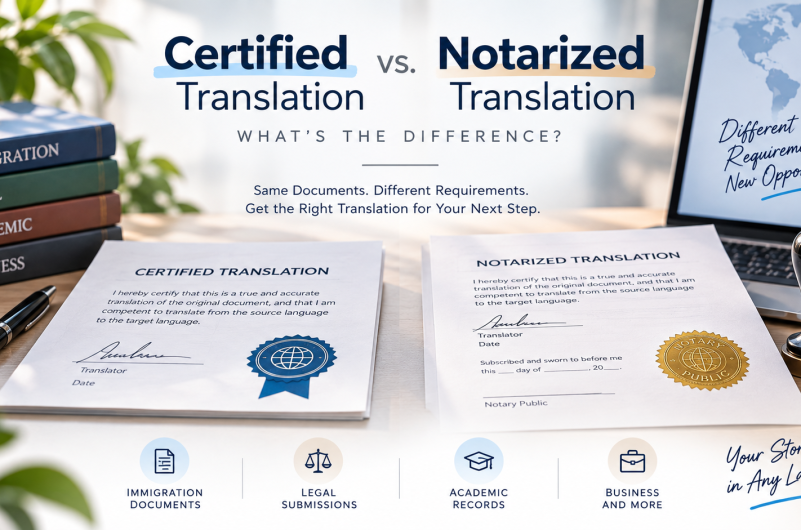
If you’re preparing documents for immigration, school, court, or another official purpose, you may be asked for a certified translation, a notarized translation, or both.
The terms are often confused, but they refer to different things.
A certified translation focuses on the translation and the translator’s certification. Notarization focuses on the signature or sworn statement associated with that certification.
Knowing which one the receiving organization actually requires can save you time and unnecessary costs.
What Is a Certified Translation?
A certified translation is a translation accompanied by a signed statement confirming that the translation is complete and accurate and that the translator is competent to translate between the relevant languages.
The certification usually identifies the translated document and includes information such as the translator’s name, signature, date, and certification statement.
For a more detailed breakdown, see our guide to certified translation letters and their requirements.
Certified translations may be requested for documents such as:
- Birth certificates
- Marriage certificates
- Diplomas and transcripts
- Immigration documents
- Court and legal records
- Government documents
- Professional or licensing records
The exact certification requirements depend on the organization receiving the document.
What Is a Notarized Translation?
A notarized translation usually involves notarizing the translator’s certification or signature.
The process may involve the translator signing or acknowledging the certification before a notary public, depending on the applicable notarial rules.
The important distinction is that notarization does not, by itself, verify the linguistic accuracy of the translation. The notary’s role generally relates to the signer’s identity, acknowledgment, oath, or signature—not whether every translated word is correct.
That is why a notarized translation should not be confused with a translation that has simply been professionally reviewed.
Certified Translation vs. Notarized Translation
The easiest way to understand the difference is to look at what each process confirms:
| Certified Translation | Notarized Translation |
| Addresses the completeness and accuracy of the translation | Adds notarization to the translator’s certification or signature |
| Includes a translator certification | Involves a notarial act |
| Often used for immigration, academic, legal, and government documents | Used when the receiving organization specifically requests notarization |
| Does not automatically require notarization | Usually begins with a translated document and accompanying certification |
In short:
Certification relates to the translation. Notarization relates to the certification or signer.
Some organizations require only a certified translation. Others may require certification plus notarization.
Does USCIS Require Notarized Translations?
For the general USCIS translation requirement, notarization is not required.
USCIS requires foreign-language documents submitted with an application or petition to be accompanied by a full English translation. The translator must certify that the translation is complete and accurate and that they are competent to translate from the foreign language into English.
Notarization is not part of that general requirement.
This means that adding notarization to a USCIS translation is generally unnecessary unless another document, agency, proceeding, or specific instruction creates a separate requirement.
For more information, read our guide to USCIS document translation rules.
Why Do People Confuse Certification and Notarization?
Official documents often involve signatures, seals, certifications, and other formal requirements, so it is easy to assume that notarization makes a translation more “official.”
But the two processes serve different purposes.
A certified translation contains a statement concerning the translation itself. A notarial act generally concerns the person signing that statement.
Adding notarization when it has not been requested does not necessarily make the translation more acceptable to the receiving organization.
What matters most is meeting the requirements of the organization that will actually review the document.
When Do You Need a Certified Translation?
You may need a certified translation when submitting foreign-language documents for an official process.
Common situations include:
Immigration Applications
USCIS generally requires a full English translation and the translator’s certification for documents containing foreign-language text submitted with immigration filings.
Common documents include birth certificates, marriage certificates, divorce records, police records, and other supporting evidence.
Academic Applications
Schools, universities, credential evaluators, and other academic organizations may request certified translations of diplomas, transcripts, certificates, and other educational records.
Requirements vary by institution, so check the school or evaluator’s instructions before ordering the translation.
Legal and Government Documents
Courts, government agencies, attorneys, licensing organizations, and other institutions may also request certified translations.
Because requirements can vary by jurisdiction and proceeding, tell your translation provider exactly where the document will be submitted.
You can learn more about eTS document translation services for immigration, legal, academic, and other official documents.
When Do You Actually Need Notarization?
A notarized translation or notarized translator certification may be requested by:
- Certain courts or legal proceedings
- Consulates or embassies
- Foreign government authorities
- Universities or credential organizations
- Licensing bodies
- Other institutions with their own document requirements
The requirements are not universal.
If an organization tells you that a document must be notarized, ask whether it wants:
- A certified translation
- A notarized translator certification
- Both certification and notarization
- A sworn translation
- An original signed certification
- Another form of authentication
Clarifying this before the translation is prepared can prevent unnecessary revisions later.
Does Notarization Make a Translation More Accurate?
No.
Notarization does not replace professional translation, proofreading, or quality review.
A notary generally does not evaluate whether terminology has been translated correctly or whether the translated document accurately reflects the source.
Translation accuracy comes from the translation and review process. Notarization serves a different administrative or legal function.
Can a Certified Translation Also Be Notarized?
Yes.
If the receiving organization requires both, a certified translation can also include the appropriate notarization.
The important point is that these are two separate requirements.
You do not need to choose between “certified” and “notarized” as though they are competing types of translation. A document may be certified without being notarized, or it may include both certification and notarization when required.
How Do You Know Which One You Need?
Before ordering a translation, check the instructions provided by the organization receiving your documents.
Look specifically for terms such as:
- Certified translation
- Translator certification
- Certificate of accuracy
- Notarized translation
- Notarized certification
- Sworn translation
- Original signature
If the instructions are unclear, ask the receiving organization what it requires rather than assuming that notarization is necessary.
You should also tell your translation provider where the document will be submitted. That gives them important context when determining the appropriate certification or additional service.
Need a Certified or Notarized Translation?
eTranslation Services provides certified document translations for immigration, legal, academic, business, and other official uses. Notarization can also be arranged when it is required for the intended submission.
If you have a deadline, send the complete document and let the team know:
- The source and target languages
- Where the document will be submitted
- Your deadline
- Whether the receiving organization requires certification, notarization, or both
This helps determine the appropriate service before the translation process begins.
Certified or Notarized? Check the Requirement First
The difference is straightforward once you separate the two functions:
A certified translation addresses the translation and its accuracy. Notarization concerns the signer or certification associated with it.
For USCIS filings, the general translation requirement calls for a complete English translation with the appropriate translator certification—not notarization.
For courts, consulates, universities, government agencies, and other organizations, requirements can differ. Checking before you order is the simplest way to avoid paying for a service you do not need—or discovering later that an additional step is required.
Frequently Asked Questions
Is a certified translation the same as a notarized translation?
No. Certification addresses the completeness and accuracy of the translation and the translator’s competence. Notarization generally relates to the signer, signature, acknowledgment, or sworn statement associated with the certification.
Does every certified translation need to be notarized?
No. Whether notarization is required depends on the organization receiving the document.
Does USCIS require a notarized certified translation?
Not as part of its general foreign-language translation requirement. USCIS requires a complete English translation accompanied by the translator’s certification of accuracy, completeness, and competence.
Can a translation be both certified and notarized?
Yes. If the receiving organization requires both, the translator’s certification can undergo the appropriate notarial process.
Which one should I order?
Follow the requirements of the organization receiving your documents. If the instructions only ask for a certified translation, do not assume that notarization is also necessary.