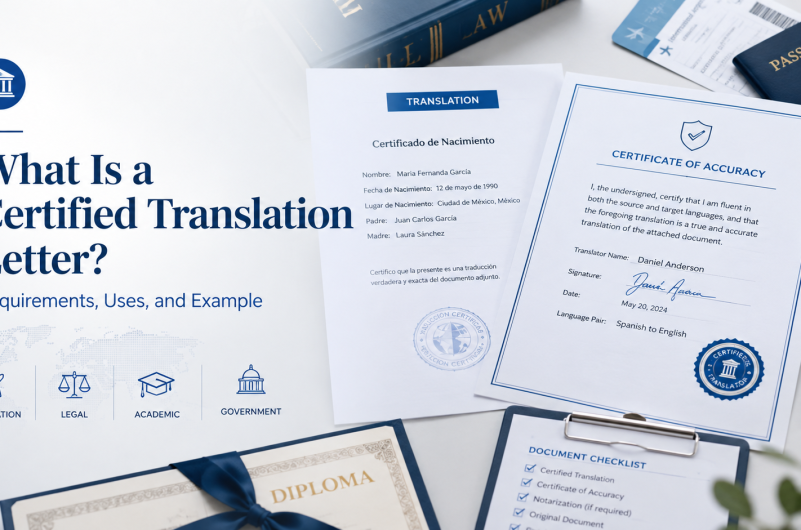
If you need to submit a translated birth certificate, marriage certificate, diploma, legal record, or other official document, you may be asked for a certified translation letter.
A certified translation letter is a signed statement confirming that a translation is complete and accurate and that the person who translated it is competent to translate between the relevant languages. It usually accompanies the translated document and may also be called a certificate of translation accuracy, translation certification letter, or translator certification statement.
The exact requirements depend on the organization receiving your documents. For U.S. immigration filings, however, USCIS has specific translation requirements.
What Is a Certified Translation Letter?
A certified translation letter is a written certification that accompanies a translated document and confirms its accuracy and completeness.
It establishes that the translation was prepared by someone competent to translate from the source language into the target language.
The letter does not replace the translation itself. Instead, a typical certified translation package includes:
- A copy of the original foreign-language document
- The complete translated document
- The certification or certificate of accuracy
The terminology can vary. You may see the same document described as a:
- Certificate of Translation Accuracy
- Translation certification
- Translator’s certification
- Certification statement
- Translation certification letter
- Certificate of accuracy
In most cases, these terms refer to a statement accompanying a translation rather than a separate type of translation.
Learn more about certified translation and document translation services.
What Should a Certified Translation Letter Include?
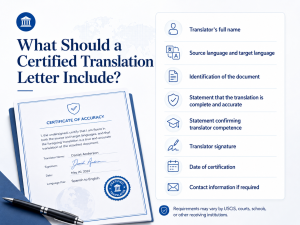
Requirements vary depending on where the document will be submitted. A professionally prepared certified translation letter will generally identify the translation and clearly state the translator’s qualifications and certification.
It commonly includes:
- The translator’s full name
- The language of the original document
- The language into which it was translated
- Identification of the document being translated
- A statement that the translation is complete and accurate
- A statement confirming the translator’s competence
- The translator’s signature
- The date of certification
- Contact information, where appropriate
Additional information may be required by a particular court, university, government agency, consulate, licensing authority, or other institution.
Always check the recipient’s specific requirements before submitting your documents.
What Does a Certified Translation Letter Look Like?
The exact wording can vary, but a straightforward certification might look like this:
Sample Certificate of Translation Accuracy
Certificate of Translation
I, [Translator’s Full Name], certify that I am competent to translate from [Source Language] into English and that the attached translation of [Document Name] is a complete and accurate translation of the original document to the best of my knowledge and ability.
Translator’s Name: [Full Name]
Signature: __________________
Date: __________________
Contact Information: __________________
This is an illustrative example rather than a universal form. The organization receiving the document may require different wording or additional information.
What Does USCIS Require for Certified Translations?
USCIS requires foreign-language documents submitted in support of an immigration request to be accompanied by a full English-language translation.
Under 8 C.F.R. § 103.2(b)(3), the translator must certify that:
- The translation is complete and accurate; and
- The translator is competent to translate from the foreign language into English.
You can also review our guide to USCIS translation certification and notarization requirements.
This distinction matters. A simple note stating that a document was “translated” or “reviewed” may not contain everything required for a USCIS filing.
The translation itself should also be complete. Leaving out portions of the original document can cause problems even when the translated sections are accurate.
Does USCIS Require a Certified Translator?
Not in the way the phrase is often understood.
USCIS rules focus on the translation and the translator’s certification of competence, rather than requiring every translator to hold a particular professional license or certification.
A “certified translation” and a translation completed by a “certified translator” are therefore not necessarily the same thing.
A translator may hold professional credentials, but the USCIS requirement centers on the certification that the translation is complete and accurate and that the translator is competent to perform it.
For a broader explanation of this distinction, see our guide on what a certified translation is.
Does a USCIS Certified Translation Need to Be Notarized?
Not generally.
USCIS’s translation requirement calls for certification of the translation’s completeness and accuracy and the translator’s competence. Notarization is not part of the general USCIS translation requirement.
That does not mean notarization is never needed.
A court, consulate, university, licensing body, foreign government, or other receiving institution may have its own requirements. Depending on where your document will be submitted, you may be asked for:
- A certified translation
- A notarized certification
- A sworn translation
- An original signed certification
- A particular certification format
Checking the recipient’s requirements before ordering a translation can help you avoid unnecessary delays or additional costs.
When Do You Need a Certified Translation Letter?
A certified translation letter is commonly requested when translated documents will be used in a formal or official process.
Immigration Applications
Foreign-language documents submitted to USCIS generally need a complete English translation accompanied by the appropriate translator certification.
Common documents include:
- Birth certificates
- Marriage certificates
- Divorce records
- Police or criminal records
- Adoption documents
- Financial records
- Employment records
Academic Applications
Universities, colleges, credential evaluators, and other educational organizations may request certified translations of:
- Diplomas
- Academic transcripts
- Certificates
- Degrees
- School records
Requirements differ among institutions, so applicants should confirm the school’s specific translation policy.
For more information, see our guide to certified translation for career and academic records.
Legal Proceedings
Courts, attorneys, government offices, and administrative bodies may need translated:
- Contracts
- Affidavits
- Court records
- Judgments
- Evidence
- Witness statements
- Civil records
Certification requirements can vary depending on the jurisdiction and proceeding.
Learn more about our legal translation services.
Professional and Government Applications
Licensing boards, employers, government agencies, consulates, and other organizations may also require certified translations when evaluating foreign-language documents.
The safest approach is to check the receiving organization’s instructions before having the document translated.
Certified Translation vs. Certified Translator: What’s the Difference?
These terms are easy to confuse.
A certified translation is a translation accompanied by a statement confirming its completeness and accuracy and, where required, the translator’s competence.
A certified translator, on the other hand, generally refers to an individual who has obtained a particular professional credential or certification.
Professional credentials can help demonstrate a translator’s qualifications, but they are separate from the certification statement attached to a specific translated document.
For USCIS purposes, the key issue is whether the required translation and translator certification are provided.
Certified Translation vs. Notarized Translation
Certification and notarization serve different purposes.
A certification relates to the translation itself. The translator makes a statement concerning its completeness and accuracy and confirms their competence to perform the translation.
Notarization, by contrast, generally concerns the identity of the person signing a document or the acknowledgment of a signature according to applicable notarial requirements.
A notarized signature does not, by itself, establish that a translation is accurate.
Some institutions require only certification. Others may request both certification and notarization. Always follow the requirements of the organization receiving the document.
Common Certified Translation Letter Mistakes
A small problem with the certification can create unnecessary delays. Before submitting your documents, watch for these common issues.
1. The Certification Does Not Say the Translation Is Complete
For USCIS filings, the certification should state that the translation is both complete and accurate.
2. The Translator’s Competence Is Not Addressed
USCIS also requires the translator to certify that they are competent to translate from the foreign language into English.
3. Parts of the Original Document Are Missing
A complete translation should account for the entire document rather than translating only the portions that appear important.
4. The Certification Cannot Be Connected to the Document
The certification should make clear which translated document it covers. This is especially important when multiple documents are submitted together.
5. Names or Dates Do Not Match
Names, dates, identification numbers, and other important details should be reviewed carefully for consistency with the source document and the rest of the application.
6. The Wrong Certification Standard Is Used
USCIS, courts, universities, consulates, and other authorities do not necessarily have identical requirements.
Before ordering a translation, tell your translation provider where the document will be submitted. That information can affect the appropriate certification.
You can also review the top reasons translations get rejected and how to avoid them.
How to Get a Certified Translation Letter
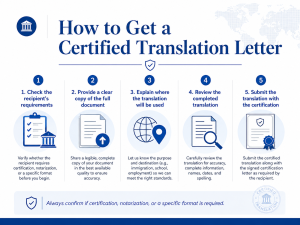
The process is usually straightforward.
Step 1: Check the Receiving Organization’s Requirements
Determine whether you need certification, notarization, hard-copy delivery, or any special wording.
Step 2: Provide a Clear Copy of the Entire Document
Include all relevant pages, stamps, seals, handwritten annotations, and other visible information.
Step 3: Explain Where the Translation Will Be Used
Tell the translation provider whether the document is intended for USCIS, a court, university, licensing body, consulate, or another organization.
Step 4: Review the Completed Translation
Check important personal details such as names, dates, addresses, document numbers, and other identifying information.
Step 5: Keep the Certification With the Translation
When submitting the translation, make sure the certification remains associated with the document it covers.
Frequently Asked Questions About Certified Translation Letters
Is a Certificate of Accuracy the Same as a Certified Translation Letter?
Usually, yes. “Certificate of accuracy,” “translation certification letter,” and “translator certification statement” are commonly used to describe the certification accompanying a translated document.
The exact name matters less than whether the certification contains the information required by the receiving institution.
Does Every Translated Document Need a Certification Letter?
No. Documents translated solely for personal or internal use may not require certification.
Certification is generally relevant when a receiving organization specifically asks for a certified translation or requires one under its submission rules.
Does USCIS Require a Certificate of Translation Accuracy?
USCIS requires foreign-language documents to have a full English translation accompanied by the translator’s certification that the translation is complete and accurate and that the translator is competent to translate from the foreign language into English.
Does a Certified Translation Need to Be Notarized?
Not always.
USCIS does not generally require notarization as part of its translation certification requirement, but another receiving organization may request it. Always check the specific submission instructions.
What Documents Commonly Need Certified Translation?
Common examples include:
- Birth certificates
- Marriage certificates
- Diplomas
- Academic transcripts
- Court documents
- Immigration records
- Legal documents
- Government records
How Long Does a Certified Translation Take?
Turnaround time depends on the document’s length, language pair, complexity, legibility, and certification requirements. Expedited options may be available depending on the document and requested service.
Get a Certified Translation With the Proper Certification
The certification letter may be only one part of your submission, but it can play an important role in whether an official translation meets the receiving organization’s requirements.
eTranslation Services provides certified document translation services for immigration, legal, academic, and other official uses.
Tell our team where your document will be submitted so the relevant translation and certification requirements can be considered from the start.
Request a quote for your certified translation today.