When a game studio brings a playable build to Gamescom, the demo shows more than gameplay. It can also reveal how far the studio has progressed with localization and whether the team is preparing for a simultaneous global launch or post-launch localization.
The language menu, translated UI, subtitles, voiceover, and even small localization errors can provide clues about a studio’s international release strategy.
For game developers and publishers, the decision between simship and Post-Launch Localization is more than a translation choice. It affects development schedules, localization costs, quality assurance, marketing, player expectations, and the overall success of a global launch.
Neither approach is automatically better. The right model depends on the game’s audience, release strategy, budget, production timeline, and localization readiness.
What Is Post-Launch Localization?
Post-Launch Localization is the process of releasing a game in one or more core languages first and adding additional languages after launch.
For example, a studio may launch a game in English and later release French, German, Spanish, Japanese, Korean, Simplified Chinese, Brazilian Portuguese, or other language versions.
The additional languages may arrive weeks or months after the initial release.
This approach gives development teams more time to stabilize the game before completing localization for every target market. It can also reduce pressure on a production schedule when the game’s content is still changing close to launch.
Post-launch localization does not mean localization is an afterthought. When planned correctly, it is a deliberate global expansion strategy.
The key is to establish the localization workflow early enough that translation, linguistic testing, voiceover, subtitle creation, and implementation can be completed efficiently after the initial release.
Simship vs. Post-Launch Localization: What Is the Difference?
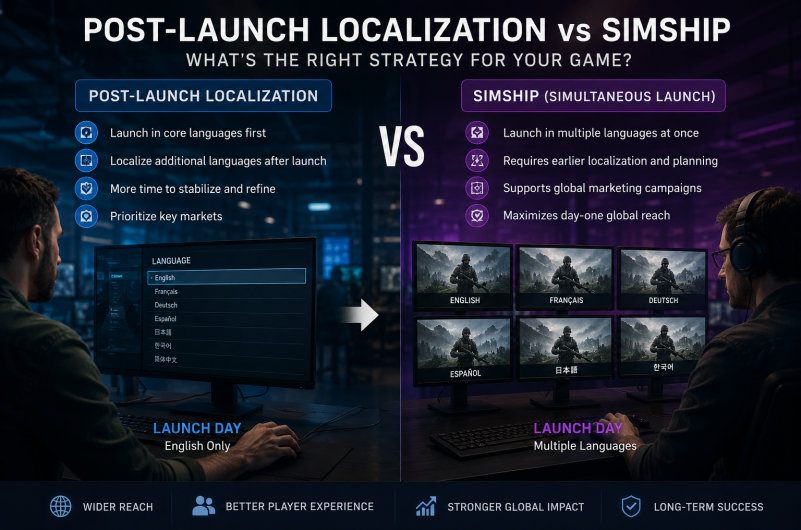
Simship, short for simultaneous shipment, means launching a game in multiple supported languages at the same time.
Post-Launch Localization means releasing the game in selected languages first and adding other localized versions later.
The difference can be summarized simply:
| Simship | Post-Launch Localization |
|---|---|
| Multiple languages launch together | Languages launch in stages |
| Requires earlier localization readiness | Provides additional time after launch |
| Supports a coordinated global marketing campaign | Allows markets to be prioritized |
| Creates greater pre-launch schedule pressure | Spreads localization work over time |
| Requires extensive localization QA before launch | Localization QA can continue after the initial release |
| Can maximize day-one global reach | Can reduce initial production pressure |
The best choice depends on what the studio is trying to achieve.
A major AAA release supported by a coordinated international marketing campaign may benefit from simship. An indie studio validating its game with an initial audience may find post-launch localization more practical.
Why Are Games Moving Toward Post-Launch Localization?
Game development has become increasingly complex. Modern titles often contain millions of words across dialogue, menus, tutorials, item descriptions, quests, achievement text, marketing materials, subtitles, and downloadable content.
That content also continues to change.
Developers may still be fixing bugs, rewriting dialogue, changing UI elements, adding features, or balancing gameplay shortly before release. Every significant change can create additional localization work.
This is one reason Post-Launch Localization can be attractive.
Instead of forcing every language through the same compressed deadline, the studio can prioritize its core release, stabilize the product, and then expand into additional markets using a more controlled localization process.
However, this strategy also has trade-offs.
Players in unsupported markets may have to wait. Reviews and word-of-mouth activity can develop unevenly across regions. A competitor may reach those players first.
The decision therefore requires careful planning rather than simply choosing the cheaper option.
What Can a Gamescom Demo Reveal About Localization Strategy?
Gamescom demos provide an interesting snapshot of a game’s localization readiness.
A demo that already supports multiple languages can indicate that localization has been integrated relatively early into development. It may also suggest that the studio is working toward a coordinated international launch.
On the other hand, an English-only demo does not automatically mean that the game will launch only in English.
The localization may simply not have reached the public demo build yet.
Still, certain patterns can provide useful clues.
1. Multiple Languages Are Fully Playable
A demo that includes polished translations across several major markets suggests that localization has been incorporated into the development pipeline early.
Clean UI text, natural dialogue, correctly displayed characters, and finished subtitles are particularly strong indicators.
This may point toward a simship strategy.
2. English Is Complete but Other Languages Are Missing
An English-only build may indicate a post-launch localization strategy or simply reflect the current development stage.
For players and industry observers, the important question is whether the studio has publicly committed to additional languages and when those languages are expected to arrive.
3. Translated Text Appears but Voiceover Is Missing
This can indicate a hybrid localization strategy.
A studio may prioritize text localization for launch while scheduling dubbed audio for later.
This approach can be particularly useful when voiceover production would significantly increase the time and cost required to support additional markets.
4. Localization Errors Appear in the Demo
Overlapping subtitles, truncated text, untranslated buttons, incorrect line breaks, missing characters, or inconsistent terminology can indicate that localization QA is still in progress.
These issues do not necessarily reveal the final quality of the game.
However, they highlight an important point: localization needs to be tested inside the actual game environment.
A translation can be linguistically accurate and still fail when implemented in the game.
Why Localization QA Matters Before Launch
Translation is only one part of game localization.
A professional localization workflow also needs linguistic QA (LQA) and functional testing.
LQA examines whether the localized content is accurate, natural, consistent, and appropriate for the target market.
Functional QA looks at how that content behaves inside the game.
For example, a translated sentence may be grammatically correct but too long for a button. A subtitle may overlap another UI element. A character name may be inconsistent between dialogue and menus.
These problems can damage the player experience even when the original translation was technically correct.
That is why localization should be tested in context rather than reviewed only in spreadsheets or translation management systems.
When Does Simship Make More Sense?
Simship can be a strong choice when international markets are central to the launch strategy.
It may be appropriate when:
- The game has a large global audience.
- International marketing campaigns are launching simultaneously.
- Day-one sales are particularly important.
- Target markets have strong demand for localized content.
- The development schedule allows sufficient localization time.
- The studio has the resources for multilingual QA.
- The source content is stable enough for localization to begin early.
The biggest advantage is consistency.
Players in different regions receive the game at approximately the same time, which allows marketing, reviews, streaming, community activity, and sales campaigns to build momentum together.
The downside is production pressure.
Every supported language becomes part of the critical launch path.
When Is Post-Launch Localization the Better Option?
Post-Launch Localization may make more sense when a studio needs flexibility.
It can be particularly useful when:
- The game is still undergoing major changes.
- The initial launch market is the studio’s priority.
- Localization resources are limited.
- The studio wants to validate player demand first.
- The game has a smaller initial audience.
- Some markets are strategically more important than others.
- The development team cannot safely accommodate every language before launch.
A staged release can also help a studio learn from its initial launch.
Player feedback may reveal terminology issues, unclear UI instructions, subtitle problems, or gameplay changes that should be incorporated before additional languages are released.
The important distinction is planning.
A deliberate post-launch localization strategy is very different from launching without a localization plan and deciding later that additional languages would be useful.
What Are the Main Cost Considerations?
Localization costs are influenced by much more than the number of languages.
A studio may need to consider:
- Word count
- Number of target languages
- Dialogue volume
- Voiceover requirements
- Subtitle creation
- Linguistic QA
- Functional testing
- Marketing localization
- Localization engineering
- Content updates
- DLC and live-service updates
- Deadlines and turnaround requirements
Simship can require a larger localization investment before launch because multiple language teams may be working simultaneously.
Post-launch localization spreads some of that investment over a longer period.
However, delaying localization does not automatically make the project cheaper.
If the game requires extensive rework, terminology changes, additional testing, or repeated translation updates, costs can increase.
The most effective approach is to calculate the total localization workload and risk, rather than comparing only the initial translation price.
Common Challenges in Post-Launch Localization
Post-launch localization offers flexibility, but it comes with its own challenges.
Maintaining Consistency
When localization happens after launch, the source game may have changed significantly.
New terminology, characters, features, quests, and UI elements can appear between releases.
A strong terminology database, style guide, and translation memory can help maintain consistency across updates.
Managing Player Expectations
Players need clear information about which languages are supported at launch and which are planned for later.
Unclear communication can create frustration.
Studios should avoid promising specific localization dates unless the schedule is sufficiently reliable.
Coordinating Updates
Post-launch localization becomes more complicated for games that receive frequent patches.
A localization team may need to translate new content while simultaneously updating previously translated material.
This is particularly important for live-service games.
Maintaining Quality Under Pressure
Post-launch does not mean “translate quickly and publish.”
The same quality standards should apply after release.
Translations still need linguistic review, contextual testing, and final approval before reaching players.
How Professional Game Localization Providers Reduce These Risks
A specialized localization service provider can help studios build a workflow around the game’s actual production schedule.
The process can include source-content preparation, terminology management, translation, editing, proofreading, voiceover localization, subtitle creation, linguistic QA, and functional testing.
Professional teams can also help identify localization risks before they become expensive problems.
For example, early review of the game’s source files may uncover inconsistent terminology, missing context, character limitations, or strings that are difficult to translate.
Addressing these problems before large-scale localization begins can save both time and rework.
A professional service provider should also understand that game localization is different from ordinary document translation.
Games require attention to character voice, UI limitations, cultural context, player expectations, gameplay terminology, and technical implementation.
Best Practices for Choosing a Localization Strategy
Start Localization Planning Early
Even studios planning Post-Launch Localization should consider localization during development.
Early planning allows the team to prepare source files, establish terminology, identify target markets, and estimate workload.
Prioritize Languages Based on Market Potential
Not every game needs the same language list.
Studios should evaluate player demographics, regional sales potential, platform distribution, genre popularity, and existing community demand before selecting target languages.
Build a Localization Kit
A localization kit can include the game’s glossary, style guide, character information, screenshots, reference materials, approved terminology, and contextual notes.
This gives translators the information they need to produce consistent work.
Separate Translation From Final QA
Translation and QA serve different purposes.
The translator focuses on language quality. LQA testers evaluate how that language works inside the game.
Both stages matter.
Plan for Updates
A localization strategy should not end on launch day.
Studios should determine how patches, DLC, seasonal content, new characters, and community-driven changes will enter the localization pipeline.
This is particularly important for live-service games.
Common Localization Mistakes Studios Should Avoid
One of the biggest mistakes is treating localization as something that can be added at the very end.
By that point, the source content may already be unstable, context may be missing, and the schedule may be too tight for proper review.
Another common mistake is assuming that machine translation alone can deliver production-ready game content.
Automated tools can assist with certain workflows, but game dialogue, humor, cultural references, character voice, and sensitive content often require qualified human linguistic review.
Studios should also avoid selecting a localization provider based only on the lowest per-word price.
A lower translation rate can become expensive if the provider lacks gaming experience, delivers inconsistent terminology, misses contextual errors, or requires extensive corrections later.
The better question is not simply, “How much does localization cost?“
It is, “What level of quality and support does the project require to launch successfully?”
How Should a Studio Choose Between Simship and Post-Launch Localization?
There is no universal answer.
The decision should be based on five core factors:
Launch strategy: Is the game being marketed as a global day-one release?
Audience: Are international players critical to the game’s revenue and community growth?
Schedule: Is there enough time to complete translation, voiceover, implementation, and QA?
Budget: Can the studio fund simultaneous localization without compromising quality elsewhere?
Content stability: Is the game stable enough for localization teams to work from a reliable source?
If the answer to most of these questions is yes, simship may be appropriate.
If the project needs more flexibility, Post-Launch Localization may provide a safer and more manageable path.
The strongest strategy is the one the studio can execute well.
A high-quality staged release is generally more sustainable than promising a simultaneous global launch and delivering unfinished localization across multiple markets.
Why Choosing the Right Game Localization Service Provider Matters
The localization provider becomes an extension of the development team.
That makes experience, communication, quality control, and scalability important considerations.
A capable provider should be able to support more than basic translation. Studios may need multilingual translation, editing and proofreading, terminology management, subtitle localization, voiceover support, linguistic QA, and localization workflows tailored to the game’s development process.
The provider should also be able to adapt as the project changes.
That flexibility matters because game development rarely follows a perfectly fixed schedule. Content has changed, deadlines have moved, and new requirements have appeared on many projects before launch.
A localization partner that can respond to those changes can help reduce unnecessary rework and protect the quality of the final player experience.
Frequently Asked Questions About Post-Launch Localization
What is Post-Launch Localization in gaming?
Post-Launch Localization is the process of releasing a game in selected languages first and adding additional localized languages after launch. It allows studios to spread localization work over time instead of completing every language before the initial release.
Is post-launch localization cheaper than simship?
Not necessarily. Post-launch localization can reduce upfront scheduling pressure and allow studios to prioritize markets, but the total cost depends on language count, word volume, voiceover, QA, updates, and project complexity.
Is simship better than post-launch localization?
Neither strategy is universally better. Simship can maximize day-one global reach, while post-launch localization provides more flexibility. The appropriate model depends on the game’s audience, budget, schedule, and content stability.
How long does game localization take?
The timeline varies significantly based on word count, language count, content type, voiceover requirements, QA needs, and how stable the source content is. Early planning is important because localization becomes harder to manage when it is compressed into the final weeks before launch.
Should indie games use post-launch localization?
Post-launch localization can be a practical option for indie studios with limited budgets or uncertain international demand. It allows the studio to prioritize its initial market and expand localization based on audience demand and commercial performance.
What does localization QA test?
Localization QA checks whether translated content works correctly inside the game. Testers may review text overflow, untranslated strings, incorrect character displays, subtitle timing, UI problems, terminology consistency, and contextual language errors.
Localization Strategy Should Match the Game
Gamescom demo builds can reveal useful clues about a studio’s localization priorities, but the deeper lesson is about planning.
Simship offers the potential for a coordinated global launch, stronger day-one international reach, and a consistent player experience across markets. However, it requires a localization pipeline that can handle significant volume without sacrificing quality.
Post-Launch Localization provides greater flexibility. It can give studios additional time to stabilize the game, prioritize markets, manage costs, and learn from the initial release before expanding internationally.
The best approach is not necessarily the fastest or the cheapest.
It is the strategy that matches the game’s production reality.
For studios preparing for an international release, eTranslation Services provides professional game localization solutions designed around the project’s language, content, quality, and scheduling requirements. From game translation and localization to subtitles, voiceover, and linguistic QA, the right localization workflow can help a studio deliver a more consistent experience to players around the world.
Planning a global game release? Contact eTranslation Services to discuss the project’s localization requirements, target languages, timeline, and quality goals, and request a customized quote.