Machine Translation (MT) has changed how large volumes of content can be translated. For AAA game studios managing hundreds of thousands of words across multiple languages, that speed is difficult to ignore.
But speed alone does not make a localization strategy successful.
AAA games depend on character personality, emotional dialogue, humor, cultural references, world-building, and precise terminology. A translation can be grammatically correct and still sound completely wrong to players.
That raises an important question: Is Machine Translation with Human Post-Editing (MTPE) finally ready for AAA game localization?
The answer is more nuanced than simply yes or no.
MTPE can be highly effective for certain types of game content. However, narrative dialogue, character writing, humor, marketing copy, and other high-impact content still require significant human expertise. The most effective studios are not replacing human linguists with machines. They are deciding where automation creates value and where human creativity must remain in control.
What Is Machine Translation Post-Editing for Games?
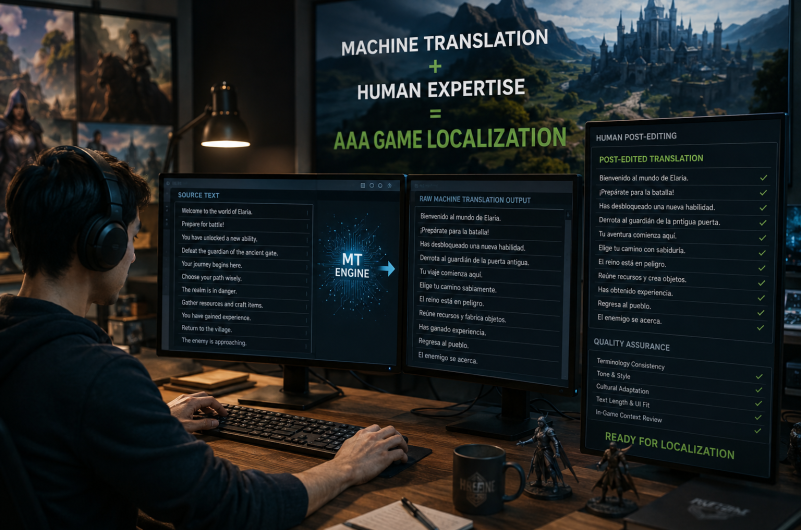
Machine Translation Post-Editing (MTPE) combines automated translation with human linguistic review.
The process generally works like this:
- The source content is processed through a Machine Translation engine.
- The system produces an initial translation.
- A qualified human linguist reviews the output.
- Errors, terminology, tone, grammar, and cultural issues are corrected.
- The final content is reviewed against project requirements and quality standards.
The important distinction is that MTPE is not the same as publishing raw Machine Translation.
Machine-generated text is only a starting point. Human post-editors remain responsible for determining whether the translated content actually works in context.
For game localization, that distinction is critical. A tooltip, inventory item, quest description, or menu label may be suitable for an efficient MTPE workflow. A character’s emotional monologue may require a completely different approach.
eTranslation Services already describes MTPE as a hybrid model that combines machine-generated translation with professional human review and terminology refinement.
Why Are AAA Studios Considering Machine Translation?
The biggest reason is scale.
Modern AAA games can contain enormous quantities of text across:
- Dialogue
- Quests
- Item descriptions
- Tutorials
- User interfaces
- Menus
- Achievement text
- System messages
- Character descriptions
- Subtitles
- DLC
- Live-service updates
- Patch notes
- Marketing materials
That content may need to be localized into numerous languages while the game is still being developed.
At the same time, source text often keeps changing. Developers may rewrite dialogue, change UI elements, add new quests, modify terminology, or introduce new features.
Traditional human translation remains essential, but translating every string from scratch can put significant pressure on schedules and budgets.
Machine Translation can help process high volumes quickly. Human post-editing can then focus linguistic expertise where it has the greatest impact.
The result can be a more scalable localization pipeline without treating automation as a substitute for professional localization.
Where Does MTPE Work Best in Game Localization?
The key is content segmentation.
Not every string in a game has the same linguistic risk or creative value.
1. System and UI Text
Standardized interface strings are often good candidates for MTPE.
Examples include:
- Settings menus
- Generic system messages
- Button labels
- Standard notifications
- Basic interface instructions
These strings usually have less creative context than narrative dialogue.
However, they still need human review because character limits, text expansion, terminology, and platform requirements can affect how the translation appears inside the game.
2. Item Descriptions and Repetitive Content
Large RPGs and live-service games can contain thousands of similar descriptions.
Machine Translation can provide a useful first draft, while human linguists ensure terminology and style remain consistent.
This becomes particularly valuable when the project uses an approved glossary and translation memory.
3. Patch Notes and Support Content
Patch notes, technical descriptions, and certain support materials can also benefit from an MTPE workflow.
These materials are often information-focused rather than emotionally driven.
Human review remains important, especially when technical terminology or gameplay instructions are involved.
4. Large Volumes of Lower-Risk Content
The strongest business case for MTPE appears when studios have high-volume content with relatively predictable language patterns.
Instead of asking whether Machine Translation should be used for the entire game, localization teams can determine which content can safely enter an automated workflow.
That approach reduces unnecessary risk.
Where Can Machine Translation Break Down?
The limitations become more obvious when language carries personality, emotion, or cultural meaning.
Narrative Dialogue
A character’s dialogue is rarely just a collection of words.
The translator needs to understand:
- Who is speaking?
- Who are they speaking to?
- What happened before the scene?
- What emotion is being expressed?
- Is the character serious, sarcastic, angry, nervous, or humorous?
- Does the character have a distinctive speech pattern?
- Does the line contain wordplay?
A Machine Translation engine may produce a grammatically acceptable sentence without understanding all of those creative requirements.
Humor and Wordplay
Humor presents another major challenge.
Puns, jokes, cultural references, slang, and double meanings often cannot be translated literally.
A human linguist may need to rewrite the line entirely while preserving its intended effect.
That is not simple post-editing. It is creative localization.
Character Voice
A villain should not suddenly sound like a tutorial narrator.
A teenage character, military commander, comic sidekick, and ancient king may all use completely different language patterns.
Maintaining those voices across thousands of lines requires context and linguistic judgment.
Cultural Adaptation
A phrase that works in one market may sound strange, offensive, confusing, or irrelevant in another.
Professional game localization therefore requires more than grammatical accuracy. Cultural context, audience expectations, and regional conventions also matter.
Is Machine Translation Ready for AAA Games?
Yes, but not as a blanket replacement for human localization.
MTPE is increasingly useful for AAA games when it is applied selectively.
A practical approach is to divide content into three categories.
| Content Type | Recommended Approach |
|---|---|
| Repetitive UI and system text | Machine Translation + Human Post-Editing |
| Moderate-context content | MTPE with intensive linguistic review |
| Narrative, humor, character voice | Human-led translation and creative adaptation |
This model allows studios to use automation where it provides measurable efficiency while protecting the content players experience most directly.
The question should therefore not be:
“Can Machine Translation translate an AAA game?”
The better question is:
“Which parts of an AAA game can benefit from Machine Translation without compromising the player experience?”
That change in thinking is what makes hybrid localization practical.
How Does MTPE Reduce Localization Costs?
Cost is one of the major reasons studios explore hybrid localization.
However, the lowest translation rate does not automatically produce the lowest total localization cost.
A poorly translated machine draft may require extensive rewriting. If linguists spend almost as much time correcting the output as they would have spent translating the content themselves, the expected savings can disappear.
The better approach is to measure total project efficiency.
Factors include:
- Translation volume
- Language count
- Content complexity
- Repetition
- Terminology consistency
- Required quality level
- Review requirements
- LQA requirements
- Turnaround time
- Number of revisions
- Post-launch updates
For suitable content, MTPE can reduce the amount of manual work required for the first draft. That can allow human linguists to spend more time on high-value linguistic decisions rather than repetitive translation.
What Does a Professional MTPE Workflow Look Like?
A reliable workflow involves more than running text through an MT engine.
Step 1: Analyze the Content
The localization team first determines what type of content is being translated.
Narrative dialogue, UI strings, technical text, and repetitive descriptions should not automatically receive the same treatment.
Step 2: Establish Terminology
A project glossary should identify important terms before large-scale translation begins.
This can include:
- Character names
- Locations
- Weapons
- Items
- Factions
- Gameplay mechanics
- Skills
- UI terminology
- Brand-specific language
Terminology consistency becomes particularly important in games with large fictional universes.
Step 3: Generate the Machine Translation
The appropriate Machine Translation workflow is then used to produce the initial draft.
The objective is not to assume the output is final. It is to create a usable starting point for qualified linguists.
Step 4: Human Post-Editing
Professional linguists review the output for accuracy, fluency, terminology, tone, context, and cultural appropriateness.
For complex content, this may involve substantial rewriting rather than simple error correction.
Step 5: Linguistic Quality Assurance
Translation quality and in-game functionality are different concerns.
LQA can identify problems such as:
- Text overflow
- Truncated strings
- Incorrect placeholders
- Missing translations
- Character encoding problems
- Incorrect line breaks
- Contextual errors
- Inconsistent terminology
A translation may look perfect in a spreadsheet and still fail once implemented in the game. This is why professional game localization combines linguistic expertise with testing inside the actual product.
Best Practices for Using MTPE in AAA Localization
Studios considering a hybrid model should follow several practical guidelines.
Do Not Use One Workflow for Everything
Content should be classified according to complexity and risk.
A quest objective and a major character monologue should not automatically go through the same localization pipeline.
Give Linguists Context
Screenshots, character profiles, gameplay references, glossaries, and previous dialogue can significantly improve translation decisions.
Context becomes even more important when Machine Translation is involved.
Maintain a Living Glossary
Game terminology changes throughout development.
The glossary should therefore be updated as new characters, mechanics, locations, and features are introduced.
Keep Human Review Accountable
Post-editing should not become a simple approval step.
The linguist must have the authority to rewrite machine-generated content when necessary.
Test Localized Text in the Game
Localization quality should be evaluated in the actual environment.
Text expansion, UI limitations, subtitle timing, and character encoding can all create problems that are invisible in a translation file.
Track Quality by Content Type
Studios should measure more than turnaround time.
Useful metrics include linguistic error rates, LQA defects, terminology consistency, rework volume, player feedback, and acceptance rates.
These measurements help determine whether MTPE is genuinely improving the localization pipeline.
Common MTPE Mistakes to Avoid
Treating Machine Translation as the Final Product
Raw Machine Translation should not automatically be considered production-ready game content.
Human review remains essential for quality-sensitive material.
Assuming Post-Editing Is Always Faster
Post-editing can be highly efficient when the machine output is strong and the content is suitable.
For creative dialogue, however, extensive rewriting can take as much effort as translating from scratch.
Ignoring Character Voice
A technically accurate translation can still damage a character if the voice changes between languages.
Localization teams should evaluate character personality as part of linguistic quality.
Choosing a Provider Based Only on Price
The cheapest per-word rate may not be the cheapest overall solution.
Studios should evaluate gaming experience, linguistic expertise, terminology management, LQA capabilities, scalability, communication, and ability to support changing development schedules.
Skipping LQA
Translation is not the final stage.
Localized content needs to be tested in the game to identify issues that cannot be detected during standard linguistic review.
How Should Studios Choose an MTPE Service Provider?
The right provider should understand both language and game development workflows.
Before selecting a localization partner, studios should ask:
- Does the provider have experience with game localization?
- Are linguists native speakers of the target language?
- Can the team handle gaming terminology?
- Can the provider support multiple languages at scale?
- How are glossaries and style guides managed?
- Is human post-editing performed by qualified linguists?
- Does the provider offer LQA?
- Can the team handle ongoing patches and DLC?
- How is confidential game content protected?
- Can the workflow be customized by content type?
These questions help studios distinguish between a generic translation service and a localization partner capable of supporting a complex game production pipeline.
The Future of Machine Translation in Game Localization
Machine Translation will continue to improve.
As language technology becomes better at understanding context, terminology, and specialized content, its role in localization will likely expand.
But better technology does not eliminate the need for human expertise.
Games are creative products. Their value comes from storytelling, character relationships, humor, emotion, world-building, and player immersion.
Those elements require judgment.
The future is therefore unlikely to be purely machine-driven or purely human-driven. Instead, successful localization teams will increasingly combine automation with human expertise based on the type, complexity, and risk of the content.
Frequently Asked Questions About Machine Translation for AAA Games
Is Machine Translation good enough for AAA games?
Machine Translation can be suitable for selected AAA game content, particularly repetitive or lower-context text. However, narrative dialogue, humor, character voice, and other creative content generally require substantial human involvement.
What is MTPE in game localization?
MTPE, or Machine Translation Post-Editing, is a workflow in which Machine Translation creates an initial draft and a human linguist reviews, corrects, and adapts the content before delivery.
Is MTPE cheaper than human translation?
It can be more cost-efficient for large volumes of suitable content, but savings depend on content complexity, translation quality, language pair, and the amount of human editing required.
Can Machine Translation preserve character voice?
Not reliably on its own. Character voice depends on context, personality, tone, relationships, and creative intent. Human linguists should review and, when necessary, rewrite character dialogue.
Should AAA studios use MTPE for all game content?
No. A content-based approach is generally safer. MTPE can be used for suitable high-volume content, while high-impact narrative and creative content should receive stronger human oversight.
Does MTPE replace game localization QA?
No. Translation and LQA perform different functions. LQA tests how localized content works inside the game, including visual, functional, contextual, and linguistic issues.
Conclusion: Machine Translation Works Best When Humans Stay in Control
Machine Translation is ready to play a role in AAA game localization, but it should not be treated as a universal replacement for professional linguists.
The strongest hybrid localization strategies use automation where it creates genuine efficiency and human expertise where language quality directly affects the player experience.
For AAA studios, that means analyzing content, establishing terminology, selecting the right workflow, applying human post-editing, and validating the final result through localization QA.
The goal is not simply to translate more words faster.
The goal is to launch a game that feels natural, consistent, culturally appropriate, and authentic in every supported market.
eTranslation Services can help studios build a customized game localization workflow that combines technology, qualified linguists, terminology management, and quality assurance according to the project’s content and production requirements.
For studios evaluating Machine Translation, MTPE, or a hybrid game localization strategy, contacting an experienced localization provider early can help identify where automation can reduce cost and turnaround time—and where human expertise remains essential.
Request a customized localization quote from eTranslation Services and build a scalable localization strategy around the content that matters most to players.