Game localization accessibility has become an important part of creating an inclusive global gaming experience. For Deaf and hard-of-hearing players, subtitles and captions can determine whether they understand the story, follow important dialogue, or even recognize an audio cue that affects gameplay.
However, translating subtitles is only one part of the process. A caption that works perfectly in English may become too long, poorly timed, difficult to read, or incorrectly formatted after localization. Different languages also use different scripts, character lengths, sentence structures, and reading patterns.
That is why accessible game localization must bring accessibility, translation, subtitle design, and in-game testing together. Studios that plan these requirements early can reduce rework while delivering a better experience across international markets.
What Is Game Localization Accessibility?
Game localization accessibility is the process of adapting a game’s localized content and user experience so players with disabilities can access and understand the game in their target language.
For Deaf and hard-of-hearing players, this often includes localized subtitles, closed captions, speaker identification, sound-effect descriptions, visual audio indicators, and customizable caption settings.
The goal is not simply to translate dialogue. The goal is to make the information carried by audio available through another visual channel.
W3C defines captions as synchronized alternatives that communicate both spoken dialogue and relevant non-speech audio, such as sound effects, music, speaker identification, and other meaningful audio information.
In games, this distinction matters because audio frequently communicates information that affects more than the storyline.
A footstep can warn a player that an enemy is approaching. A weapon reload can signal that an opponent is temporarily vulnerable. A radio transmission can provide a mission objective. Background music can signal danger or a change in the game environment.
If that information exists only in audio, some players may miss it.
Subtitles vs. Captions: What Is the Difference?
One of the most important questions in accessible game localization is whether a game needs subtitles or captions.
Subtitles generally communicate spoken dialogue. Captions communicate dialogue plus important audio information that a player needs to understand the experience.
For example:
Subtitle:
“Get down!”
Caption:
“[Explosion]”
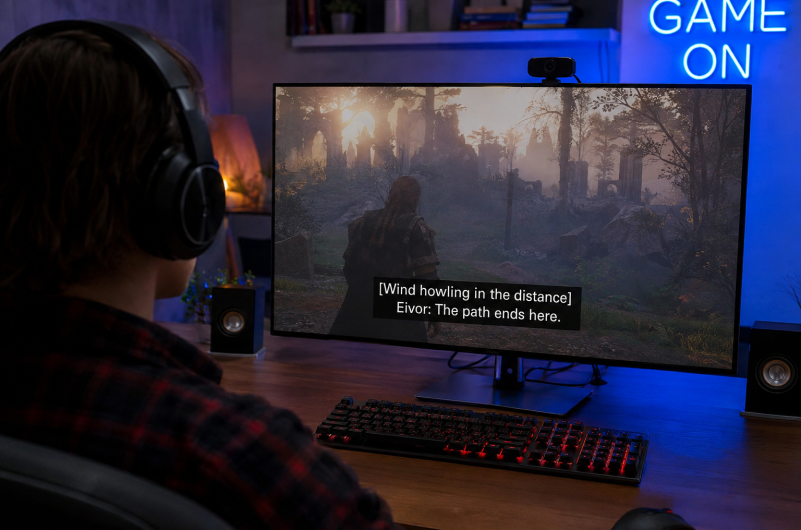
Captain Reyes: “Get down!”
[Heavy footsteps approaching from behind]
The second approach gives the player information that would otherwise come through sound.
Microsoft’s Xbox Accessibility Guidelines specifically recommend providing text equivalents for speech as well as important audio information, including sound effects and audio cues that may affect gameplay.
For games designed for Deaf and hard-of-hearing players, captions should therefore be treated as a functional accessibility feature rather than simply translated dialogue.
Why Game Localization Accessibility Matters
A game can have excellent translations and still provide a poor localized accessibility experience.
This happens when the localization process focuses on dialogue while overlooking the rest of the game’s audio design.
A player may understand every translated conversation but still miss:
- An enemy approaching from outside the screen
- A character speaking through a radio
- A warning siren
- A weapon being reloaded
- A door opening behind the player
- Important background dialogue
- A musical cue that signals danger
- A sound indicating that an objective has changed
Game Accessibility Guidelines recommend ensuring that important information communicated through audio is also represented through text or visual information. They also recommend customizable captions, speaker identification, and captions for significant background sounds.
For developers targeting multiple countries, the challenge becomes even greater because every one of these elements must work in every supported language.
How Localization Changes Subtitle Design
A subtitle system that was designed around English cannot automatically be assumed to work in every language.
1. Text Expansion Can Break Captions
Translations do not always occupy the same amount of screen space.
A short English sentence may become substantially longer in another language. If the interface has limited space, the translated caption may wrap onto additional lines, overlap other interface elements, or become difficult to read.
This can also affect timing.
A line that players could comfortably read in English may require more time in the localized version. If the original timing remains unchanged, the translated caption may disappear before the player finishes reading it.
2. Reading Speed Can Affect Timing
Subtitle timing should consider how much text appears and how quickly players are expected to read it.
Localization teams should therefore review timing after translation rather than assuming that source-language timing can simply be reused.
This is particularly important during rapid dialogue, combat sequences, cutscenes, and scenes containing multiple speakers.
3. Different Scripts Need Different Treatment
Games can contain Latin, Cyrillic, Greek, Arabic, CJK, and other writing systems.
Font selection becomes especially important when a title supports many languages. A font that works well for English may not provide complete or attractive support for another script.
Poor font support can lead to missing characters, inconsistent visual weight, awkward line breaks, or reduced readability.
4. Sound Descriptions Must Also Be Localized
Sound descriptions are not disposable technical text.
A phrase such as “[distant explosion]” needs to communicate the same meaning naturally in the target language. Automatic translation can produce literal wording that sounds unnatural or fails to communicate the intended game context.
This is why accessibility localization requires linguistic expertise as well as knowledge of game mechanics and audio context.
What Should Accessible Game Captions Include?
A strong captioning system should communicate the audio information that is important to understanding or playing the game.
Depending on the title, this can include:
Dialogue
All important spoken dialogue should be available as readable text.
This includes cinematic dialogue, NPC conversations, radio communications, tutorials, mission instructions, and other speech that carries meaningful information.
Speaker Identification
Players should be able to determine who is speaking, particularly when several characters are talking or when a speaker is off-screen.
Microsoft recommends identifying speakers and, where useful, providing additional visual information about where the voice originates.
Important Sound Effects
Meaningful sounds should be represented when they provide information that cannot otherwise be understood.
Examples include:
“[Door opens]”
“[Enemy reloading]”
“[Alarm sounds]”
“[Footsteps approaching]”
The description should be useful rather than overly detailed. Section 508 guidance similarly recommends identifying meaningful sound effects and background audio rather than captioning every insignificant noise.
Music and Environmental Audio
Music does not always need to be described, but it can matter when it communicates important information.
For example, “[dramatic music begins]” may be useful if the music signals a major gameplay event or story transition.
Directional Information
Some games use positional audio as part of gameplay.
If an enemy is approaching from the left or a character is speaking from a radio behind the player, the caption system should provide an equivalent visual indication when that information matters.
Best Practices for Accessible Subtitle Localization
Successful game localization accessibility begins before translation starts.
Design for Localization From the Beginning
Localization should be considered during subtitle system development rather than after the English version has been completed.
The interface should allow for longer translations, different scripts, multiple lines, speaker names, and sound descriptions.
This reduces the risk of expensive engineering changes later.
Allow Caption Customization
Accessibility needs vary from player to player.
Useful options can include:
- Caption size
- Text color
- Background opacity
- Caption background
- Speaker identification
- Caption positioning
- On/off controls
Microsoft’s accessibility guidance recommends readable fonts, adequate size, strong contrast, and customizable presentation options.
Keep Captions Readable
Small text and poor contrast can make an otherwise accurate translation unusable.
Captions should remain readable against different environments, including bright outdoor scenes, dark interiors, fast-moving action, and visually complex backgrounds.
A background panel, outline, shadow, or other visual treatment can improve legibility.
Localize the Entire Caption Layer
The localization scope should include more than dialogue.
Speaker names, sound descriptions, interface labels, accessibility settings, and other caption-related content should be reviewed as part of the localization process.
Test in Actual Gameplay
This is one of the most important steps.
A translation may look correct in a spreadsheet or translation management system and still fail inside the game.
In-game testing can reveal:
- Text clipping
- Overlapping UI
- Poor line breaks
- Incorrect timing
- Missing characters
- Unsupported fonts
- Incorrect speaker names
- Truncated sound descriptions
- Captions appearing too early or too late
- Captions disappearing too quickly
This is where linguistic QA and functional LQA become valuable.
Common Accessibility Localization Mistakes
Several problems repeatedly appear when accessibility is added too late.
Translating Dialogue but Ignoring Sound
A game may have perfectly translated dialogue but provide no captions for important sound effects.
That creates an accessibility gap.
Reusing English Timing for Every Language
Source-language timing can become unsuitable after translation. Longer text may need additional screen time.
Testing Only Strings
A localization review that checks text outside the game cannot identify every visual or timing problem.
Using Color as the Only Speaker Indicator
Color can help distinguish speakers, but it should not be the only method because players may have difficulty distinguishing certain colors.
Game Accessibility Guidelines recommend combining color with another identification method, such as speaker names or positional indicators.
Relying Entirely on Machine Translation
AI and machine translation can assist with workflows, but accessibility content requires contextual review.
A literal translation of a sound effect may be grammatically acceptable while still sounding unnatural or failing to communicate what is happening in the game.
Adding Accessibility at the End
Retrofitting captions after localization has already been completed often increases cost and creates avoidable production pressure.
A better approach integrates accessibility requirements into the game’s localization pipeline from the start.
How Professional Game Localization Services Help
Professional game localization providers can help studios manage the linguistic and technical complexity of multilingual accessibility.
A strong process typically combines native-language translators, localization specialists, subtitle expertise, and in-game QA.
The workflow may include:
Content analysis → subtitle preparation → translation → linguistic review → implementation → multilingual LQA → accessibility review → final corrections
The most important advantage is context.
Translators and QA testers need to understand what a line means inside the game, who is speaking, what sound is being described, and whether that information affects gameplay.
That context helps prevent technically correct translations from becoming poor player experiences.
For studios preparing a major global launch, multilingual testing can also identify problems before players encounter them in the market.
Which Games Benefit Most From Accessible Localization?
Game localization accessibility can benefit virtually any title containing meaningful audio, but it becomes particularly important for:
Action and Shooter Games
Audio can provide critical information about enemies, weapons, footsteps, reloads, and incoming attacks.
RPGs and Story-Driven Games
Dialogue, character identity, environmental sounds, and cinematic audio often carry important narrative information.
Horror Games
Sound is frequently a core gameplay mechanic. Captions can communicate environmental and directional information that would otherwise be unavailable.
Multiplayer Games
Players may need visual indicators for voice communications, important alerts, and other audio information during fast-paced gameplay.
Adventure and Open-World Games
Environmental sounds and NPC dialogue can provide clues, objectives, warnings, and world-building information.
A Practical Accessibility Localization Checklist
Before release, development and localization teams should ask:
- Are all important spoken lines captioned?
- Are meaningful sound effects represented?
- Are speakers clearly identified?
- Are important directional audio cues represented visually?
- Can players customize caption size and appearance?
- Does the font support every target language?
- Has text expansion been tested?
- Has caption timing been reviewed for each language?
- Are sound descriptions natural in every target language?
- Have captions been tested during actual gameplay?
- Have accessibility and localization QA teams reviewed the final implementation?
If several answers are “no,” the game may still have accessibility gaps even if its basic subtitle system is working.
Why the Right Localization Partner Matters
Accessible localization requires more than language fluency.
The provider should understand game terminology, subtitle conventions, accessibility requirements, localization workflows, and in-game QA.
It should also have processes for managing large volumes of multilingual content while maintaining consistency across dialogue, UI, captions, and sound descriptions.
For studios, the right partner can reduce rework, identify problems earlier, and help create a more consistent experience across international releases.
The objective is not simply to make translated text fit inside a box.
It is to make sure the player receives the same meaningful information regardless of language or hearing ability.
The Future of Game Localization Accessibility
Accessibility and localization have traditionally been treated as separate production areas. That approach is changing.
Modern games are increasingly designed for global audiences from the beginning, and accessibility is becoming part of that design conversation.
W3C guidance recognizes captions as a way to provide Deaf and hard-of-hearing users with access to both speech and relevant non-speech audio. Meanwhile, game-specific accessibility guidance increasingly emphasizes caption customization, speaker identification, and visual alternatives for important audio information.
As games become more cinematic, connected, and multilingual, these requirements will become even more important.
Studios that build accessibility into the localization pipeline early will be better positioned to deliver consistent experiences across regions rather than fixing accessibility problems after launch.
Accessibility Should Be Part of Localization, Not an Afterthought
Game localization accessibility is ultimately about making sure players do not lose important information simply because they experience a game differently.
For Deaf and hard-of-hearing players, effective captions can provide access to dialogue, sound effects, speaker identity, environmental information, and gameplay cues. For global releases, those captions must also survive translation, text expansion, different scripts, timing changes, and platform-specific requirements.
The strongest approach combines accessible subtitle design, professional translation, localization engineering, linguistic review, and multilingual LQA.
For game studios preparing a global launch, eTranslation Services can help with multilingual game localization and quality-focused language support designed around the needs of international players. Teams can request a quote or discuss their game’s localization and accessibility requirements to develop a solution that supports quality, consistency, and a better player experience across markets.