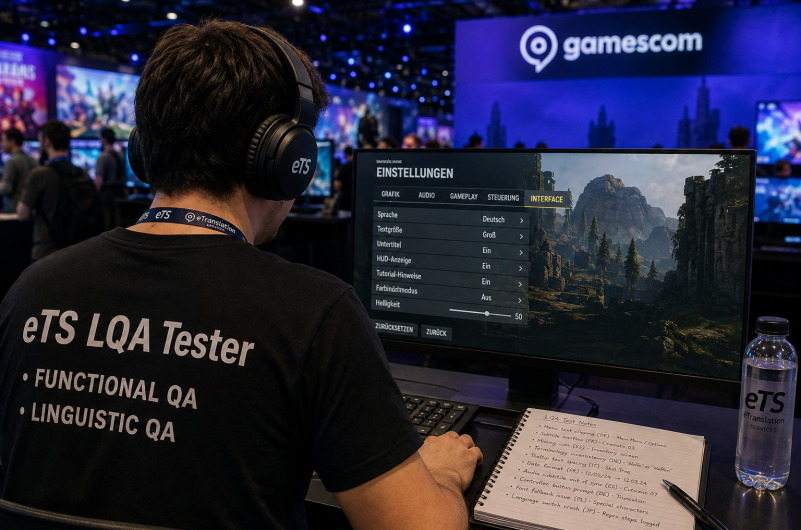
A playable game demo can look polished, run smoothly, and still reveal serious localization problems within minutes of reaching a live audience. That is why LQA (Localization Quality Assurance) has become an important part of preparing games for international markets.
At an event such as Gamescom, localized builds are exposed to real players, different hardware configurations, multiple languages, and unpredictable gameplay behavior. A translation that looked correct during development may suddenly overflow a menu, break a UI element, use inconsistent terminology, or sound unnatural to a native player.
The challenge is that these problems do not all belong to the same category. Functional LQA checks whether the localized game works correctly. Linguistic QA checks whether the language is accurate, natural, consistent, and appropriate for the target market.
Both are essential. A game needs technically stable localization and language that feels native before it is ready for a global audience.
What Is LQA in Game Localization?
LQA, or Localization Quality Assurance, is the testing process used to identify problems in a localized game before players encounter them.
Unlike a simple translation review, professional LQA examines the localized game in its actual environment. Testers look at translated text, menus, subtitles, dialogue, character names, UI elements, audio, formatting, cultural references, and language-specific behavior.
This distinction matters because translation quality cannot always be judged from a spreadsheet or translation management system. A sentence may be accurate in isolation but incorrect when displayed inside a button, subtitle box, quest window, or dialogue sequence.
Likewise, a technically correct translation can still feel unnatural when spoken by a character.
Professional LQA connects the translated content with the way players actually experience the game.
Functional LQA vs. Linguistic QA: What Is the Difference?
Functional and linguistic LQA have the same overall objective—delivering a high-quality localized game—but they focus on different types of problems.
What Does Functional LQA Check?
Functional LQA focuses on whether the localized version works properly from a technical and gameplay perspective.
A functional tester may check:
- Text truncation and UI overflow
- Missing or incorrectly displayed characters
- Font and encoding problems
- Broken menus and buttons
- Incorrect language selection
- Language-switching behavior
- Date, time, number, and currency formats
- Subtitles and text synchronization
- Incorrect localized assets
- Text appearing in the wrong location
- Crashes caused by localized content
- Incorrect regional settings
- Controller, platform, or hardware-specific issues
For example, English text may fit comfortably inside a button while the German translation requires significantly more space. If the interface was not designed to accommodate text expansion, the translation may be cut off or overlap another element.
The translation itself may be completely correct. The localization is still defective.
What Does Linguistic LQA Check?
Linguistic LQA focuses on the quality of the language and the player’s cultural experience.
Native-language testers review issues such as:
- Translation accuracy
- Grammar and spelling
- Natural phrasing
- Terminology consistency
- Character voice
- Tone and style
- Contextual meaning
- Cultural appropriateness
- Humor and wordplay
- Offensive or inappropriate wording
- Gender and formality
- Dialogue continuity
- Consistency with the game’s glossary and style guide
This type of review requires more than knowing two languages. Testers need to understand the target market, the game context, and how language is actually used by players.
A sentence can be grammatically correct and still sound like something no native speaker would say.
That is why functional LQA and linguistic QA should not be treated as interchangeable services.
Why Gamescom Playable Demos Are a Localization Stress Test
A Gamescom demo creates an unusual testing environment.
In a controlled development environment, testers generally follow defined test cases. A public demo is different. Players may select unexpected options, skip dialogue, change settings, repeat actions, or explore areas that developers did not expect them to reach.
The current article correctly identifies this uncontrolled environment as one of the main reasons a show-floor demo can expose localization weaknesses that internal testing has missed.
Several factors make public demos particularly demanding.
Real Players Do Not Follow Test Scripts
Professional testers follow structured test cases. Event attendees do not.
A player may rapidly click through menus, switch languages, revisit screens, trigger optional dialogue, or interact with the game in an unexpected sequence.
These behaviors can reveal bugs that scripted testing never encountered.
Multiple Languages Are on Public Display
A Gamescom demo can place several localized versions directly in front of native speakers.
That creates an immediate quality test.
A player who notices an awkward German sentence, incorrect French terminology, broken Japanese characters, or an unnatural Spanish expression does not need to understand the development pipeline. The problem simply looks like a poorly localized game.
For studios preparing a global launch, that perception can matter.
Hardware Can Change the Result
Localization issues are not always visible on the developer’s primary test setup.
Different monitors, resolutions, aspect ratios, operating-system settings, and platform configurations can affect how localized content appears.
A subtitle that fits perfectly on one display may clip on another. A font that supports one language may fail to display another language’s characters correctly.
Functional LQA should therefore test the actual build and, where possible, the hardware configuration intended for the event.
The Demo May Be the First Public Exposure
A show-floor build often becomes one of the first opportunities for players and industry professionals to experience the localized game.
By this stage, obvious errors should already have been removed.
If they have not, the demo can expose unfinished localization at exactly the wrong moment.
What Can Go Wrong Even When a Game Has Passed QA?
One of the most important LQA lessons is that a game can pass one type of quality check and fail another.
Consider a few realistic scenarios.
A translated menu has been reviewed by the localization team. The wording is accurate, but the text is too long for the button and gets cut off.
A subtitle fits correctly within the interface, but the translation uses a phrase that sounds unnatural to native players.
A language has been translated and approved, but a new build accidentally contains older untranslated strings.
A Japanese font displays correctly in one menu but produces missing characters in another.
A game has consistent terminology in the main storyline, but an update introduces an older translation in an optional quest.
None of these problems should be dismissed as minor details. Small localization defects can affect player confidence, brand perception, reviews, and the overall impression of a game.
Common LQA Challenges for Game Developers
Tight Development Deadlines
Localization frequently happens while other parts of development are still changing.
New strings may continue to arrive. UI elements may be redesigned. Dialogue may be rewritten. Features may be added shortly before an event.
This creates a moving target for LQA teams.
A strong process therefore needs version control, clear build identification, issue tracking, and communication between developers, localization teams, and testers.
Limited Context
Translators do their best work when they understand how a line will be used.
A short phrase such as “Charge,” “Save,” “Return,” or “Attack” can have different meanings depending on the screen and gameplay context.
Providing screenshots, character information, string context, and gameplay access helps translators and linguistic testers make better decisions.
Text Expansion
Some languages require considerably more space than English.
This can affect:
- Buttons
- Menus
- Character creation screens
- Tutorials
- Subtitles
- Notifications
- Inventory screens
- Quest descriptions
UI design should account for localization from the beginning rather than treating text expansion as a late-stage problem.
Terminology Inconsistency
Games often contain hundreds or thousands of recurring terms.
Character names, locations, abilities, items, factions, weapons, skills, and interface elements need to remain consistent.
A professional localization workflow should use approved glossaries and terminology databases where appropriate. Linguistic LQA can then verify that those decisions remain consistent throughout the playable build.
How Professional LQA Services Solve These Problems
A professional LQA provider does more than identify errors. The goal is to create a repeatable quality process that helps development teams understand, prioritize, and resolve localization issues.
A typical professional workflow can include several stages.
1. Build Preparation
The provider receives the appropriate localized build, target languages, test instructions, reference materials, and known limitations.
Clear build information is essential because testing the wrong version can create unnecessary reports or cause valid issues to be missed.
2. Functional Testing
Testers run the game through defined paths while checking localized UI, text rendering, functionality, language settings, formatting, and other technical elements.
Issues are documented with enough information for developers to reproduce them.
3. Linguistic Testing
Native-speaking testers review the actual game experience.
They evaluate translation accuracy, grammar, tone, terminology, cultural suitability, and contextual meaning.
4. Bug Reporting and Classification
Good LQA reports are actionable.
A useful report should explain what happened, where it happened, how to reproduce it, the expected result, and the actual result. Screenshots or video evidence can also help development teams resolve problems faster.
5. Retesting
After corrections are implemented, the affected areas should be tested again.
This step is important because a fix can sometimes create another problem elsewhere.
Professional LQA therefore works as a continuous quality loop rather than a one-time inspection.
Key Benefits of Professional Game LQA
The value of LQA goes beyond finding spelling mistakes.
Better Player Experience
Players should be able to understand menus, dialogue, instructions, quests, and other content without being distracted by localization errors.
Reduced Launch Risk
Finding localization bugs before release gives development teams time to correct them.
The earlier a serious issue is discovered, the more options the team generally has to address it.
Stronger Global Brand Perception
Players often judge a game by its details.
Consistent terminology, natural dialogue, correctly displayed text, and culturally appropriate content can make a localized game feel intentionally designed for its market rather than simply translated into another language.
More Efficient Localization Management
A structured LQA process creates clearer feedback between developers, translators, localization managers, and publishers.
This can reduce repeated issues and make future builds easier to test.
Better Readiness for Public Events
For Gamescom and other major gaming events, LQA helps studios approach the show floor with greater confidence.
The objective is not perfection at any cost. It is to identify the problems that could have the greatest effect on players and address them before public exposure.
Which Industries and Game Types Benefit From LQA?
LQA is relevant across virtually every segment of the gaming industry.
AAA publishers often need large-scale testing across multiple platforms and languages. Independent studios may need targeted testing for a smaller number of high-priority markets.
LQA is also valuable for:
- Console games
- PC games
- Mobile games
- Multiplayer titles
- RPGs
- Action games
- Strategy games
- Simulation games
- Educational games
- VR and AR experiences
- Live-service games
- Game demos and beta releases
The testing approach should be adapted to the game’s technology, audience, platforms, languages, and release schedule.
An RPG with extensive dialogue requires different linguistic testing priorities than a mobile game dominated by short UI strings.
Best Practices for LQA Before Gamescom
Studios preparing a playable demo can reduce risk by treating the event as a launch rehearsal.
Test the Actual Demo Build
Do not rely solely on testing completed weeks earlier.
The exact build going to the show should receive a final localization review.
Test Every Language That Will Be Publicly Available
If a language appears in the demo menu, it should be ready for public use.
Half-completed translations should not be exposed simply because the language option exists in the development build.
Test on the Intended Hardware
Use the same or comparable display resolutions, platforms, controllers, and settings whenever possible.
Combine Functional and Linguistic Testing
A technically correct build can still have poor language quality. Excellent translation can still be broken by the interface.
Both forms of LQA need to work together.
Prioritize High-Visibility Content
Menus, opening sequences, character introductions, subtitles, tutorials, promotional dialogue, and other frequently viewed content deserve particular attention before a public event.
Keep the Bug-Reporting Process Clear
Developers should know how issues will be reported, prioritized, assigned, fixed, and retested.
A clear workflow reduces delays when the event deadline is approaching.
Common LQA Mistakes to Avoid
Treating Translation Review as LQA
Translation review and LQA overlap, but they are not identical.
A document can be perfectly translated while the game itself contains UI, rendering, formatting, or integration problems.
Testing Only in English
English may be the development language, but localization issues often appear only after content is translated.
Testing should reflect the actual target languages and markets.
Waiting Until the Final Release
Late testing leaves less time to correct problems.
LQA should be integrated into the localization process rather than being treated as a final emergency check.
Ignoring Context
Reviewing strings without seeing how they appear in the game can lead to incorrect linguistic decisions.
Whenever possible, testers should review language in context.
Choosing a Provider Based Only on Price
Cost matters, especially when multiple languages and platforms are involved. However, the lowest quoted price does not necessarily represent the lowest total cost.
Poor testing can allow defects into later stages, where corrections may require additional development, localization, certification, or release-management work.
The better approach is to compare the provider’s testing methodology, language coverage, reporting process, experience, turnaround times, and quality standards alongside cost.
How to Choose the Right LQA Service Provider
The right provider should fit the project’s technical and linguistic requirements.
Before selecting a professional service provider, game studios should consider:
Language expertise: Does the provider have qualified native-speaking testers for the target markets?
Gaming experience: Does the team understand game terminology, UI behavior, dialogue, gameplay, and platform requirements?
Testing coverage: Can the provider handle both functional and linguistic LQA?
Reporting: Are bugs documented clearly enough for developers to reproduce and fix?
Scalability: Can the provider support multiple languages and builds when the project expands?
Turnaround: Can testing fit the game’s production and event schedule?
Communication: Is there a clear process for handling urgent issues and retesting fixes?
These questions help studios evaluate the actual service rather than relying on broad claims about translation quality.
Why LQA Matters Beyond Gamescom
Gamescom is an excellent example of why localization quality needs to be tested in realistic conditions, but the principle extends far beyond one event.
The same issues can affect a game’s beta release, certification process, soft launch, regional launch, or global release.
A public demo simply makes those problems easier to see.
The current version of the article correctly describes a Gamescom demo as an early preview of the scrutiny a localized game can face at launch. That makes the event more than a marketing opportunity. It can also function as a valuable localization readiness test.
Studios that identify problems early have more time to improve the player experience before the game reaches a much larger audience.
LQA Is a Quality Process, Not Just a Final Check
The strongest localization programs do not treat LQA as a box to tick immediately before release.
Instead, LQA supports the broader localization process by connecting translation, game development, testing, and player experience.
Functional testing confirms that the localized game works.
Linguistic testing confirms that the localized experience feels right.
Neither replaces the other.
For developers preparing a Gamescom demo or planning a multilingual game launch, this distinction can make the difference between discovering localization problems internally and having players discover them first.
Get Professional Game LQA Support for Global Releases
A successful global game launch requires more than translating strings. It requires making sure the localized game works correctly and communicates naturally in every target market.
eTranslation Services provides professional game localization and LQA solutions designed to help studios identify functional, linguistic, and contextual issues before they reach players. The company works with qualified language professionals and supports localization across more than 200 languages, providing scalable solutions for studios preparing demos, launches, and international releases.
For teams preparing a Gamescom demo, beta, or global launch, professional LQA can provide an additional layer of quality control when schedules are tight and public exposure is high.
Instead of waiting for players to report localization problems, studios can identify and resolve them before release.
Explore eTranslation Services Game Localization Services
For a project-specific assessment, studios can also request a quote based on the game’s languages, platforms, build requirements, testing scope, and release timeline.