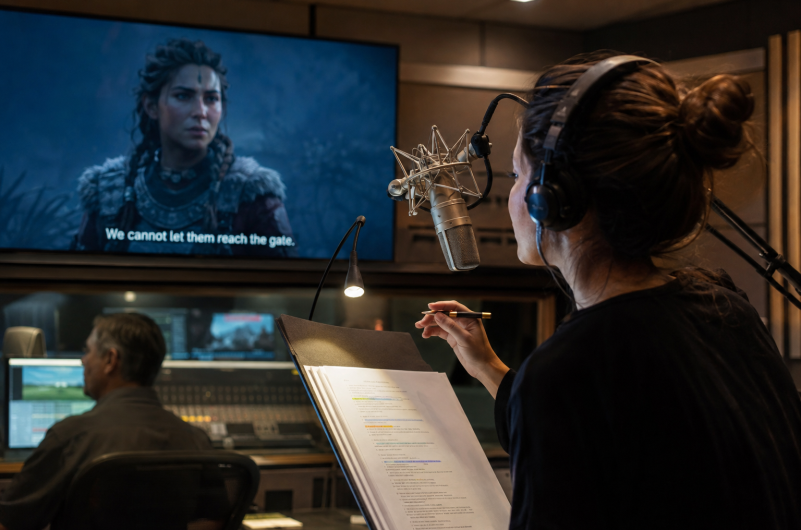
For years, game dubbing was often treated as a straightforward translation task followed by a recording session. A translated script was handed to an actor, the lines were recorded, and the localized audio was delivered. Technically, the words might have been correct, but the performance could still feel disconnected from the character, scene, or original creative intent.
That approach is changing.
Modern dubbing has become much more than translating dialogue into another language. Professional voice direction now focuses on preserving character, emotion, timing, humor, personality, and narrative intent across cultures. Instead of simply asking whether an actor delivered the translated words correctly, localization teams are asking a more important question: Does the performance feel natural and convincing to players in the target language?
This shift matters for game developers, publishers, and producers preparing titles for global markets. Players expect localized experiences to feel intentional, not like an English performance that has simply been reproduced in another language.
What Is Dubbing in Game Localization?
Dubbing is the process of replacing a game’s original spoken dialogue with professionally recorded dialogue in another language.
Unlike subtitles, which allow players to hear the original performance while reading translated text, dubbing recreates the spoken performance for the target audience. This requires more than linguistic accuracy.
A professional dubbing process may involve:
- Translation and script adaptation
- Character and terminology review
- Voice casting
- Dubbing direction
- Voice recording
- Timing and synchronization
- Audio editing
- Linguistic quality assurance
- Performance review
- Final audio integration and testing
The goal is not to reproduce every word mechanically. The goal is to recreate the intended player experience in another language.
That distinction has become increasingly important as games have become more cinematic, character-driven, and globally distributed.
Why Is Dubbing Becoming More Important for Global Games?
Players increasingly expect localized games to feel native to their market. A technically accurate translation can still fail if the dialogue sounds unnatural, the humor does not work, or a character suddenly feels different in another language.
Dubbing can help remove that barrier by allowing players to experience dialogue directly in their preferred language.
It can also improve accessibility and immersion. Players may be more comfortable listening to dialogue than reading subtitles while simultaneously navigating gameplay, combat, menus, or cinematic sequences.
For narrative-heavy games, voice performance can be especially important. Characters are not defined only by what they say. Their personality can also come through in pacing, hesitation, volume, emotion, sarcasm, fear, confidence, and silence.
A localization strategy that preserves only the words can therefore lose much of the character.
How Has Voice Direction for Dubbing Changed?
The biggest change is a move from translation fidelity toward performance fidelity.
Traditional workflows often placed considerable emphasis on reproducing the source script accurately. Modern voice direction still values linguistic accuracy, but it also considers what the line is supposed to accomplish.
A threatening line should sound threatening. A joke should feel funny. A vulnerable moment should carry emotional weight. A confident character should still sound confident after localization.
This means the target-language performance may not always follow the source sentence word for word.
The meaning remains important, but the way that meaning is communicated may need to change.
From Reading Lines to Performing Characters
Actors perform characters, not isolated sentences.
A professional dubbing director therefore needs to understand the character’s background, relationships, motivations, personality, and emotional state before directing a session.
Consider a character who says a short sentence after losing a close friend. The same translated words could be delivered with anger, disbelief, sadness, or emotional restraint.
All four performances may technically contain the correct translation.
Only one may fit the scene.
That is why context has become such an important part of modern dubbing workflows.
What Does a Dubbing Director Actually Do?
A dubbing director serves as a bridge between the original creative performance and the target-language version.
The role involves much more than supervising a recording booth.
A director may need to:
- Study the original performance and scene context
- Understand character motivations and relationships
- Guide actors on emotion, pacing, and delivery
- Resolve ambiguous lines or cultural references
- Work with translators and script adapters
- Determine when a literal translation does not work
- Maintain character consistency throughout the game
- Help actors interpret difficult scenes
- Review recordings for performance quality
- Coordinate with localization and production teams
This requires linguistic awareness as well as creative judgment.
The director must understand what the original line means while also recognizing how that meaning should be expressed naturally in another culture.
Why Literal Translation Does Not Always Work in Dubbing
Literal translation can preserve words while losing intent.
Humor is one of the clearest examples. A joke that works perfectly in English may depend on wordplay, cultural references, rhythm, or pronunciation. Translating the individual words may produce a sentence that is accurate but not funny.
The same problem can occur with sarcasm, idioms, insults, emotional expressions, and character-specific speech patterns.
Professional script adaptation gives the localization team room to reshape dialogue while protecting the original meaning and character.
The objective is not to change the story.
It is to make the story work naturally for the new audience.
Casting for Character Instead of Voice Similarity
Casting is another area where dubbing has evolved.
A common instinct is to find an actor whose voice sounds as close as possible to the original performer. While voice similarity can sometimes be useful, it should not automatically be the deciding factor.
The stronger question is:
Can this actor convincingly become the character in the target language?
A successful localized performance depends on personality, emotional range, timing, pronunciation, acting ability, and cultural authenticity.
An actor may sound completely different from the original performer while delivering a much more convincing interpretation of the character.
This is particularly important when a game contains large casts, complex character relationships, or distinctive regional personalities.
The Importance of Context in Professional Dubbing
One of the biggest challenges in game localization is that actors cannot always understand a scene from a line of text alone.
A short sentence can have completely different meanings depending on who says it, who hears it, what happened immediately before it, and what happens afterward.
For that reason, professional dubbing workflows should provide actors and directors with useful reference material whenever possible.
This may include:
- Original audio
- Video references
- Character descriptions
- Scene descriptions
- Gameplay context
- Pronunciation guides
- Glossaries
- Character relationships
- Emotional direction
- Previous recorded lines
Better context reduces guesswork.
It also helps create greater consistency across a large localization project.
How Technology Is Changing the Dubbing Process
Technology has made global dubbing workflows more distributed and flexible.
Voice talent, directors, translators, audio engineers, and localization teams may now work across different studios, countries, and time zones. Remote recording can expand access to specialized talent, but it also introduces coordination challenges.
Clear documentation becomes essential.
Teams need reliable scripts, terminology references, audio specifications, pronunciation guidance, file naming conventions, performance notes, and review processes.
Technology can make recording faster, but it does not remove the need for human creative judgment.
Automation, speech technology, and AI-assisted tools can support parts of the localization workflow. However, character performance, cultural interpretation, emotional direction, and final quality decisions still require careful human oversight when the goal is a polished player experience.
What Are the Biggest Dubbing Challenges?
Several challenges can affect the quality, cost, and schedule of a game dubbing project.
1. Limited Context
Actors may receive lines without enough information about the scene or character.
Solution: Provide reference material and detailed character and scene notes.
2. Literal Script Adaptation
A translation may be linguistically correct but difficult to perform naturally.
Solution: Include professional adaptation before recording and allow reasonable adjustments during direction.
3. Poor Casting
A recognizable voice does not necessarily mean a suitable character performance.
Solution: Cast according to character, acting ability, language, cultural fit, and emotional range.
4. Inconsistent Characterization
A character may sound confident in one scene and uncertain in another without a narrative reason.
Solution: Maintain character profiles, voice references, terminology, and direction notes throughout production.
5. Compressed Production Schedules
Late localization can leave little time for recording, review, corrections, and integration.
Solution: Build dubbing into the localization schedule early rather than treating it as a final production task.
6. Insufficient Quality Assurance
A recording can sound good in isolation but fail when integrated into the game.
Solution: Combine linguistic review, audio QA, functional testing, and in-context performance checks.
What Are the Benefits of Professional Dubbing?
When handled correctly, dubbing can provide several business and player-experience benefits.
Stronger Player Immersion
Natural dialogue helps players remain inside the story instead of being reminded that they are experiencing a translated product.
Better Character Connection
Strong voice performances preserve personality and emotional identity across languages.
Improved Accessibility
Players who prefer listening to dialogue in their own language can engage with the game without depending entirely on subtitles.
Greater Market Appeal
A polished localized voice experience can make a game more attractive to audiences in important international markets.
More Consistent Brand Experience
For major publishers and established franchises, consistent voice direction helps maintain character and brand identity across regions.
Reduced Localization Risk
Early planning, experienced direction, and structured quality control can reduce costly re-recording, script revisions, and late-stage corrections.
Which Industries and Content Types Use Dubbing?
Although gaming is a major application, professional dubbing is used across many forms of content.
These include:
- Video games and interactive entertainment
- Animated films and series
- Television and streaming content
- E-learning and training
- Corporate videos
- Product demonstrations
- Advertising and promotional campaigns
- Mobile applications
- Educational content
The requirements differ by project.
A role-playing game may require extensive character development and emotional direction. A corporate training program may prioritize clarity, terminology, and consistency. An animated production may require precise synchronization and highly expressive performances.
The right workflow depends on the content, audience, language, platform, and business objective.
Best Practices for a Successful Dubbing Project
A strong dubbing project begins well before actors enter the studio.
Start Localization Planning Early
Dubbing should be considered during production planning rather than added after the original version is finished.
Early planning allows teams to identify dialogue volume, character count, recording requirements, target languages, scheduling needs, and quality-control stages.
Give Actors Enough Context
A translated script alone is rarely enough for complex performances.
Character information, scene references, original audio, and visual context can significantly improve delivery.
Separate Translation From Performance Direction
Translation and voice direction are connected, but they solve different problems.
The translator or adapter ensures the dialogue works linguistically and culturally. The director ensures the actor delivers the intended performance.
Both functions deserve appropriate attention.
Create a Consistent Terminology System
Games often contain names, locations, weapons, abilities, factions, fictional terminology, and recurring expressions.
A controlled glossary helps maintain consistency across scripts, recordings, subtitles, UI text, and marketing materials.
Review Dialogue in Context
Listening to isolated lines is useful, but in-context testing can reveal issues that are otherwise difficult to detect.
Timing, emotional continuity, scene transitions, audio balance, and gameplay interruptions can all affect the final experience.
Build Time for Corrections
Professional localization should account for review and re-recording.
Trying to eliminate all correction time from the schedule may appear efficient initially, but it can create greater costs when problems are discovered close to launch.
Common Dubbing Mistakes to Avoid
Treating Dubbing as Simple Voice Recording
A professional dubbing project requires translation, adaptation, direction, casting, recording, editing, and quality assurance.
Reducing it to a recording task can compromise the final performance.
Prioritizing Word-for-Word Accuracy
Accuracy matters, but dialogue must also sound natural.
A line that perfectly mirrors the source sentence can still sound unnatural to a native speaker.
Choosing Actors Only by Voice
Voice resemblance is not the same as character suitability.
Casting should consider acting ability and the character’s identity within the target culture.
Removing Creative Flexibility
Actors and directors sometimes need room to adjust delivery or phrasing to make dialogue work naturally.
Overly rigid scripts can limit performance quality.
Leaving Localization Until the Last Minute
Late localization creates pressure on translators, actors, directors, engineers, and QA teams.
A rushed workflow makes it harder to maintain quality.
Ignoring In-Game Testing
Audio should not be judged only in a studio environment.
The final test should consider how dialogue works alongside gameplay, music, sound effects, subtitles, cinematics, and interactive events.
How Much Does Professional Dubbing Cost?
Dubbing costs vary considerably depending on the scope of the project.
Factors can include:
- Number of languages
- Total word or dialogue count
- Number of characters
- Recording hours
- Voice talent requirements
- Studio requirements
- Dubbing direction
- Script adaptation
- Audio editing
- Synchronization requirements
- Linguistic QA
- Re-recording requirements
- Project timeline
For this reason, a professional service provider should assess the project before providing a meaningful estimate.
A small promotional video and a large AAA game may both require dubbing, but their production requirements can be dramatically different.
The lowest initial quote is not always the lowest overall cost. Re-recording, inconsistent terminology, missed deadlines, and poor integration can create additional expenses later.
How to Choose the Right Dubbing Service Provider
Choosing a provider requires more than checking whether a company supports the target language.
Producers should evaluate the provider’s experience with the type of content being localized and ask how the project will be managed from script preparation through final QA.
Important questions include:
- Does the provider use qualified native-language talent?
- Does the workflow include professional voice direction?
- How are scripts adapted for natural delivery?
- How are character and terminology references maintained?
- Can the team work with source audio and video?
- What quality-control processes are used?
- How are corrections and re-recordings handled?
- Can the provider manage multiple languages simultaneously?
- Does the team understand the requirements of the target market?
- Can the provider meet the project’s production schedule?
These questions help separate a simple recording vendor from a professional localization partner.
The Future of Dubbing Is Performance-Led Localization
The evolution of dubbing reflects a broader change in global content localization.
Audiences are no longer satisfied simply because dialogue has been translated. They expect characters to sound believable, humor to feel natural, emotional moments to carry weight, and the overall experience to feel appropriate for their language and culture.
That expectation has changed the role of everyone involved.
Translators must consider performance. Adapters must consider character voice. Directors must interpret intent across cultures. Actors must perform rather than simply read. QA teams must evaluate the finished experience rather than only individual lines.
Technology will continue to make localization workflows faster and more connected, but the human element remains essential when performance and cultural nuance matter.
For game developers and publishers, the practical lesson is straightforward: dubbing should be planned as a creative localization discipline, not treated as the final step after translation.
Why Professional Dubbing Expertise Matters
A successful localized performance requires more than fluent speakers and recording equipment. It requires linguistic expertise, cultural understanding, careful casting, experienced direction, structured workflows, and quality control.
eTranslation Services provides professional localization and multilingual language solutions designed to help businesses adapt content for international audiences. With access to qualified native-language translators and support for more than 200 languages, the team can help organizations manage multilingual projects while maintaining consistency, quality, and cultural relevance.
For games and other content requiring professional dubbing, the right approach begins with understanding the project’s characters, audience, languages, production schedule, and performance goals.
Dubbing Is About Recreating the Experience
Modern dubbing is no longer simply about replacing one language with another.
It is about recreating a performance.
The strongest localized dialogue preserves what makes the original work compelling while giving target-language audiences an experience that feels natural in their own language. That requires thoughtful adaptation, character-focused casting, experienced voice direction, reliable production workflows, and rigorous quality assurance.
For studios preparing a game or media project for international markets, investing in professional dubbing can help strengthen immersion, protect character identity, reduce localization risks, and create a better experience for players worldwide.
When quality, cultural authenticity, and consistency matter, choosing an experienced localization partner can make the difference between dialogue that has simply been translated and a performance that genuinely feels native.
Ready to take a global release beyond subtitles? Contact eTranslation Services to discuss professional dubbing, voice direction, and multilingual localization solutions tailored to the project’s languages, audience, and production requirements.
Frequently Asked Questions About Dubbing
What is dubbing in game localization?
Dubbing is the process of replacing a game’s original spoken dialogue with professionally recorded dialogue in another language. Unlike subtitles, dubbing allows players to hear characters speak in their preferred language. Professional dubbing typically includes translation, script adaptation, voice casting, voice direction, recording, audio editing, synchronization, and linguistic quality assurance.
How is dubbing different from subtitles?
Subtitles translate spoken dialogue into written text while keeping the original voice performance. Dubbing replaces the original spoken dialogue with a recorded performance in the target language. Subtitles are generally faster and less expensive to produce, while dubbing can create a more immersive experience for players who prefer listening to dialogue in their native language.
Why is voice direction important in dubbing?
Voice direction helps actors understand how a character should speak, react, and express emotion in each scene. A professional director considers character personality, context, pacing, relationships, and emotional intent. This helps ensure that a translated performance feels natural rather than sounding like a direct reading of a translated script.
Does dubbing require more than translation?
Yes. Translation is only one part of a professional dubbing workflow. Dialogue may need cultural adaptation, performance adjustments, timing changes, casting, direction, recording, editing, and quality assurance. A literal translation may be linguistically accurate but still sound unnatural when spoken by an actor.
How does professional dubbing improve game localization?
Professional dubbing can improve immersion, character connection, accessibility, and the overall localized player experience. It allows players to experience dialogue naturally in their preferred language while helping preserve character personality, emotional intent, humor, and narrative context across markets.
How are voice actors selected for game dubbing?
Voice actors should be selected based on more than how closely their voice resembles the original performer. Professional casting considers acting ability, vocal range, character personality, pronunciation, cultural suitability, emotional range, and the requirements of the target language. The objective is to find an actor who can convincingly perform the character for the new audience.
How much does professional dubbing cost?
Professional dubbing costs vary depending on factors such as the number of languages, dialogue volume, number of characters, recording hours, voice talent, script adaptation, direction, audio editing, synchronization, quality assurance, and project deadlines. A service provider should review the project’s requirements before providing an accurate quotation.
What information does a dubbing team need before recording?
A dubbing team typically benefits from translated scripts, original audio, video or gameplay references, character descriptions, pronunciation guides, terminology glossaries, scene context, and performance notes. Providing this information early helps translators, directors, and actors produce more consistent and authentic performances.
Can AI be used in the dubbing process?
AI can support certain parts of the dubbing workflow, including transcription, translation assistance, timing preparation, and production management. However, high-quality character dubbing often requires human expertise for cultural adaptation, casting, emotional direction, performance decisions, and final quality review. Human oversight remains important when authenticity and character performance are priorities.
What are the most common dubbing mistakes?
Common mistakes include relying on literal translations, providing actors with insufficient context, selecting talent only by voice similarity, overlooking character consistency, rushing recording schedules, and failing to perform in-game quality checks. These issues can result in dialogue that is technically correct but does not feel natural or appropriate for the target audience.
How can a company choose the right dubbing service provider?
Companies should evaluate a provider’s experience, native-language talent, voice direction capabilities, script adaptation process, quality assurance procedures, technology, project management, and ability to support multiple languages. It is also useful to ask how the provider handles terminology, character consistency, revisions, deadlines, and in-context testing.
Is dubbing suitable for all types of games?
Dubbing can be particularly valuable for narrative-heavy, cinematic, role-playing, adventure, action, and character-driven games where dialogue plays an important role in the player experience. For smaller projects with limited dialogue, subtitles may provide a more practical solution depending on the target markets and localization budget.
When should dubbing be included in a game’s localization process?
Dubbing should be considered early in the localization planning process rather than added immediately before launch. Early planning gives teams enough time for translation, adaptation, casting, recording, editing, quality assurance, re-recording, and integration testing. This can reduce production pressure and help maintain consistent quality across languages.