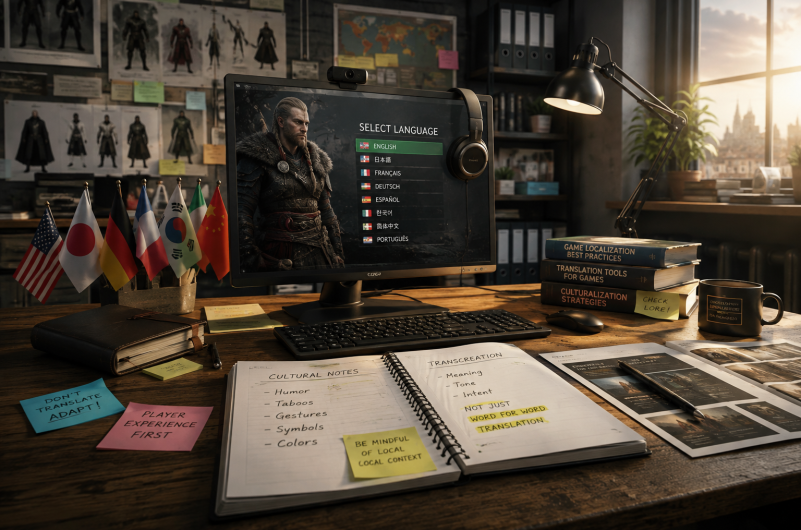
Game translation is not simply the process of changing dialogue from one language to another. A game can have accurate translated text and still feel unfamiliar, confusing, or inappropriate to players in another market.
Humor may depend on a pun that does not exist in the target language. A hand gesture that appears harmless in one country may carry an offensive meaning somewhere else. A color, symbol, religious reference, or character design may also have cultural associations that developers never intended.
That is why successful game localization goes beyond linguistic translation. It considers how dialogue, visuals, characters, humor, symbols, and gameplay elements are understood by the target audience.
For studios preparing a global launch, the goal is not simply to make a game understandable. The goal is to make the experience feel natural and culturally appropriate while preserving the original creative intent.
What Is Game Translation and Cultural Adaptation?
Game translation converts written or spoken content into another language while preserving its intended meaning. It can include dialogue, menus, subtitles, instructions, item descriptions, tutorials, character names, marketing content, and other player-facing material.
Cultural adaptation goes further.
It examines whether the content itself makes sense for the target market. This can involve adapting jokes, idioms, references, imagery, gestures, symbols, character expressions, and other culturally sensitive elements.
The distinction is important:
Translation asks: Can players understand what the game says?
Cultural adaptation asks: Will players understand what the game means and how it is intended to make them feel?
A professional localization process needs both.
A technically correct translation can still produce a poor player experience if the humor falls flat, the tone changes, or an important cultural reference has an unintended meaning.
Why Does Translation Need Cultural Adaptation in Games?
Games combine language with visual storytelling, sound, animation, character behavior, and interactive systems. As a result, cultural meaning can appear almost anywhere.
A single scene may contain dialogue, gestures, clothing, colors, symbols, background artwork, music, and gameplay mechanics. Translating the dialogue alone does not guarantee that the complete scene will work in another culture.
This becomes especially important when studios release the same title across multiple international markets.
A joke that worked in the original version may have been rewritten for another language. A character’s expression may need to change. A symbol may require replacement. A reference to a local celebrity, television show, historical event, or social custom may need a completely different treatment.
Professional game localization identifies these issues before they become expensive production problems.
How Is Game Translation Different From Culturalization?
Translation and culturalization are closely connected, but they solve different problems.
Translation focuses on language. Culturalization examines how the complete experience is received within a particular market.
For example, consider a character who uses a joke based on a word with two meanings in English. A literal translation might preserve the sentence but remove the joke.
A culturalized version may replace the wordplay with a different joke that creates a similar reaction for players in the target language.
The words have changed, but the intended experience remains.
This process is often called transcreation. Instead of translating every word literally, the localization team recreates the intended effect.
That approach can be particularly valuable for comedy, character banter, slogans, idioms, songs, and culturally specific references.
How Do Studios Adapt Humor for Different Markets?
Humor is one of the most difficult elements of game translation because jokes often depend on language and shared cultural knowledge.
Wordplay and Puns
Puns frequently rely on words that sound alike or have multiple meanings.
When those relationships do not exist in another language, translating the original wording may produce a grammatically correct sentence without the intended joke.
Professional translators and localization specialists can instead create new wordplay that fits the target language while preserving the character’s personality and the purpose of the original scene.
Cultural References
Games often include references to movies, celebrities, internet culture, sports, television, historical events, or local expressions.
A reference that is instantly recognizable in one country may be meaningless somewhere else.
The localization team must determine whether to keep the original reference, adapt it, replace it with a culturally relevant equivalent, or remove it when it creates unnecessary confusion.
The appropriate decision depends on the game’s audience, tone, genre, and creative direction.
Character-Specific Humor
Humor also communicates personality.
A sarcastic character should remain sarcastic. A childish character should still sound playful. A sophisticated character should not suddenly sound informal because the translation uses an inappropriate register.
For this reason, translators need context rather than isolated lines.
Character profiles, dialogue references, glossaries, and style guides can help preserve a consistent personality across languages.
How Do Studios Handle Taboos and Sensitive Content?
Cultural expectations vary significantly between markets.
Content involving religion, sexuality, violence, drugs, gambling, death, political themes, or other sensitive subjects may be received differently depending on the target audience and local requirements.
The challenge is not necessarily to remove anything controversial.
Instead, localization teams need to identify which elements may create problems and determine whether adaptation is necessary.
Content Ratings and Market Requirements
A particular scene may contribute to a different content rating in another market. Changes can also affect publishing requirements, platform approval, or the way audiences perceive the game.
These considerations should be reviewed early.
Finding a cultural issue after the game’s artwork, dialogue, animation, and marketing assets have already been finalized can create unnecessary rework.
Religious and Cultural References
Religious symbols and culturally significant imagery require particular care.
A symbol that appears decorative to a development team may have deep meaning to the target audience. Similarly, fictional representations can unintentionally resemble real-world religious or cultural symbols.
Early cultural review gives studios an opportunity to identify these risks before release.
Why Do Gestures, Colors and Symbols Matter in Game Localization?
Not every localization issue involves words.
Non-verbal communication can also carry cultural meaning.
A hand gesture may be friendly in one country and offensive in another. Colors can be associated with celebration, mourning, luck, danger, or other cultural concepts. Numbers may have positive or negative associations depending on the market.
Symbols, flags, maps, clothing, character poses, icons, and religious imagery can also require review.
These elements are particularly challenging because they are often embedded in the game’s artwork or animation.
A translation pass will not identify them.
Why Visual Cultural Review Should Happen Early
Changing a sentence in a translation file can be relatively straightforward.
Changing an animated character, environmental asset, user-interface icon, cinematic sequence, or promotional image after production has been completed can be much more expensive.
That is why cultural review should happen while creative decisions are still flexible.
What Are the Most Common Culturalization Challenges?
Studios working on international game releases commonly encounter several challenges.
Literal Translation of Humor
A joke is translated word for word, but the target audience does not understand it.
Solution: Use transcreation when the original joke depends on language, cultural knowledge, or wordplay.
Insufficient Context
Translators receive individual lines without knowing who is speaking, where the scene occurs, or what happens before and after the dialogue.
Solution: Provide screenshots, videos, character information, gameplay context, and scene descriptions.
Cultural Issues Found Too Late
Sensitive symbols or references are discovered shortly before release.
Solution: Add cultural review to the development and localization schedule rather than treating it as a final inspection.
Inconsistent Character Voice
A character may use different terminology, speech patterns, or levels of formality across different parts of the game.
Solution: Establish character-specific style guidelines and maintain centralized terminology resources.
Treating Every Market the Same
A single localization strategy is applied to every region without considering local expectations.
Solution: Develop market-specific localization requirements based on the audience, genre, platform, and release strategy.
How Does a Professional Game Translation Process Work?
A structured localization process helps studios identify linguistic and cultural problems before they affect the final product.
Step 1: Analyze the Game
The localization team reviews the game’s genre, story, characters, target markets, content volume, technical requirements, and release schedule.
This stage helps determine the appropriate workflow and identify potential cultural risks.
Step 2: Build a Terminology and Style Guide
Key names, locations, abilities, weapons, factions, items, recurring phrases, and character terminology should be documented.
A centralized glossary helps translators maintain consistency as the project grows.
Step 3: Translate With Context
Professional translators should have access to the context needed to make accurate decisions.
Screenshots, videos, character descriptions, developer notes, and previous translations can all improve the quality of the final work.
Step 4: Adapt Culturally Sensitive Content
Humor, idioms, references, symbols, gestures, and other market-specific elements should be reviewed rather than translated mechanically.
When necessary, the team can use transcreation to preserve the intended effect.
Step 5: Perform Linguistic and Cultural QA
Quality assurance should examine more than spelling and grammar.
Reviewers can check terminology, character voice, cultural appropriateness, UI constraints, missing text, inconsistencies, and context-specific errors.
Step 6: Test the Localized Game In Context
Localized content should be reviewed inside the actual game whenever possible.
A sentence that looks correct in a spreadsheet may be too long for a button, incorrectly assigned to a character, poorly timed in a cinematic, or inappropriate for the scene.
In-context testing helps reveal problems that traditional translation review can miss.
What Are the Benefits of Professional Game Translation?
Professional game translation and cultural adaptation can provide several practical benefits for studios preparing international releases.
A More Natural Player Experience
Players are more likely to connect with a game when dialogue, humor, terminology, and cultural references feel natural.
Fewer Localization Problems Before Launch
Early review can identify issues before they require expensive changes to artwork, dialogue, animation, or marketing materials.
Greater Consistency Across Languages
Professional workflows use terminology management, style guides, translation memory, review processes, and quality assurance to maintain consistency.
Better Protection of the Original Creative Intent
The objective is not to rewrite a game unnecessarily. It is to preserve what makes the original experience work while adapting elements that do not transfer naturally.
A Scalable Localization Process
Studios may begin with a few languages and expand into additional markets over time. A structured localization process makes it easier to manage that growth without losing control of terminology or quality.
Which Game Content Requires Localization?
Game localization can extend well beyond dialogue.
Depending on the project, a professional service may cover:
- In-game dialogue
- Subtitles
- User interfaces
- Menus
- Tutorials
- Character names
- Item descriptions
- Quests
- Achievement text
- Marketing materials
- Store descriptions
- Trailers and promotional content
- Voice-over scripts
- Audio and dubbing
- Accessibility content
- Player support documentation
Each content type has different requirements.
A menu label has different constraints from a cinematic conversation. A marketing slogan may require creative adaptation, while a technical instruction may require strict terminology control.
Industry-specific knowledge therefore matters when selecting a localization service provider.
Best Practices for Successful Game Localization
Studios can improve their localization workflow by treating language planning as part of development rather than an activity that starts immediately before launch.
Start Early
Early planning gives teams more time to evaluate languages, budgets, production schedules, cultural risks, and technical requirements.
Give Translators Context
Context improves decisions about tone, terminology, humor, character relationships, and meaning.
Use Native-Language Specialists
Native-language professionals can identify expressions and cultural nuances that may not be obvious to someone who has only studied the target language.
Maintain a Centralized Glossary
A shared terminology resource reduces inconsistencies across translators, languages, updates, and content types.
Review More Than Text
Culturalization should include visual elements, gestures, symbols, colors, character behavior, and other content that may influence how players interpret the game.
Include Human Quality Assurance
Technology can support translation workflows, but human review remains important for context, cultural nuance, tone, and player-facing quality.
Common Mistakes to Avoid in Game Translation
Several avoidable mistakes can undermine an otherwise well-designed localization strategy.
Translating without context: Isolated strings make it difficult to understand tone, character intent, or visual relationships.
Using literal translation for every joke: Humor often needs adaptation rather than direct translation.
Waiting until the end of development: Late cultural changes can affect schedules and production costs.
Ignoring non-textual content: Art, animation, symbols, colors, and gestures can create cultural issues that a standard translation review will not catch.
Using inconsistent terminology: Different translations for the same game mechanic, character, or item can confuse players.
Assuming one regional language fits every audience: Spanish, Portuguese, Chinese, and other languages can require regional adaptation depending on the target market.
How Should Studios Choose a Game Translation Service Provider?
The right service provider should be evaluated based on more than the number of languages offered.
Studios should consider whether the provider has experience with game localization, access to qualified native-language translators, appropriate quality assurance processes, terminology management, cultural adaptation capabilities, and the ability to work within production schedules.
It is also useful to ask how the provider handles context, confidential game assets, revisions, linguistic QA, and communication between translators and development teams.
A provider that understands the difference between translation, localization, transcreation, and culturalization can help studios make better decisions before content reaches players.
Why Cultural Adaptation Is Part of Quality Game Translation
A successful international game release requires more than replacing English words with words in another language.
Players experience games through dialogue, characters, humor, visuals, animation, music, interface elements, and cultural references. Every one of those elements can influence whether the localized version feels natural.
That is why professional translation should be viewed as part of a broader localization strategy.
For studios, the practical lesson is simple: translate the language, adapt the experience, and review the complete game in context.
Frequently Asked Questions About Game Translation
What is game translation?
Game translation is the process of adapting a game’s written or spoken content into another language while preserving its meaning, tone, and intended player experience. It can include dialogue, subtitles, menus, interfaces, tutorials, item descriptions, marketing content, and other player-facing material.
What is the difference between translation and game localization?
Translation focuses on converting language from one language to another. Game localization includes translation plus cultural, technical, visual, and contextual adaptation needed to make the game appropriate for a specific market.
Why can’t game humor simply be translated?
Many jokes depend on puns, wordplay, cultural references, timing, or shared knowledge. A literal translation may preserve the words but lose the humor. Transcreation allows the localization team to recreate the intended comedic effect in the target language.
What is culturalization in game localization?
Culturalization is the process of reviewing and adapting content so that it is appropriate for a particular market. It can involve humor, taboos, gestures, symbols, colors, religious references, imagery, character behavior, and other culturally significant elements.
When should culturalization begin?
Culturalization should begin during development or early localization planning, rather than immediately before release. Early review allows studios to address potential issues before artwork, animation, dialogue, or other assets become difficult and expensive to change.
Does AI replace professional game translators?
AI-assisted translation can support certain parts of a localization workflow, particularly when projects involve large volumes of content. However, human expertise remains important for context, humor, cultural nuance, character voice, transcreation, and quality assurance. The appropriate workflow depends on the type of content, target market, quality requirements, and project goals.
How can professional game localization reduce project risk?
A structured localization process can identify terminology inconsistencies, cultural issues, context problems, and implementation errors before launch. Early planning also gives development teams more time to resolve issues instead of making expensive last-minute changes.
Bring Global Players Into the Experience
Game translation should do more than make a title understandable. It should help players feel that the game was thoughtfully prepared for their language and market.
That requires more than linguistic accuracy. It requires cultural awareness, context, terminology management, transcreation, quality assurance, and a localization workflow built around the way games are actually developed and played.
eTranslation Services provides professional game localization and multilingual language solutions supported by qualified native-language translators and coverage across 200+ languages.
Whether a project requires dialogue translation, cultural adaptation, localization QA, subtitles, voice-over, or broader game localization support, the process can be tailored around the game’s content, target markets, production schedule, and quality requirements.
Ready to prepare a game for global players? Contact eTranslation Services to discuss the languages, content, timeline, and localization requirements for the project and request a customized quote.