When a customer, patient, employee, or business partner speaks a different language, waiting hours for an interpreter may not be an option. Over-the-phone interpretation services have become a practical solution for organizations that need professional language support quickly, without scheduling an interpreter to travel to a location.
So, how fast can a professional interpreter be connected?
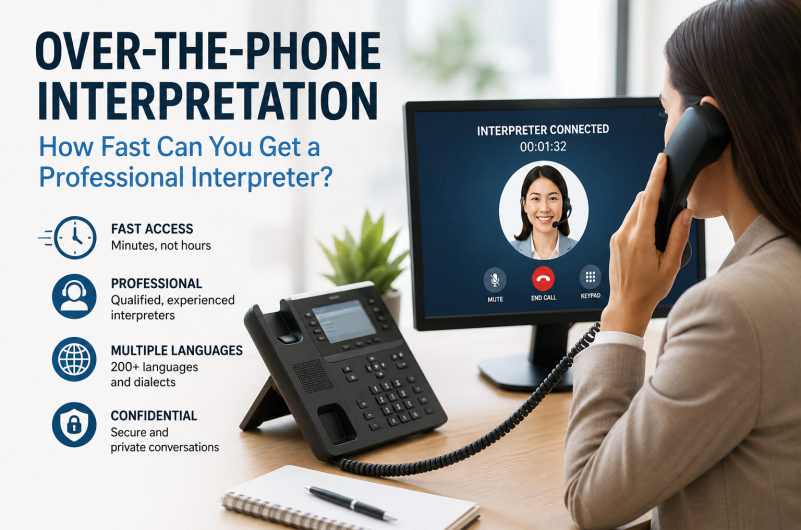
In many situations, a qualified telephone interpreter can be available within minutes. The exact response time depends on the language, service provider, availability, call volume, and complexity of the conversation. For common languages, on-demand access is often possible, while less frequently requested languages may require advance scheduling.
How Fast Are Over-the-Phone Interpretation Services?
Professional over-the-phone interpretation services are designed for situations where speed matters. Unlike in-person interpretation, there is no need to coordinate travel, meeting rooms, or physical availability.
A typical process is straightforward:
- The organization contacts the interpretation provider or accesses its interpretation platform.
- The requested language is identified.
- A professional interpreter is connected to the call.
- The interpreter facilitates communication between the parties.
- The call ends when the interpretation is complete.
For frequently requested languages such as Spanish, Mandarin, French, Arabic, or Portuguese, connection times can be very short. However, organizations should not assume that every language will have identical availability.
The best service providers maintain large interpreter networks so they can respond quickly while still matching calls with qualified language professionals.
Why Do Businesses Need Fast Telephone Interpretation?
Language barriers rarely happen at convenient times.
A hospital may need to communicate with a patient immediately. A government agency may have to explain an important procedure. A company may receive an urgent call from an international customer. A legal professional may need to communicate with a client before a deadline.
In these situations, postponing communication can create more than inconvenience.
Delays can lead to misunderstandings, missed opportunities, poor customer experiences, or compliance problems. Professional telephone interpretation gives organizations a way to address these situations without waiting for an interpreter to arrive onsite.
What Makes Telephone Interpretation Different?
The biggest advantage is accessibility.
An organization does not necessarily need to know where the interpreter is located. The interpreter can participate remotely, allowing communication to begin without the logistical challenges associated with onsite appointments.
This has made telephone interpretation particularly useful for organizations with multiple locations, remote teams, customer service departments, and time-sensitive operations.
What Challenges Can Professional Interpreters Solve?
Speed alone does not guarantee quality. One of the biggest mistakes organizations can make is choosing an interpretation service based only on how quickly someone answers the phone.
Professional interpretation requires more than bilingual ability.
Interpreters must understand terminology, communicate accurately, maintain impartiality, and know how to handle sensitive conversations. Industry knowledge also matters.
For example, a medical conversation may involve symptoms, medications, diagnoses, or treatment instructions. A legal call can involve terminology that has significant consequences if misunderstood. Customer service calls may require interpreters who understand business communication and cultural nuances.
Experienced service providers address these challenges by maintaining qualified interpreter networks and matching language professionals to the requirements of each call.
Key Benefits of Over-the-Phone Interpretation Services
The strongest benefit is rapid access to professional language support. But speed is only one part of the value.
Telephone interpretation can also provide:
- Convenience: No onsite interpreter needs to travel.
- Broader language access: Organizations can support languages beyond those spoken by internal employees.
- Scalability: Interpretation can be used when needed rather than requiring permanent multilingual staff.
- Privacy: Sensitive conversations can be handled without unnecessary participants in the room.
- Operational efficiency: Employees can resolve language barriers without significantly interrupting their workflow.
- Remote accessibility: Calls can be supported across offices, branches, and service locations.
For organizations handling frequent multilingual interactions, these advantages can translate into faster decisions and more consistent customer or patient communication.
Where Is Telephone Interpretation Commonly Used?
Over-the-phone interpretation has applications across many industries.
Healthcare organizations use it for patient communication, appointments, instructions, and other interactions where accurate communication is essential.
Legal organizations may use interpreters when communicating with clients, witnesses, or other parties who have limited English proficiency.
Businesses and customer service teams can use telephone interpretation to support international customers and multilingual communities.
Government agencies and public services may rely on professional interpreters when providing information or assistance to residents who speak different languages.
Financial institutions can use interpretation when customers need assistance understanding account information, procedures, or services.
The right solution depends on the language requirements, industry, call frequency, and sensitivity of the information being discussed.
Best Practices for Using Telephone Interpretation
Organizations can improve the quality of interpreted calls by preparing before the interpreter joins.
First, identify the required language as accurately as possible. Some languages have regional variations, and certain conversations may require a specific dialect.
Next, explain the purpose of the call. Providing basic context allows the provider to determine whether a specialized interpreter may be appropriate.
During the conversation, speakers should use clear language and avoid unnecessary jargon. Important information should be communicated in manageable sections rather than through long, complicated explanations.
Finally, allow the interpreter to interpret completely. Speaking over the interpreter or asking multiple people to talk simultaneously can increase the risk of misunderstanding.
Common Mistakes to Avoid
One common mistake is relying on an untrained bilingual employee or family member simply because that person happens to speak the language.
Another is choosing a provider based solely on the lowest price or fastest advertised connection. Quality, confidentiality, interpreter qualifications, language coverage, and reliability should also be evaluated.
Organizations should also avoid assuming that machine translation or automated tools can replace professional interpretation in sensitive or high-stakes conversations. Technology can support communication, but human interpreters remain important when context, nuance, accuracy, and confidentiality matter.
Why Choosing the Right Service Provider Matters
The quality of the interpreter depends heavily on the quality of the provider’s network and processes.
A reliable over-the-phone interpretation services provider should be able to explain its language coverage, interpreter qualifications, availability, confidentiality practices, and pricing structure. It should also have procedures for handling specialized or less commonly requested languages.
Organizations should consider whether the provider can support both immediate and scheduled interpretation needs. A scalable solution becomes particularly valuable as multilingual communication grows.
The goal is not simply to connect a caller with someone who speaks another language. The goal is to create a clear, accurate communication channel that allows both parties to understand one another.
How Quickly Can an Interpreter Really Be Connected?
For many common languages, professional telephone interpreters can often be accessed within minutes through an established on-demand service. However, response times vary by provider, language, interpreter availability, and call requirements.
For critical or less commonly requested languages, advance scheduling may provide a more reliable solution.
That distinction is important when selecting a provider. Organizations should ask about both on-demand availability and scheduled interpretation, rather than assuming that every language is immediately available at all times.
Fast Interpretation Without Sacrificing Quality
Over-the-phone interpretation services give organizations a practical way to overcome language barriers when communication cannot wait. They combine remote accessibility with professional human interpretation, making them useful across healthcare, legal, government, financial, customer service, and business environments.
The fastest service is not necessarily the best service. The stronger choice is a provider that can deliver timely access while maintaining interpreter quality, confidentiality, language coverage, and industry-specific expertise.
For organizations that regularly communicate with multilingual customers, patients, employees, or clients, professional telephone interpretation can provide a dependable language solution when it matters most. Contact a qualified interpretation provider to discuss language requirements, availability, pricing, and customized solutions, or request a quote for professional interpretation services tailored to the organization’s needs.