Game localization involves far more than translating dialogue from one language into another. It requires linguistic accuracy, cultural awareness, technical understanding, quality assurance, and a clear understanding of how players experience a game.
That is why game localization interview questions often go beyond basic translation skills. Interviewers may ask about cultural adaptation, terminology, localization testing, player expectations, voice-over, project workflows, and even the use of artificial intelligence.
For studios, journalists, researchers, and industry professionals, the right questions can reveal how a localization specialist actually approaches the work. A strong interview should uncover practical experience rather than simply produce yes-or-no answers.
This guide provides a structured set of game localization interview questions, along with guidance on what each question can reveal and how to make localization interviews more useful.
What Is Game Localization?
Game localization is the process of adapting a video game for players in a specific language and market. It can include dialogue, menus, tutorials, quests, subtitles, item descriptions, character names, user interfaces, marketing materials, voice-over scripts, and other player-facing content.
However, localization is broader than translation.
A translator may accurately convert a sentence into another language, but the localized version can still feel unnatural if the humor, cultural reference, character voice, or context does not work for the target audience.
Professional game localization therefore considers both what the original text says and how the player is expected to understand it.
Modern localization workflows can also involve linguistic QA, functional testing, terminology management, voice-over, subtitling, localization engineering, and cultural adaptation. eTranslation Services, for example, describes its game localization offering as covering in-game text translation, linguistic QA, voice-over, and subtitling.
Why Are Game Localization Interview Questions Important?
A good interview can uncover the decisions behind a localized game rather than simply discussing the final translation.
For example, asking a translator whether they can translate a sentence does not reveal much about their problem-solving process. Asking how they would handle a joke that depends on an English pun can reveal considerably more.
Similarly, asking an LQA tester whether they check translated text is less useful than asking how they identify a localization defect inside an actual game build.
Industry research and publicly reported localization interviews have covered topics such as localization workflows, cultural adaptation, quality assurance, authenticity, terminology, and the role of player feedback.
Publicly reported candidate interviews also show that employers may ask about gaming experience, translation and localization experience, language knowledge, and practical translation exercises.
The strongest questions therefore encourage interviewees to explain how they think, how they solve problems, and how they protect the player experience.
Game Localization Interview Questions for Background and Experience
These opening questions help establish the interviewee’s experience before moving into technical subjects.
1. How did you get into game localization?
This question provides useful background while allowing the interviewee to explain how their skills developed.
A good follow-up is:
What attracted you to game localization rather than general translation?
The answer can reveal whether the person’s experience comes primarily from translation, gaming, localization management, QA, writing, linguistics, or another related field.
2. How would you explain game localization to someone outside the gaming industry?
This is a simple but revealing question.
An experienced professional should be able to explain localization without relying heavily on industry terminology. The response can also reveal whether the interviewee understands localization as a complete player-experience process rather than simple text conversion.
3. What does a typical game localization project look like from start to finish?
This question opens the door to discussing the complete workflow.
A typical project may involve:
- Content analysis
- Source-text preparation
- Terminology and glossary development
- Translation
- Linguistic review
- Cultural adaptation
- Integration
- In-context testing
- Linguistic QA
- Corrections and regression testing
- Final delivery
The exact workflow varies according to the game’s size, engine, content type, languages, release schedule, and development process.
4. What types of games have you worked on?
Different genres create different localization challenges.
An RPG may involve extensive dialogue, lore, character relationships, and terminology. A strategy game may require precise terminology and complex interface text. A casual mobile game may place greater emphasis on short UI strings, events, monetization content, and frequent updates.
Asking about genres helps put the interviewee’s experience into context.
Questions About the Craft of Game Localization
The next group of questions focuses on the actual work involved in adapting game content.
5. What is the hardest part of localizing a game?
There is no single answer.
The difficulty could involve context, humor, terminology, character voice, technical limitations, cultural references, text expansion, or tight production schedules.
The most useful follow-up is:
Can you give an example of how that challenge was solved?
Specific examples generally provide more insight than general statements.
6. How important is context when translating game dialogue?
Context is critical because a translator may not always know who is speaking, where the line appears, what happened previously, or what the player is doing when the dialogue appears.
A short sentence can have multiple valid translations depending on the character, situation, gender, relationship, or gameplay context.
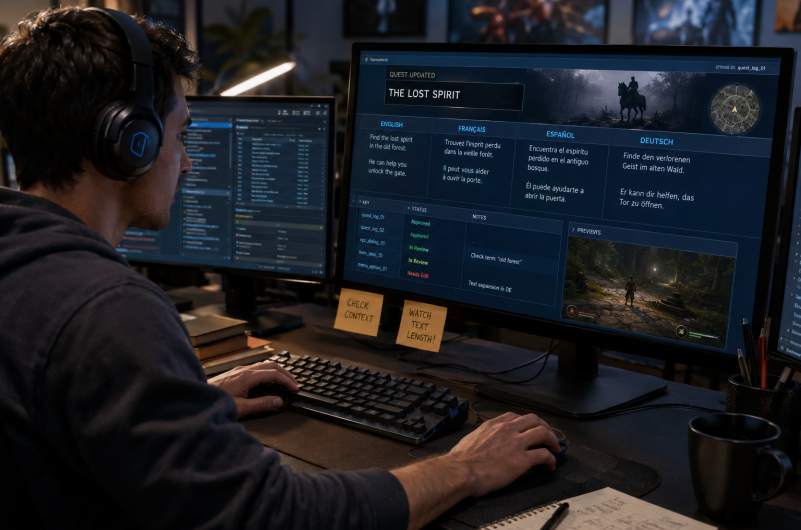
Providing translators with screenshots, character information, glossary entries, and gameplay context can reduce unnecessary guesswork.
7. How do you handle jokes, puns, and wordplay?
Humor is one of the clearest examples of why game localization cannot always rely on literal translation.
A pun in English may not exist in another language. The localization team may therefore need to recreate the intended effect rather than reproduce the exact wording.
The key question becomes:
What should the player experience?
Sometimes preserving the joke’s function is more important than preserving its exact construction.
8. What happens when a translation is technically correct but does not fit the scene?
This question explores the difference between linguistic accuracy and contextual accuracy.
A sentence can be grammatically correct but still sound unnatural for a particular character or situation.
For example, a warrior, child, scientist, villain, and comic character may need completely different speech patterns even when they are communicating the same basic idea.
9. How do you maintain terminology consistency across a large game?
Large games can contain thousands of recurring terms.
Character names, locations, weapons, abilities, quests, factions, items, skills, and interface elements often appear across multiple files and systems.
Professional workflows can use glossaries, style guides, translation memories, terminology databases, and QA checks to reduce inconsistencies.
This is particularly important for games that continue receiving expansions, downloadable content, seasonal updates, and live-service content.
Culturalization Questions for Game Localization
Localization also requires an understanding of cultural context.
10. What needs to change beyond the language when a game enters a new market?
This question encourages discussion of culturalization.
Depending on the market, localization may involve reviewing:
- Humor
- Idioms
- Symbols
- Gestures
- Names
- Character behavior
- Historical references
- Religious references
- Visual content
- Social conventions
- Date, time, currency, and number formats
A game can be linguistically accurate while still creating an unintended reaction because of a cultural reference or visual element.
11. Can you describe a cultural reference that was difficult to localize?
This question encourages a practical example.
The interviewee can explain what made the reference difficult, what alternatives were considered, and how the final decision preserved the original creative intent.
12. How early should localization teams become involved in game development?
Early involvement can help identify localization risks before they become expensive to fix.
For example, developers may discover that a UI design works well in English but cannot accommodate longer translated text. Similarly, a character name or gameplay mechanic may create challenges in certain languages.
Early localization input can therefore help development teams make more adaptable design decisions.
13. What do game developers most often overlook about localization?
This is particularly useful when interviewing an experienced localization manager or vendor.
The answer may highlight problems such as insufficient context, late content delivery, missing screenshots, hard-coded text, unclear terminology, unrealistic deadlines, or failure to test localized content in the actual game.
Game Localization QA and Testing Interview Questions
Localization QA, or LQA, is an important part of preparing a localized game for release.
Testing can reveal problems that are difficult or impossible to identify from a translation file alone.
eTranslation Services describes its LQA process as including in-context review, localization bug identification, text-overlap checks, font-support verification, and functionality-related checks.
14. What is the difference between translation review and localization QA?
Translation review primarily examines the language.
Localization QA goes further by examining how that language behaves inside the game.
A tester may discover:
- Text clipping
- Overlapping UI elements
- Missing characters
- Incorrect line breaks
- Unsupported fonts
- Incorrect placeholders
- Wrong speaker names
- Truncated dialogue
- Incorrect subtitles
- UI elements that no longer fit
- Contextual translation errors
These problems may not appear in a spreadsheet or translation management system.
15. What localization bugs do you see most often?
This question can reveal the interviewee’s practical experience.
Useful answers should explain not only the type of bug but also why it happens and how it can be prevented.
For example, a text-overflow problem may result from designing a UI around the length of the source language rather than allowing for expansion in the target language.
16. How do you test localized text in context?
A strong answer should address actual gameplay rather than reviewing isolated strings.
Testers may need to navigate menus, play quests, trigger dialogue, inspect inventory screens, read tutorials, review subtitles, and test different game states.
The goal is to verify that the translated content works where players actually encounter it.
17. Which localization issues should be fixed before launch?
Not every linguistic issue has the same impact.
Critical problems include errors that prevent players from understanding instructions, completing a quest, purchasing an item, navigating the interface, or understanding important story information.
The interview can explore how the localization team categorizes severity and decides which issues must be fixed before release.
Questions About Voice-Over and Dubbing
Games with extensive voice acting require another layer of localization expertise.
18. How is game dubbing different from translating a script?
Dubbing requires consideration of performance as well as language.
The localized script needs to work for actors, fit the scene, preserve character personality, and align with timing requirements.
Voice direction can also affect pronunciation, emotional delivery, pacing, and consistency across a game’s cast.
19. What makes a localized performance sound authentic?
A strong answer may discuss casting, character voice, cultural nuance, pronunciation, direction, timing, and consistency.
Simply having a native speaker read a translated script does not automatically create a convincing performance.
20. What types of dialogue are particularly difficult to dub?
Possible challenges include rapid dialogue, emotional scenes, humor, overlapping speech, dramatic performances, character-specific speech patterns, and lines with strict timing requirements.
This question can reveal whether the interviewee understands the relationship between translation, writing, acting, and production.
AI and Game Localization Interview Questions
Artificial intelligence has introduced new tools into translation and localization workflows, but its role should be discussed carefully.
21. How is AI changing game localization?
AI can assist with tasks such as terminology suggestions, translation drafts, content classification, repetitive language work, and quality checks.
However, game localization also involves context, tone, cultural meaning, character voice, and creative intent. Those areas may require human judgment.
The useful interview question is therefore not simply whether AI is “good” or “bad.”
A better question is:
Where does AI genuinely improve the workflow, and where does human review remain essential?
22. When should machine translation be reviewed by human linguists?
Human review becomes particularly important when content involves narrative dialogue, humor, cultural references, character voice, sensitive subjects, or high-visibility player-facing content.
A professional workflow should establish where automated tools can save time and where linguistic expertise is required to protect quality.
23. What risks should studios consider when using AI for localization?
An interview can explore issues such as:
- Loss of context
- Inconsistent terminology
- Incorrect character voice
- Cultural mistakes
- Confidentiality
- Data handling
- Poor handling of creative language
- Errors that automated checks fail to detect
The goal should be to evaluate AI according to the project’s requirements rather than treating it as a replacement for the entire localization process.
Indie and AAA Game Localization Questions
Localization requirements can differ significantly between smaller studios and large publishers.
24. How does localization differ between an indie game and a AAA title?
A AAA production may involve many languages, large volumes of dialogue, voice recording, multiple platforms, extensive LQA, and complex release schedules.
An indie studio may have a smaller budget and team and may need to prioritize markets, content, and testing more carefully.
The underlying localization principles remain similar, but the workflow and resource allocation can be very different.
25. What advice would you give an indie studio with a limited localization budget?
This question encourages practical advice rather than generic recommendations.
A localization professional might discuss prioritizing high-value markets, preparing source content correctly, creating terminology resources early, providing sufficient context, and testing the most important player journeys first.
The objective is not necessarily to localize everything immediately. It is to make informed decisions about scope and quality.
Questions About the Business Side of Localization
Localization is also a project-management discipline.
26. What information should a studio provide before starting localization?
Useful project information can include:
- Source files
- Target languages
- Word counts
- Game genre
- Character information
- Screenshots or builds
- Glossaries
- Style guides
- Platform requirements
- Audio requirements
- Deadlines
- QA expectations
- Marketing requirements
Better source information generally gives translators and testers more context, which can reduce clarification cycles and rework.
27. What factors affect game localization cost?
Cost can depend on language count, word volume, content complexity, translation requirements, editing and review, LQA, voice-over, subtitling, engineering support, deadlines, and the number of deliverables.
A professional service provider should assess the actual project scope rather than relying on a generic per-word estimate.
28. How can studios reduce localization costs without sacrificing quality?
Cost control should begin with project organization.
Clear source content, reusable terminology, centralized feedback, early localization involvement, structured files, and appropriate QA planning can reduce avoidable rework.
Rushing translation or removing essential quality checks may reduce the initial invoice while increasing the risk of corrections later.
What Makes a Good Game Localization Interview?
The best interviews do more than collect a list of answers.
A strong interview should encourage the subject to explain decisions, challenges, trade-offs, and lessons learned.
Instead of asking:
“Is localization important?”
ask:
“What is one localization problem that could have been prevented if the studio had involved the localization team earlier?”
Instead of:
“Do you use LQA?”
ask:
“What localization defect is easiest to miss until the text is tested inside the game?”
Instead of:
“Is cultural adaptation necessary?”
ask:
“Can you describe a situation where a direct translation would have created a cultural problem?”
These questions generate more useful information because they invite examples and reasoning.
Best Practices for Conducting a Game Localization Interview
An interview does not need dozens of questions to produce useful material.
For most interviews, selecting approximately 8–12 questions around the interviewee’s specialty can create a more focused discussion. The current eTranslation Services article also recommends limiting the number of questions and using open-ended prompts to encourage detailed responses.
A practical structure is:
- Start with two background questions.
- Move into the interviewee’s area of expertise.
- Ask for one or two real examples.
- Explore challenges and solutions.
- Discuss current industry changes such as AI.
- End with a question that produces a broader industry insight.
For written interviews, giving respondents reasonable flexibility can result in more detailed answers. For live interviews, the questions should serve as a framework rather than a rigid script.
Most importantly, follow interesting answers with useful follow-up questions.
A simple “Why?”, “What happened next?”, or “How did the team solve that?” can turn a short response into a valuable industry insight.
Common Mistakes to Avoid When Interviewing Localization Professionals
Asking Only Yes-or-No Questions
Questions that can be answered with “yes” or “no” rarely produce detailed insights.
Open-ended questions encourage the interviewee to explain their reasoning.
Focusing Only on Translation
Game localization covers much more than written language.
A complete discussion can include culturalization, LQA, voice-over, subtitles, UI, technical limitations, player expectations, and project management.
Ignoring Context
A localization professional’s answer means more when readers understand the game type, target market, language, and production stage involved.
Asking Too Many Questions
A long list can make an interview feel like a questionnaire instead of a conversation.
A focused set of questions usually provides better material.
Forgetting the Player
The ultimate purpose of game localization is to help players experience the game naturally in their language and market.
Questions should therefore connect localization decisions to comprehension, immersion, accessibility, usability, and player experience.
Why Choosing the Right Game Localization Partner Matters
For studios preparing a multilingual release, the quality of the localization workflow can affect more than the translated text.
A capable provider should be able to understand the game’s content, target markets, terminology, production schedule, and quality requirements.
The process may involve translators, editors, localization project managers, engineers, voice specialists, and LQA testers working together.
eTranslation Services states that its gaming localization workflow is supported by project management, specialized linguists, localization engineers, and a QA team. Its gaming services include game localization, voice-over and subtitling, and linguistic QA.
Its broader localization services also describe linguistic review, functional testing, text-overflow checks, usability testing, and cultural adaptation as components of the localization process.
For studios evaluating a provider, useful questions include:
- Which languages and markets can the provider support?
- Does the team have gaming localization experience?
- Are translators native speakers of the target language?
- Is LQA available?
- Can the provider work with in-game context?
- How are terminology and style guides managed?
- Can voice-over and subtitling be included?
- How is confidential game content protected?
- How are revisions and feedback handled?
- Can the workflow scale as the game adds languages or content?
These questions help studios evaluate service providers based on the actual requirements of their project.
Frequently Asked Questions About Game Localization Interview Questions
What questions are asked in a game localization interview?
Common questions cover gaming experience, translation and localization experience, language skills, cultural adaptation, terminology, LQA, problem-solving, and the ability to work with game-specific content. Some reported interviews have also included practical translation exercises and questions about the types of games candidates play.
What should a game localization interviewer ask a translator?
Useful questions include how the translator handles humor, wordplay, terminology, character voice, missing context, cultural references, and difficult-to-translate dialogue. Asking for specific examples usually provides more useful information than asking about skills in general.
What should an interviewer ask an LQA tester?
Questions can focus on localization bugs, in-context testing, UI problems, text expansion, font support, placeholders, subtitles, terminology, severity levels, and how defects are reported and verified.
What is the difference between game translation and game localization?
Game translation converts language from the source language into the target language. Game localization is broader and may include cultural adaptation, UI changes, technical considerations, voice-over, subtitles, linguistic QA, and in-context testing.
Why is culturalization important in game localization?
Culturalization helps ensure that jokes, symbols, gestures, references, character behavior, and other content are appropriate and understandable for the target market. A direct translation may preserve the words while missing the intended cultural meaning.
How many questions should be included in a localization interview?
There is no fixed number, but a focused interview often works better than an excessively long questionnaire. Around 8–12 well-selected questions can provide enough room for detailed answers while keeping the discussion manageable.
How can a studio prepare for a game localization interview?
The interviewer should understand the game’s genre, target markets, languages, content scope, and localization stage. Questions should then be tailored to the interviewee’s role, whether that person is a translator, localization manager, LQA tester, voice professional, or project manager.
Final Thoughts on Game Localization Interview Questions
The most useful game localization interview questions do not simply ask what a localization professional does. They reveal how the professional thinks, solves problems, manages cultural differences, protects quality, and works within the realities of game development.
For translators, that means exploring context, terminology, humor, tone, and cultural adaptation. For LQA testers, it means examining how language behaves inside the actual game. For voice professionals, it means discussing performance, timing, casting, and character authenticity. For studios and localization managers, it means understanding workflow, cost, deadlines, and quality standards.
For developers preparing a global release, these same principles can help identify the right localization requirements before production begins.
eTranslation Services provides game localization solutions that include in-game text translation, linguistic QA, voice-over, and subtitling, with professional language support across 200+ languages.
Whether a project is an indie release, mobile game, or AAA title, the localization approach should be built around its content, audience, target markets, schedule, and quality requirements.
When the goal is to give international players an experience that feels natural rather than simply translated, choosing the right localization process matters.
Ready to prepare a game for international markets? Contact eTranslation Services to discuss the game’s languages, content, timeline, LQA requirements, and localization goals, and request a customized quote for professional game localization support.