Expanding into new markets has never been easier, but communicating effectively with global audiences remains a challenge. A single mistranslated sentence can confuse customers, delay business deals, or even damage a company’s reputation. That is why Professional Translation Services have become an essential investment for organizations that want to build trust, meet compliance requirements, and connect with customers in their native language.
Businesses today serve clients, partners, and employees from different countries and cultures. As international opportunities continue to grow, companies have been relying on experienced language professionals to ensure every document, website, marketing campaign, and technical manual communicates the intended message accurately. Quality translation is no longer just about converting words. It is about preserving meaning, intent, tone, and cultural relevance.
What Are Professional Translation Services?
Professional Translation Services involve converting written content from one language to another while maintaining accuracy, context, and readability. Unlike automated translation tools, professional translators understand grammar, industry terminology, cultural differences, and regional language preferences.
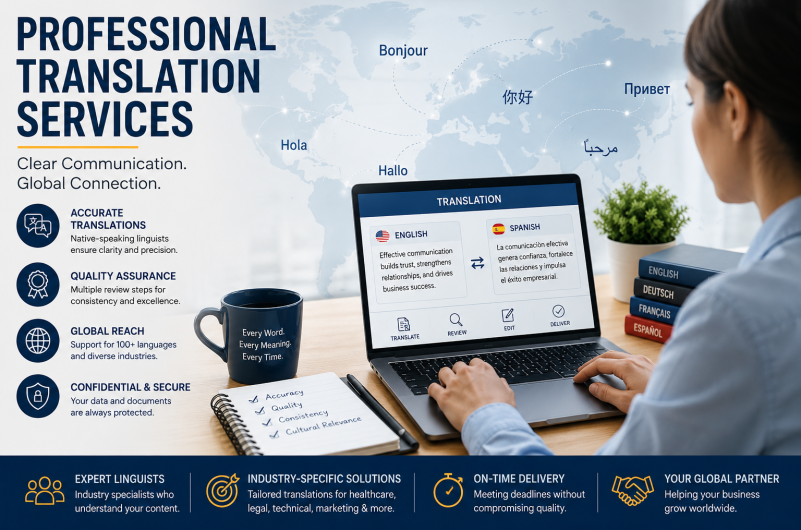
The process typically includes several quality assurance steps. A document is translated by a qualified linguist, reviewed by an editor, and often undergoes proofreading before delivery. Many projects also involve terminology management and style guides to ensure consistency across all business communications.
This structured approach helps organizations avoid costly mistakes while producing content that sounds natural to native speakers.
Why Businesses Need Translation Services More Than Ever
Global commerce has changed the way companies communicate. Customers expect information in their own language, whether they are reading product descriptions, legal agreements, healthcare information, or software instructions.
Businesses that invest in professional language solutions often experience stronger customer engagement because people naturally trust content they fully understand. Clear communication also reduces misunderstandings during negotiations, improves customer satisfaction, and supports long-term business growth.
Regulated industries have become especially dependent on accurate translations. Legal contracts, medical records, financial reports, and technical documentation often require precise wording because even a small error could create compliance issues or legal disputes.
Common Challenges Businesses Face
Many organizations underestimate how complex translation projects can become. One of the biggest challenges is maintaining consistency across thousands of pages of content created by different departments.
Industry-specific terminology also creates difficulties. Technical manufacturing documents, pharmaceutical research, engineering manuals, and financial statements all contain specialized vocabulary that general translators may not fully understand.
Another common issue involves cultural adaptation. A slogan that worked perfectly in one country may sound confusing or even offensive somewhere else. Businesses have learned that successful communication requires more than literal translation.
Fast turnaround expectations can add another layer of complexity. Companies often need multilingual content delivered quickly without sacrificing quality. Balancing speed and accuracy requires experienced project management and efficient workflows.
How Professional Service Providers Solve These Problems
An experienced translation service provider uses proven processes to deliver accurate and consistent results.
Projects usually begin with understanding the client’s objectives, target audience, preferred terminology, and formatting requirements. Translators with expertise in the relevant industry are then assigned to the project rather than relying on general language specialists.
Professional providers also use translation memory technology. This tool stores previously approved translations, allowing repeated phrases to remain consistent while reducing costs and turnaround times for future projects.
Quality control remains a major part of the process. Multiple reviews help identify language issues before the final document reaches the client. This attention to detail has helped businesses maintain accuracy even across large multilingual projects.
Key Benefits of Professional Translation Services
Choosing experienced professionals delivers benefits that extend far beyond accurate wording.
Clear communication strengthens customer confidence and improves brand credibility. Businesses can present a consistent voice across every language while protecting their reputation in international markets.
Professional translation also supports operational efficiency. Employees working across different regions receive accurate internal documents, reducing confusion and improving collaboration.
From a financial perspective, investing in quality translation often prevents expensive corrections later. Reprinting marketing materials, updating legal documents, or fixing product instructions after publication usually costs far more than getting the translation right the first time.
Perhaps most importantly, professional translation helps businesses create better customer experiences. People are more likely to engage with brands that communicate naturally in their own language.
Industry Applications
Translation services support nearly every sector of the global economy.
Healthcare organizations require accurate patient records, clinical trial documentation, and medical device instructions. Legal firms depend on precise translations of contracts, court documents, and compliance materials.
Manufacturers translate technical manuals, product specifications, and safety documentation for international distribution. Technology companies localize software interfaces, user guides, and support documentation to improve user experiences worldwide.
Marketing teams also rely on translation to adapt websites, advertising campaigns, social media content, and product catalogs while preserving brand identity across different cultures.
Each industry demands specialized knowledge, making subject-matter expertise just as important as language fluency.
Best Practices for Successful Translation Projects
Businesses achieve better outcomes when they prepare translation projects carefully.
Providing clear source material is one of the simplest ways to improve translation quality. Documents written with consistent terminology and straightforward language reduce ambiguity for translators.
Creating a glossary of approved business terms also improves consistency across future projects. Many organizations have been maintaining terminology databases for years because they help preserve brand voice and technical accuracy.
It is equally important to allow enough time for editing and quality assurance. Rushing complex translations often increases the risk of mistakes that could have been prevented through proper review.
Working with a long-term translation partner instead of switching providers frequently also creates better consistency over time.
Common Mistakes to Avoid
Many businesses assume that bilingual employees can handle professional translation work. While language skills are valuable, professional translation requires specialized training, research skills, and industry knowledge.
Another common mistake is choosing a provider based solely on price. Low-cost services may skip editing, quality reviews, or subject-matter expertise, increasing the likelihood of costly errors.
Companies should also avoid relying entirely on machine translation for customer-facing or legally sensitive content. Although technology has improved significantly, human expertise remains essential for preserving meaning, context, and cultural nuance.
Finally, businesses sometimes forget to update translated content after revising the original documents. Keeping all language versions aligned is essential for maintaining consistency.
Why Choosing the Right Provider Matters
Selecting the right translation partner is a strategic business decision rather than a simple outsourcing task.
Reliable providers invest in qualified linguists, robust quality assurance procedures, secure data handling, and industry-specific expertise. They communicate clearly throughout each project and adapt their services to meet changing business needs.
Businesses should also look for providers with experience in their industry, transparent workflows, and a commitment to meeting deadlines without compromising quality.
Over time, a trusted language partner becomes an extension of the business, helping organizations communicate confidently across every market they serve.
Global business depends on clear communication
Language should never become a barrier to growth. Professional Translation Services help organizations deliver accurate, culturally appropriate, and trustworthy content that strengthens customer relationships, supports compliance, and protects brand reputation.
Whether a business is expanding into new markets, translating technical documentation, or localizing marketing materials, working with an experienced translation provider delivers long-term value. If your organization is ready to communicate with confidence in any language, contact a trusted translation specialist today to request a customized quote and discover how expert language solutions can support your global success.