Steam reviews have become one of the most influential factors in a game’s long-term success. Before purchasing a title, most players scroll through reviews to see what others experienced. Positive feedback builds confidence, while negative comments often discourage potential buyers. One issue appears repeatedly across thousands of Steam reviews: poor localization.
Many developers invest heavily in gameplay, graphics, and marketing, yet underestimate how much localization affects player satisfaction. A game with polished mechanics can still receive negative reviews if translations are confusing, dialogue feels unnatural, or cultural references fail to connect with international audiences. Understanding how localization influences player perception helps studios protect their reputation, improve user experience, and increase sales in global markets.
What Is Localization in Game Development?
Localization goes beyond translating text from one language into another. It adapts a game so that players in different regions enjoy the same experience as the original audience.
A complete localization process includes translating dialogue, menus, tutorials, achievements, store descriptions, downloadable content, subtitles, and user interface elements. It may also involve adapting humor, cultural references, graphics, symbols, date formats, currencies, and even voice-over timing.
Professional localization ensures that every part of the game feels natural to local players instead of appearing like a direct translation. This level of quality creates a smoother experience that encourages positive player feedback.
Why Localization Matters More Than Ever
Steam serves millions of players across the world. While English remains widely used, a large percentage of users prefer playing games in their native language. Markets such as China, Japan, South Korea, Germany, France, Brazil, Spain, and Poland have continued driving global PC game sales over the past several years.
When players purchase a localized version of a game, they expect the experience to feel complete. If important instructions are translated incorrectly or conversations become difficult to understand, frustration quickly replaces excitement.
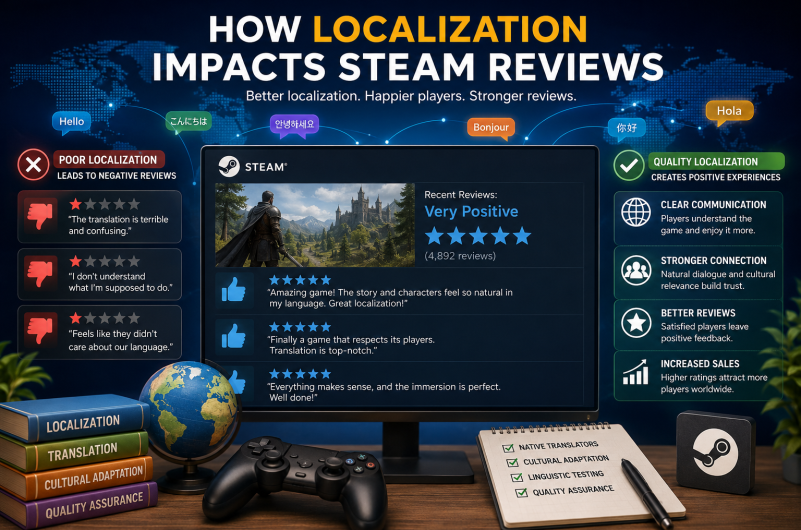
Poor localization often leads players to believe that the developer rushed development or ignored international audiences. As a result, negative reviews appear even when the gameplay itself performs well.
How Localization Directly Affects Steam Reviews
First Impressions Matter
Many players leave reviews after only a few hours of gameplay. During that time, they encounter tutorials, menus, quests, and dialogue. If these early interactions contain awkward translations or grammatical errors, confidence in the game’s overall quality decreases.
Even minor mistakes can create the impression that the product lacks polish.
Confusing Gameplay Creates Frustration
Translation errors can change the meaning of quests, item descriptions, or combat instructions. Players may fail missions simply because objectives were explained incorrectly.
Instead of blaming the translation, many users blame the game itself. Their frustration often appears in Steam reviews, lowering the overall rating.
Immersion Is Easily Broken
Story-driven games depend on emotional engagement. Characters must sound believable, jokes should make sense, and dramatic moments need the right tone.
Literal translations rarely achieve this. Professional localization preserves emotion and context, allowing players to stay immersed throughout the game.
Positive Experiences Encourage Recommendations
Satisfied players frequently mention localization in positive reviews, especially when translations feel natural. Reviews often praise games that “feel like they were made” for their language rather than simply translated.
These positive comments improve credibility and encourage additional purchases from international players.
Common Localization Challenges for Game Studios
Game localization presents several challenges, particularly for independent developers and growing studios.
Development schedules frequently change, leaving limited time for translation and quality assurance. Game text may continue evolving until shortly before release, requiring translators to update hundreds or even thousands of strings quickly.
Context is another major issue. Translators sometimes receive isolated text without screenshots or gameplay footage. A single word may represent an action, a weapon, a location, or a menu option. Without context, even experienced linguists can make incorrect choices.
Technical limitations also create obstacles. Character limits, different writing systems, font compatibility, and right-to-left languages require careful planning during development.
These common challenges highlight why localization should be integrated early instead of becoming a last-minute task.
How Professional Localization Services Improve Player Satisfaction
Experienced localization professionals follow structured workflows designed specifically for interactive entertainment.
Native-speaking translators understand gaming terminology and cultural nuances. Editors review translations for consistency, tone, and accuracy before implementation. Linguistic testers then play the game to identify missing text, formatting issues, broken interface elements, and translation errors within the actual gameplay environment.
This multi-step quality assurance process significantly reduces mistakes that players would otherwise notice immediately.
Professional service providers also maintain terminology databases and style guides, ensuring consistency across updates, expansions, downloadable content, and future releases.
The Business Benefits of High-Quality Localization
Strong localization delivers measurable business value beyond better translations.
Improved user satisfaction often results in higher review scores, which influence Steam’s recommendation system and purchasing decisions. Better reviews also increase player confidence before buying a game.
Localization can reduce customer support requests because players better understand gameplay mechanics and interface instructions. Studios also benefit from stronger player retention, higher engagement, and more positive community discussions.
For multiplayer games, consistent localization helps international communities communicate more effectively, creating healthier player ecosystems.
Ultimately, investing in professional localization often costs far less than repairing a damaged reputation after launch.
Industry Applications
Localization benefits nearly every game genre.
Role-playing games rely on accurate dialogue and storytelling. Strategy games require precise descriptions and tutorials. Simulation titles need clear interface instructions. Multiplayer games benefit from consistent terminology, while educational games depend on accuracy to maintain learning outcomes.
Whether a studio develops indie games or large-scale AAA titles, localization supports broader business applications by making games accessible to larger audiences worldwide.
Best Practices for Better Steam Reviews
Studios that consistently receive positive feedback usually follow several proven best practices.
First, involve localization early in the development process instead of waiting until the final weeks before release. Second, provide translators with screenshots, gameplay videos, and design documentation to improve context. Third, perform linguistic testing inside the game rather than reviewing text in spreadsheets alone.
Finally, continue improving localization after launch. Steam reviews frequently highlight translation issues, giving developers valuable insights for future patches and updates.
Common Mistakes to Avoid
Several mistakes continue to hurt review scores.
Relying entirely on machine translation without human review often produces unnatural dialogue. Ignoring regional cultural differences can confuse players or unintentionally create offensive content. Skipping quality assurance allows formatting problems, untranslated strings, and interface bugs to reach players.
Another common mistake is treating localization as a one-time project. Games evolve through updates, seasonal events, and downloadable content. Localization should evolve alongside the product.
Why Choosing the Right Localization Provider Matters
Not every translation service specializes in games. A provider with gaming experience understands player expectations, technical limitations, platform requirements, and localization quality standards.
The right professional service provider combines linguistic expertise with structured workflows, experienced project management, and thorough quality testing. This approach helps studios launch confidently while protecting both player experience and brand reputation.
Selecting an experienced localization partner also creates long-term value, especially for studios planning international growth, live-service games, or multiple future releases.
Steam reviews reflect far more than gameplay quality. They capture the complete player experience, and localization has become an essential part of that experience. Clear translations, culturally appropriate content, and polished user interfaces help players stay immersed, understand the game, and enjoy every moment from the first tutorial to the final credits.
For studios targeting global audiences, professional localization is no longer optional—it is a strategic investment that directly influences customer satisfaction, review scores, player retention, and international success. Working with an experienced localization provider gives developers access to expert linguists, proven quality processes, and customized solutions tailored to each game’s unique requirements. If a studio is preparing for a worldwide launch or wants to improve an existing title, requesting a consultation or quote from a trusted localization specialist is a practical first step toward earning stronger Steam reviews and building lasting player trust.