Every August, the gaming industry turns its attention to Gamescom, where publishers unveil new titles, gameplay trailers, release dates, and major announcements. While these reveals generate excitement among players, they also trigger one of the most demanding phases of game development; Localization planning.
A release date announced during Gamescom is more than a marketing milestone. It becomes a public commitment that affects every department involved in bringing a game to market. For localization teams, that announcement starts a carefully coordinated process involving translation, voice recording, engineering, cultural adaptation, and linguistic quality assurance (LQA).
Studios that plan localization early are far more likely to deliver a polished multilingual experience on launch day. Those that wait until after the announcement often face compressed schedules, higher costs, and quality issues that can affect player reviews and global sales.
Why Gamescom Matters for Game Localization
Gamescom has become one of the industry’s biggest launch platforms. Millions of players, media outlets, influencers, and business partners closely watch every announcement. Once a release date or launch window is revealed, expectations are set across every target market.
That public commitment changes how localization projects are managed.
Before a Gamescom reveal, development schedules may still be flexible. After a trailer with a confirmed launch date is published, every localization milestone must align with a fixed deadline. Translation, voiceover, subtitle production, UI localization, localization testing, and final certification all have to move together without sacrificing quality.
For studios planning a simultaneous worldwide release, localization is no longer a supporting task, it becomes a critical part of launch readiness.
What Day-One Localization Really Means
Day-one localization means players in multiple regions can enjoy the game immediately after launch in their native language. This extends beyond simply translating text.
Professional game localization typically includes:
- User interface translation
- Dialogue and subtitle localization
- Voice-over recording and dubbing
- Cultural adaptation
- Terminology management
- Linguistic Quality Assurance (LQA)
- Functional testing of localized builds
Every stage depends on the previous one. Delays in content approval or script revisions can quickly affect the entire production schedule.
Why Businesses Need Localization Planning Before Gamescom
Many studios still view localization as a final production step. In reality, successful localization begins long before the first trailer is shown.
Once marketing confirms a Gamescom reveal, localization providers need enough time to prepare glossaries, translation memories, style guides, recording schedules, and language resources.
Planning ahead provides several advantages:
- More consistent terminology
- Better translation quality
- Lower revision costs
- Smoother voice recording sessions
- Reduced launch risks
- Higher player satisfaction across global markets
Early preparation also gives developers time to identify technical issues before they become expensive production delays.
The Biggest Challenge: Working Backward from a Public Release Date
One of the biggest challenges after Gamescom is that localization often receives finalized content later than most departments.
Game dialogue evolves until late in development. UI elements continue changing. Tutorials are updated. Marketing assets are revised repeatedly.
Every late content change creates additional work for translators, editors, voice actors, engineers, and QA testers.
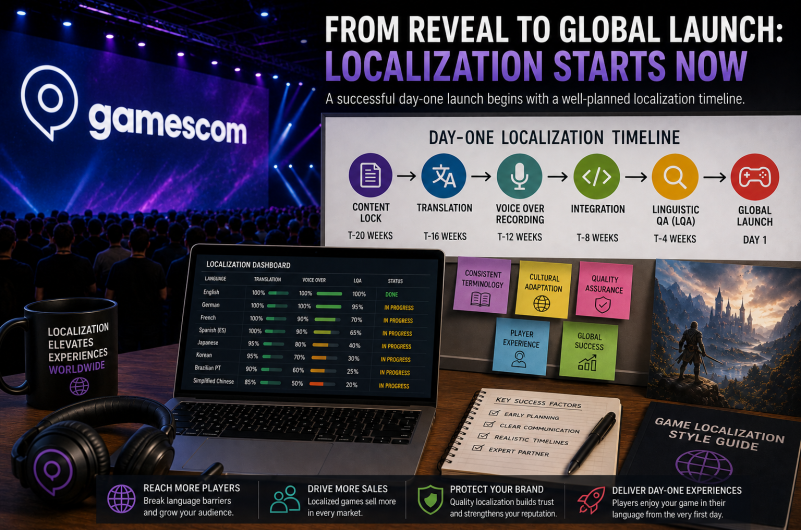
Experienced producers avoid this problem by building a reverse-engineered localization schedule.
Instead of asking, “When can localization begin?” they ask, “What needs to happen before launch?” Then they work backward from the announced release date.
This approach creates realistic milestones for:
- Final content lock
- Translation
- Editing
- Voice-over production
- Asset integration
- Localization QA
- Final bug fixes
- Platform certification
Studios that follow this process are far more likely to meet launch deadlines without compromising quality.
Trailer Localization Sets the First Impression
Many developers focus entirely on localizing the game while overlooking the reveal itself.
In reality, the Gamescom trailer is often the very first localized experience players encounter.
Subtitles, dubbed narration, marketing copy, on-screen graphics, and promotional materials all shape how international audiences perceive the game.
Poorly localized trailers can create confusion before players even add the title to their wishlist. Inconsistent terminology between the trailer and the final game can also weaken brand trust.
Using the same professional localization team for both marketing assets and the game itself helps maintain consistency from announcement through launch.
Common Localization Challenges After Gamescom
Every Gamescom announcement introduces new production pressures.
Common challenges include:
Compressed Timelines
Public release dates leave little room for unexpected revisions or content changes.
Voice Talent Availability
Studios often compete for the same recording studios and professional voice actors after major industry announcements, making scheduling more difficult.
Continuous Content Updates
Game scripts frequently continue evolving after trailers have already been localized, creating additional translation and QA work.
Localization Quality Assurance
When schedules become compressed, LQA is often shortened. Unfortunately, this is where issues such as broken variables, missing text, UI overflow, subtitle timing, and contextual translation errors are usually discovered.
Reducing QA may save time initially, but it often leads to higher post-launch support costs and negative player feedback.
How Professional Localization Providers Reduce Risk
Professional game localization providers do far more than translate text.
An experienced localization partner helps studios build realistic production schedules, manage multilingual assets, maintain terminology consistency, coordinate voice recording, and conduct thorough linguistic testing before release.
They also understand the unique challenges of game development, including frequent content updates, branching dialogue, downloadable content (DLC), live-service releases, and post-launch patches.
Rather than reacting to last-minute changes, experienced providers develop flexible workflows that keep localization moving without sacrificing quality.
Best Practices for Successful Gamescom Localization
Studios preparing for Gamescom can reduce production risk by following several proven best practices.
Begin localization planning before announcing a release date. Waiting until after a reveal limits available options and often increases costs.
Create approved glossaries and style guides early so every language remains consistent throughout development.
Separate content that is ready for translation from material that is still changing to reduce unnecessary revisions.
Allow sufficient time for localization QA rather than treating it as schedule padding.
Most importantly, involve localization specialists in production planning, not only after marketing campaigns have already been finalized.
Common Mistakes to Avoid
Several mistakes continue to delay multilingual launches:
- Treating localization as the final production task
- Announcing release dates before confirming localization schedules
- Compressing QA to recover lost development time
- Using different providers for marketing and in-game localization without shared terminology
- Underestimating the time required for voice recording and multilingual testing
Avoiding these issues improves both development efficiency and the overall player experience.
Why Choosing the Right Localization Partner Matters
A successful global launch depends on more than accurate translation.
Professional localization providers combine linguistic expertise with structured project management, industry-specific workflows, cultural knowledge, and rigorous quality standards.
For studios exhibiting at Gamescom or preparing worldwide releases, choosing an experienced localization partner helps reduce production risk while delivering a consistent player experience across every supported language.
Whether launching in five languages or fifty, early collaboration leads to smoother production, stronger international engagement, and greater confidence on release day.
The Bottom Line
A Gamescom reveal is exciting because it marks the beginning of a game’s public journey. Behind every trailer, however, is a complex localization process that determines whether players around the world enjoy the same high-quality experience on day one.
Studios that consistently deliver successful global launches understand that localization is not a last-minute task. It is a strategic investment that influences development schedules, marketing consistency, player satisfaction, and long-term commercial success.
Planning localization before announcing a release date allows development teams to reduce risk, maintain quality, and meet global launch expectations with confidence.
If your studio is preparing for Gamescom or planning an international release, partnering with an experienced game localization provider can help streamline every stage of the process, from multilingual trailer localization and voice-over production to linguistic QA and launch-day support. Contact eTranslation Services today to discuss a customized localization strategy and request a quote for your next global game launch.