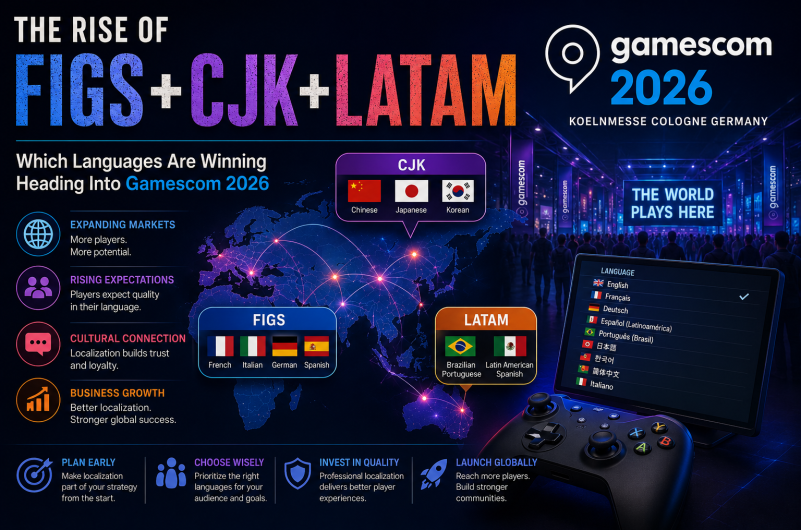
For years, game localization was often defined by a familiar acronym: FIGS French, Italian, German, and Spanish. For many Western studios, shipping in these four languages alongside English was considered enough to reach international audiences. That approach helped countless games expand beyond their home markets, but the global gaming landscape has changed.
Heading into Gamescom 2026, the world’s largest gaming event, successful international launches are being shaped by a broader localization strategy. Studios are no longer asking whether they should localize, they’re deciding which languages must be ready for day one. Increasingly, the answer extends beyond Europe to include CJK (Chinese, Japanese, and Korean) and LATAM (Brazilian Portuguese and Latin American Spanish).
This evolution reflects changing player expectations, growing regional markets, and the business reality that high-quality localization can influence visibility, reviews, community engagement, and long-term revenue. As Gamescom 2026 approaches, the language choices studios make will reveal as much about their global ambitions as the games themselves.
FIGS Is Still the Foundation, But Not the Finish Line
FIGS remains the cornerstone of European game localization. These markets continue to represent strong purchasing power, mature gaming communities, and players who expect professionally localized content. In many genres, that expectation goes beyond translated text to include localized user interfaces, subtitles, voiceover, and culturally appropriate messaging.
However, industry expectations have evolved.
A game launching with only FIGS localization no longer signals an aggressive global strategy. Instead, it often suggests a limited initial rollout or a carefully managed production scope. For indie studios with constrained budgets, this may be the right business decision. For publishers pursuing worldwide growth, however, FIGS has become the starting point rather than the complete localization package.
The studios attracting the most international attention today increasingly view FIGS+CJK+LATAM as the modern baseline for global releases.
Why CJK Has Become a Strategic Priority
Chinese, Japanese, and Korean localization represents more than additional language support. Each market has distinct player expectations, purchasing behaviors, and quality standards that can directly influence a game’s success.
Japanese Players Expect Quality
Japan remains one of the world’s most influential gaming markets. Players value polished localization, accurate terminology, and natural dialogue that respects the tone of the original game. Poor translations are quickly discussed within gaming communities and can negatively affect player trust.
Korean Audiences Reward Well-Localized Games
South Korea has built one of the world’s strongest gaming ecosystems, particularly across PC, esports, and live-service titles. Players expect fast updates, consistent terminology, and localization that feels native rather than translated. Even small linguistic inconsistencies can become highly visible in competitive gaming communities.
Chinese Localization Requires Early Planning
Simplified Chinese opens the door to one of the largest gaming audiences in the world. At the same time, the market presents unique publishing, regulatory, and platform considerations.
Because of these complexities, successful studios plan Chinese localization much earlier in development than they did in previous years. Rather than treating it as an optional addition after launch, they evaluate language support alongside publishing strategy, regional partnerships, and release timelines.
At Gamescom 2026, many studios will showcase demos, trailers, and storefronts that already include CJK support, demonstrating that localization planning has become part of the product strategy rather than a last-minute task.
LATAM Continues to Gain Momentum
If one localization trend has accelerated the fastest over the past few years, it is the growing importance of Latin America.
Brazilian Portuguese and Latin American Spanish are no longer viewed as regional variations of European languages. Players recognize meaningful differences in vocabulary, tone, humor, and cultural references. Reusing European translations often creates an experience that feels disconnected from local audiences.
Brazil has become one of the world’s largest gaming markets, supported by highly engaged PC, console, and mobile communities. Across Latin America, players are increasingly vocal about localization quality and quick to support studios that invest in language experiences designed specifically for their region.
For many publishers, supporting Brazilian Portuguese and Latin American Spanish is no longer considered a bonus feature. It has become an investment in player satisfaction, stronger community engagement, and long-term market growth.
What Gamescom 2026 Will Reveal About Global Localization
Gamescom has always been a showcase for new games, but it also offers valuable insight into where the localization industry is heading. Looking beyond gameplay trailers, several indicators often reveal a studio’s international strategy.
Demo Language Options
The languages available in playable demos frequently reflect launch priorities. A demo featuring FIGS, CJK, and LATAM languages suggests that localization has been integrated into production from an early stage.
Store Page Language Lists
Steam and other digital storefronts often update language support alongside Gamescom announcements. These lists provide an early look at which markets publishers intend to serve at launch and which languages may follow later.
Voiceover Investment
Not every language receives full voice acting. The distinction between subtitles and complete dubbing often reflects where publishers expect the strongest player engagement and commercial return.
Business Conversations Behind the Scenes
Inside the Gamescom business halls, localization providers, publishers, and developers discuss future releases months before players see them. The language pairs receiving the most attention frequently become the localization priorities of the following year.
The Real Challenge Is Scaling Without Losing Quality
Expanding from FIGS to FIGS+CJK+LATAM introduces far more complexity than simply translating additional text.
Every new language adds terminology management, linguistic review, user interface testing, localization QA, voiceover coordination, and ongoing update support. Live-service games increase that workload even further by requiring continuous localization after launch.
Studios that underestimate this process often experience inconsistent terminology, delayed releases, or quality issues that become visible to players immediately after launch.
The most successful global releases treat localization as an integral part of development instead of a final publishing milestone.
Best Practices for a Successful Global Launch
Studios preparing for international releases can reduce risk by adopting proven localization practices early in production.
Begin language planning during pre-production rather than after content is finalized. Defining launch languages early helps teams build realistic budgets and production schedules.
Develop a centralized terminology glossary to maintain consistency across every language. This becomes increasingly valuable as more translators and reviewers join the project.
Test localized content within the actual game instead of relying solely on spreadsheets. Context matters, and interface limitations often reveal issues that cannot be identified during translation alone.
Finally, use machine translation carefully. AI-assisted workflows can improve efficiency, but player-facing content still benefits from professional translators, editors, and linguistic quality assurance to ensure accuracy, cultural relevance, and consistency.
Common Localization Mistakes to Avoid
Even experienced development teams can encounter avoidable localization challenges.
One of the most common mistakes is assuming European Spanish or European Portuguese will satisfy Latin American audiences. Another is postponing Chinese localization until late in development, creating unnecessary production pressure.
Some studios also underestimate the importance of localization QA, believing accurate translation alone guarantees a quality player experience. In reality, layout issues, missing text, inconsistent terminology, and untranslated assets often appear only after implementation.
Addressing these issues before launch protects both player experience and brand reputation.
Why Choosing the Right Localization Partner Matters
As language coverage expands, successful localization depends on more than translation alone. It requires careful planning, experienced project management, scalable workflows, and a deep understanding of gaming culture.
Professional game localization providers help studios coordinate multilingual projects, maintain consistent terminology, manage linguistic quality assurance, and adapt content for players across different regions. The result is a smoother production process and a more authentic experience for players worldwide.
Whether launching an indie title or a large-scale AAA release, partnering with specialists who understand gaming workflows can reduce production risks while helping studios reach new audiences with confidence.
The Future of Global Game Localization
The biggest story heading into Gamescom 2026 is not that one language has overtaken another. It is that the industry’s definition of complete localization has expanded.
Today’s leading studios increasingly approach FIGS+CJK+LATAM as a strategic framework for international success rather than an ambitious wish list. That shift reflects changing player expectations, stronger regional markets, and a growing recognition that localization is closely tied to commercial performance.
For producers planning global launches, the key question is no longer whether to localize. Instead, it is deciding which languages can be delivered with the quality players expect on day one while creating a scalable roadmap for future expansion.
Studios that make these decisions early and support them with experienced localization partners, are better positioned to build trust with international audiences, strengthen player engagement, and maximize the impact of their Gamescom announcements.
As Gamescom 2026 approaches, every language included in a demo, trailer, or storefront tells a story. The studios that invest in thoughtful, professional localization are the ones most likely to turn global interest into lasting success.
If your studio is preparing for a worldwide launch, now is the ideal time to evaluate your localization strategy. Working with an experienced game localization provider can help you prioritize the right languages, streamline production, and deliver a polished experience that resonates with players in every target market. Request a consultation or quote to explore a localization plan tailored to your game’s goals and global audience.
Frequently Asked Questions
What does FIGS+CJK+LATAM mean?
FIGS refers to French, Italian, German, and Spanish. CJK includes Chinese, Japanese, and Korean, while LATAM refers to Brazilian Portuguese and Latin American Spanish.
Why should studios localize before Gamescom 2026?
Preparing localized demos, trailers, and store pages before Gamescom helps studios connect with international audiences and maximize launch visibility.
Can AI replace professional game localization?
AI can speed up certain workflows, but human linguists are essential for cultural adaptation, natural dialogue, and quality assurance.
Which languages should indie studios prioritize?
The best language mix depends on budget and target markets. Many indie studios start with FIGS and expand to CJK or LATAM based on demand.