For AAA game studios, a successful global launch begins long before release day. It starts during planning, where strategic decisions shape how players around the world will experience the game. That is one reason Localization Leads have become increasingly visible at major industry events like Gamescom.
Once viewed as a support function that translated completed content, localization has evolved into a strategic discipline that influences development, marketing, production schedules, and international growth. Today, localization leaders attend Gamescom not simply to observe trends but to build partnerships, evaluate service providers, secure production capacity, and prepare for worldwide launches months or even years in advance.
Studios that involve localization early often reduce costly delays, improve player experiences, and create stronger launches across multiple markets.
Why Localization Leads Are Becoming Essential to Global Game Development
Game localization has changed dramatically over the past decade.
In the past, localization teams typically received game assets near the end of development. Their task was to translate text, record voice-over, and complete linguistic testing under extremely tight deadlines. While this approach allowed games to ship internationally, it frequently created avoidable issues, including inconsistent terminology, delayed releases, higher costs, and cultural mistakes that were difficult to correct.
Today’s leading publishers have taken a different approach.
Instead of treating localization as the final production step, they integrate Localization Leads into planning from the beginning. These professionals collaborate with producers, narrative designers, marketing teams, developers, and external localization partners to ensure international markets are considered throughout development rather than after it.
This proactive process helps studios build scalable global launch strategies while maintaining quality standards across every supported language.
Why Gamescom Has Become a Strategic Meeting Place for Localization Leads
Although Gamescom is widely known for game announcements, playable demos, and consumer excitement, its business area serves a very different purpose.
Behind closed meeting rooms, publishers, developers, technology vendors, voice-over studios, QA specialists, and localization service providers spend several days planning future projects.
For Localization Leads, these meetings provide opportunities that cannot easily be replicated through video calls or email.
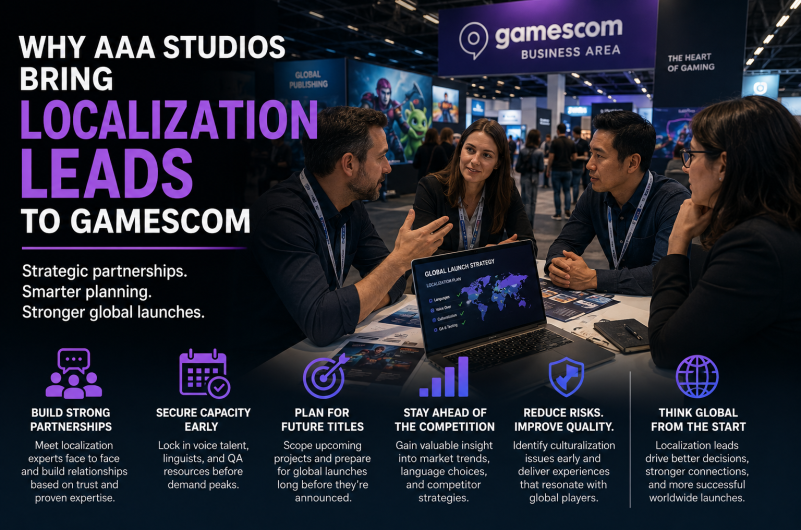
Building Trusted Localization Partnerships
Selecting the right localization service provider involves much more than comparing pricing.
Localization partners become extensions of a studio’s development team. They must understand game genres, player expectations, technical workflows, cultural adaptation, and platform requirements.
Meeting providers face-to-face allows localization leaders to evaluate communication styles, technical capabilities, scalability, quality assurance processes, and industry-specific solutions before committing to long-term partnerships.
Strong relationships established during Gamescom often become the foundation for successful multi-year localization programs.
Securing Production Capacity Before Demand Peaks
Professional game localization depends on resources that are often limited.
Experienced linguists, voice actors, audio studios, localization engineers, cultural consultants, and linguistic QA testers are frequently booked months in advance.
Studios that wait until content is finalized may discover that the best talent has already been committed to competing projects.
Localization Leads use Gamescom to reserve production capacity early, reducing scheduling conflicts and minimizing the risk of delayed international launches.
Early planning also provides greater budget predictability and allows teams to allocate resources more efficiently.
Planning Future Releases Before They’re Announced
Many of the discussions taking place in Gamescom’s business halls involve titles that have not yet been revealed publicly.
Localization Leads often begin planning multilingual support well before marketing campaigns start.
These early conversations help studios estimate localization costs, identify technical requirements, prepare terminology databases, schedule voice recording sessions, and establish localization workflows that support simultaneous worldwide releases.
This strategic preparation reduces production bottlenecks later in development.
How Localization Leads Gather Valuable Market Intelligence
Gamescom is also an opportunity to study the competition.
Every playable demo, trailer, and marketing presentation provides insight into how competing studios approach international audiences.
Localization Leads often analyze questions such as:
- Which languages are included in playable demos?
- Are competitors offering subtitles or full voice-over?
- Which regional language variants are supported?
- How are cultural references adapted for different markets?
- Which accessibility features have been localized?
These observations help studios benchmark their own localization strategies against industry trends.
Rather than simply translating games, modern localization increasingly influences market positioning and player acquisition. The languages supported and the quality of that support, often affect whether international players feel genuinely included.
Reducing Culturalization Risks Before They Become Expensive
Translation is only one part of delivering a successful international game.
Culturalization ensures that visuals, symbols, dialogue, humor, historical references, character designs, and gameplay elements are appropriate for different regions.
Issues discovered after development has been finalized can require expensive redesigns, additional testing, or even launch delays.
Localization Leads help identify these risks during planning, when changes are significantly easier and less costly to implement.
This proactive approach protects both production schedules and brand reputation while helping developers create experiences that resonate with diverse audiences.
Common Challenges Studios Face Without Early Localization Planning
Studios that postpone localization often encounter avoidable obstacles, including:
- Compressed localization schedules
- Higher production costs
- Limited availability of experienced linguists
- Inconsistent terminology across languages
- Last-minute voice recording delays
- Cultural adaptation issues
- Increased quality assurance revisions
- Delayed international releases
Many of these challenges stem from involving localization too late rather than from the localization process itself.
How Professional Localization Service Providers Support AAA Studios
Experienced localization providers offer far more than translation services.
Modern game localization partners support studios throughout the entire production lifecycle by providing:
- Localization strategy consulting
- Terminology management
- Cultural adaptation
- Voice-over production
- Multilingual QA testing
- Localization engineering
- Continuous localization workflows
- International launch planning
Working with a professional service provider allows internal development teams to focus on creating great games while localization specialists manage the complexities of multilingual production.
This collaborative approach improves efficiency, maintains consistent quality standards, and helps studios meet aggressive global release schedules.
Best Practices for Working with Localization Leads
Studios planning international releases can improve results by following several proven best practices:
- Involve Localization Leads during pre-production.
- Build localization into project schedules instead of treating it as a final task.
- Choose experienced partners with proven game industry expertise.
- Reserve voice-over and QA resources early.
- Establish terminology and style guides before translation begins.
- Review cultural considerations during content creation.
- Maintain regular communication between development and localization teams.
These practices reduce production risk while improving the overall player experience.
Common Mistakes to Avoid
Even experienced studios occasionally make decisions that create unnecessary localization challenges.
Some of the most common mistakes include:
- Treating localization as translation only
- Selecting vendors based solely on price
- Waiting until development is complete before planning localization
- Ignoring cultural adaptation requirements
- Underestimating linguistic QA
- Failing to reserve production resources early
- Overlooking regional language preferences
Avoiding these mistakes helps studios deliver more polished and successful global launches.
Why Choosing the Right Localization Partner Matters
A localization partner does more than translate content.
The right provider understands game development workflows, international player expectations, technical integration, and the unique challenges of launching games across multiple regions simultaneously.
Experienced localization teams become strategic advisors who help reduce production risks, improve efficiency, and deliver consistent player experiences worldwide.
For AAA studios—and increasingly for independent developers—this expertise has become a competitive advantage rather than an optional service.
Localization Leads Are Driving Better Global Launches
The growing presence of Localization Leads on the Gamescom show floor reflects a larger industry shift. Successful global launches are no longer built around last-minute translation efforts. They are built through early planning, trusted partnerships, cultural expertise, and strategic collaboration.
Studios that invest in localization from the beginning consistently position themselves for smoother production, higher-quality multilingual releases, and stronger engagement with players around the world.
If your studio is preparing for Gamescom or planning an international launch, partnering with an experienced game localization provider can help reduce risk, improve efficiency, and ensure every player enjoys an authentic experience in their native language. Contact eTranslation Services to learn how customized game localization solutions can support your next global release from early planning through launch day and beyond.