A great game can capture players from the first minute. The story feels exciting. The characters feel real. The world feels alive.
But when a game enters new markets, that experience can quickly change if players struggle with the language.
That is why Localization has become such an important part of game development. It helps players connect with content in a way that feels natural rather than translated.
One question often comes up during the process: should developers invest in voiceover localization or rely on subtitles?
Both approaches help players understand a game. Yet they influence the overall experience in very different ways. The right choice can affect immersion, engagement, player retention, and even long-term success in international markets.
Table of Contents
- Introduction
- Why Language Matters in Gaming
- What Makes Voiceover Localization So Effective?
- The Lasting Value of Subtitles
- How Players Actually Engage With Games
- Cost, Production, and Scalability
- Accessibility and Player Choice
- Which Option Fits Your Game Best?
- The Real Winner: Understanding Your Audience
Why Language Matters in Gaming
Games are no longer limited to a single region. A title released today can reach players across North America, Europe, Asia, the Middle East, and Latin America within hours.
Players want more than translated menus and instructions. They want experiences that feel familiar and authentic.
When characters speak naturally or when dialogue is easy to follow, players tend to stay engaged longer. They understand the story better and often develop stronger emotional connections with the game world.
This is where the debate between voiceovers and subtitles becomes important.
What Makes Voiceover Localization So Effective?
Voiceover localization replaces the original dialogue with professionally recorded audio in the player’s language.
When done correctly, it can completely transform the experience.
Imagine playing a story-driven RPG filled with emotional scenes and cinematic moments. Instead of dividing attention between gameplay and reading text, players simply listen and react.
The experience feels smoother.
The characters feel closer.
The story flows naturally.
Over the years, many major game studios have invested heavily in localized voice acting because it helps players become emotionally involved in the narrative. Strong performances can make heroes more memorable, villains more convincing, and dramatic moments more impactful.
Voiceovers are especially valuable in games where storytelling is a major selling point.
Players often remember how a character made them feel long after they have completed the game.
The Lasting Value of Subtitles
Despite the growing popularity of voiceovers, subtitles remain one of the most effective localization tools available.
For many players, subtitles are not a compromise. They are a preference.
Some gamers enjoy hearing the original voice actors because they believe it preserves the creator’s vision. This is particularly common among fans of Japanese, Korean, and other internationally popular titles.
Subtitles also allow developers to support multiple languages without the cost of recording thousands of lines of dialogue.
For independent studios and smaller publishers, this can be a practical advantage.
A well-written subtitle track can still deliver a strong player experience. Modern games have improved subtitle design significantly, making text easier to read without distracting from gameplay.
When implemented properly, subtitles help players follow the story while maintaining the authenticity of the original performance.
How Players Actually Engage With Games
The discussion is not really about voiceovers versus subtitles.
It is about player behavior.
Different players interact with games in different ways.
A competitive multiplayer player may barely notice story dialogue and simply wants clear instructions. In that situation, subtitles may be more than enough.
A player exploring a rich narrative adventure may prefer full voiceovers because they deepen immersion.
Age can also influence preferences. Younger audiences often find spoken dialogue easier to follow. Experienced gamers, meanwhile, may already be comfortable reading subtitles during gameplay.
The most successful developers recognize that there is no universal solution.
Instead, they focus on understanding what their audience values most.
Cost, Production, and Scalability
Voiceover localization offers powerful benefits, but it requires a larger investment.
Projects often involve translators, voice actors, recording studios, audio engineers, and quality assurance teams.
The process takes time and careful coordination.
Subtitles are generally faster to produce and easier to scale across multiple languages. A game can often support a larger global audience without dramatically increasing production costs.
This flexibility makes subtitles an attractive option for studios with limited budgets.
For many developers, the decision comes down to balancing player experience with available resources.
Accessibility and Player Choice
Accessibility should never be overlooked.
Subtitles help players who are deaf or hard of hearing. They also support gamers playing in noisy environments or those who simply prefer reading dialogue.
Voiceovers, on the other hand, can benefit players who find large amounts of on-screen text distracting or difficult to follow.
Because player preferences vary, many modern games now offer both.
This approach gives players the freedom to customize their experience.
And when players have choices, satisfaction often improves.
Which Option Fits Your Game Best?
There is no single answer.
Narrative-heavy games, RPGs, and cinematic adventures often gain the most from voiceover localization.
Strategy games, puzzle games, mobile games, and indie projects may find subtitles more practical while still delivering an excellent experience.
The decision should always support the game’s goals rather than follow industry trends.
A smaller game with outstanding subtitles can outperform a poorly localized voiceover project every time.
Quality matters more than the method itself.
The Real Winner: Understanding Your Audience
The debate between voiceover localization and subtitling sometimes misses a simple truth.
Players care most about having a smooth and enjoyable experience.
They want to understand the story.
They want to connect with characters.
They want to feel part of the world developers have created.
Whether that happens through spoken dialogue, subtitles, or a combination of both depends largely on the audience.
The best localization strategy is the one that removes barriers and helps players stay immersed.
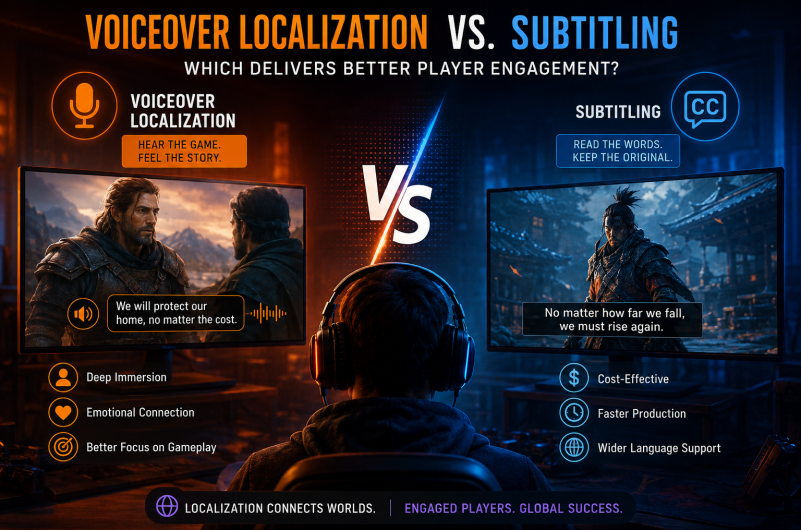
Voiceover localization and subtitling both play valuable roles in modern gaming. Voiceovers often deliver deeper immersion and stronger emotional engagement, while subtitles provide flexibility, affordability, and broader language coverage.
Rather than choosing a universal winner, developers should focus on what their players expect and what their game truly needs.
When localization is handled professionally, players spend less time thinking about language and more time enjoying the experience. That is the ultimate goal. With expert gaming localization services, developers can create games that feel authentic, engaging, and ready to succeed in markets around the world.