A legal document can look perfect on the surface and still contain serious errors.
Many businesses discover this only after a problem appears. A contract may have been translated correctly from a linguistic perspective, yet an important legal concept may have lost its original meaning. In some cases, this leads to delays, compliance concerns, or costly revisions.
As organizations continue expanding across borders, the demand for accurate multilingual legal documents has grown significantly. Contracts, court filings, regulatory submissions, employee agreements, and intellectual property documents are now regularly translated into multiple languages. With so much at stake, one question keeps coming up:
How can legal translation quality be measured with confidence?
The answer goes beyond proofreading. Effective quality measurement requires a structured process that evaluates accuracy, consistency, legal intent, and long-term performance.
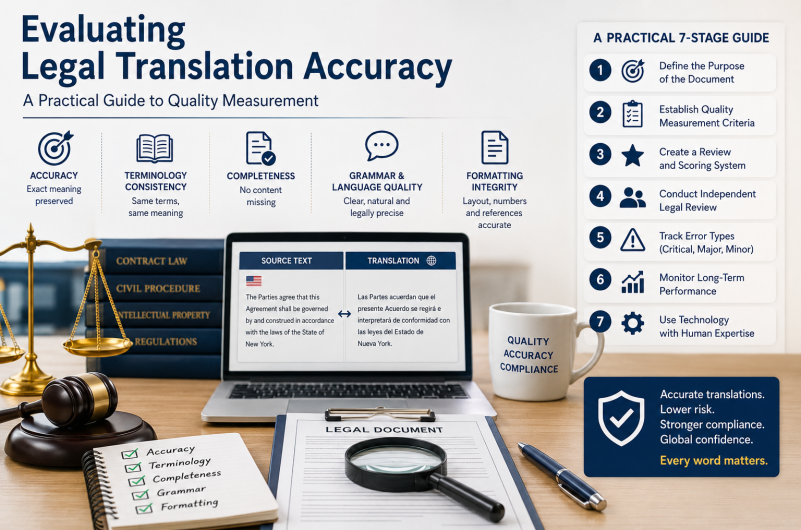
This practical guide follows a real-world case-study approach to explore how businesses and legal teams evaluate Legal Translation quality and reduce risk throughout the review process.
Table of Contents
- The Challenge: Why Accuracy Matters
- Stage 1: Define the Purpose of the Document
- Stage 2: Establish Clear Quality Criteria
- Stage 3: Build a Practical Scoring System
- Stage 4: Introduce Independent Review
- Stage 5: Classify and Track Errors
- Stage 6: Measure Performance Over Time
- Stage 7: Use Technology Wisely
- Key Performance Indicators to Monitor
The Challenge: Why Accuracy Matters
A multinational company once conducted an internal review of contracts that had been translated for several international markets. At first glance, everything seemed acceptable.
However, the legal department noticed something concerning.
The same legal term had been translated differently across multiple documents. None of the translations were technically incorrect, but the inconsistencies created confusion during negotiations. Legal reviewers spent additional hours checking terminology, and approval timelines became longer than expected.
The issue was not poor translation. The issue was the lack of a quality measurement framework.
This challenge is more common than many organizations realize. Legal content demands a higher level of precision than most other forms of communication. A translated document must preserve the exact meaning, intent, and legal effect of the original text.
That is why quality evaluation should be based on measurable standards rather than assumptions.
Stage 1: Define the Purpose of the Document
Before reviewing accuracy, it is important to understand why the document exists.
Different legal documents carry different levels of risk. A court filing requires a much stricter review process than an internal policy document. Likewise, a merger agreement demands greater scrutiny than a general information sheet.
Experienced legal teams often begin by asking:
- Who will use this document?
- What legal function does it serve?
- What are the consequences of an error?
- Does it need to meet specific regulatory requirements?
Organizations that have clearly defined document objectives often find that the review process becomes faster and more focused.
Stage 2: Establish Clear Quality Criteria
Once the document’s purpose is understood, quality standards can be established.
Many legal departments evaluate translations using five primary criteria.
Accuracy
The translated text must communicate the same meaning as the source document.
Nothing should be added, omitted, or altered.
Terminology Consistency
Legal terminology should remain consistent throughout the document.
When the same concept appears multiple times, readers should encounter the same approved term.
Completeness
Every clause, note, reference, and attachment should be accounted for.
Missing information can create significant legal risks.
Language Quality
The text should read naturally while maintaining legal precision.
Clear language improves understanding without changing meaning.
Formatting Integrity
Dates, section numbers, tables, citations, and signatures should remain accurate throughout the document.
These criteria provide a reliable foundation for objective evaluation.
Stage 3: Build a Practical Scoring System
Many businesses struggle because quality reviews are based on personal opinion rather than measurable results.
One legal services team solved this problem by introducing a scoring framework.
Each document received scores across several categories:
- Accuracy: 40%
- Terminology Consistency: 25%
- Completeness: 15%
- Language Quality: 10%
- Formatting Integrity: 10%
The final score provided a clear picture of overall quality.
After several months, patterns began to emerge. Certain document types consistently required more revisions than others. The team used this information to improve workflows and allocate resources more effectively.
A scoring system transformed quality discussions from subjective opinions into actionable data.
Stage 4: Introduce Independent Review
Even highly experienced translators can overlook issues.
That is why many organizations rely on independent reviews before approving legal documents.
The process often includes two separate stages.
Linguistic Review
A language specialist evaluates grammar, terminology, consistency, and readability.
Legal Review
A legal expert verifies that the translated document preserves legal meaning and complies with relevant regulations.
This dual-review approach provides an additional layer of protection and helps identify issues that a single reviewer may miss.
Stage 5: Classify and Track Errors
Not every mistake carries the same level of risk.
Successful quality programs categorize errors based on their potential impact.
Critical Errors
These errors can affect legal meaning or create compliance concerns.
Examples include:
- Incorrect legal terminology
- Missing clauses
- Incorrect figures or dates
Major Errors
These mistakes affect clarity and may create misunderstandings.
Examples include:
- Inconsistent terminology
- Ambiguous sentence structures
Minor Errors
These issues have limited impact on legal meaning.
Examples include:
- Formatting inconsistencies
- Typographical mistakes
Tracking error types allows teams to focus their improvement efforts where they matter most.
Stage 6: Measure Performance Over Time
Quality measurement should not end when a document is approved.
One global legal services provider monitored translation performance over a twelve-month period. The company tracked revision rates, approval times, reviewer comments, and client feedback.
The results were revealing.
As quality standards became more consistent, revision cycles decreased. Reviewers spent less time correcting recurring issues, and approval processes moved more efficiently.
Over time, the organization improved both quality and productivity.
Long-term monitoring helped turn quality management into a continuous improvement strategy rather than a one-time exercise.
Stage 7: Use Technology Wisely
Technology has become an important part of modern translation workflows.
Translation memory systems, terminology databases, and automated quality assurance tools can identify inconsistencies quickly. These solutions help reviewers work more efficiently and reduce repetitive errors.
However, technology should support human expertise rather than replace it.
Legal language often depends on context, jurisdiction, and intent. Software can identify potential issues, but experienced legal and linguistic professionals remain essential for making final decisions.
The most successful quality programs combine both human knowledge and technology.
Key Performance Indicators to Monitor
Organizations that regularly evaluate Legal Translation quality often monitor several important metrics.
These include:
- Accuracy rate
- Critical error frequency
- Terminology consistency score
- Revision rate
- First-pass approval rate
- Turnaround time
- Client satisfaction levels
Together, these indicators provide a clearer understanding of translation performance and long-term quality trends.
Legal documents are among the most sensitive forms of business communication. Accuracy cannot be left to chance, assumptions, or simple proofreading alone.
Organizations that have implemented structured quality measurement processes have consistently reduced risk, improved consistency, and strengthened confidence in their multilingual legal documents.
The true value of Legal Translation extends beyond converting words from one language to another. It lies in preserving legal meaning, protecting compliance, and ensuring that every document can be trusted wherever it is used.
For businesses operating across borders, a strong quality measurement framework is not simply a best practice. It is an investment in clarity, reliability, and long-term success.